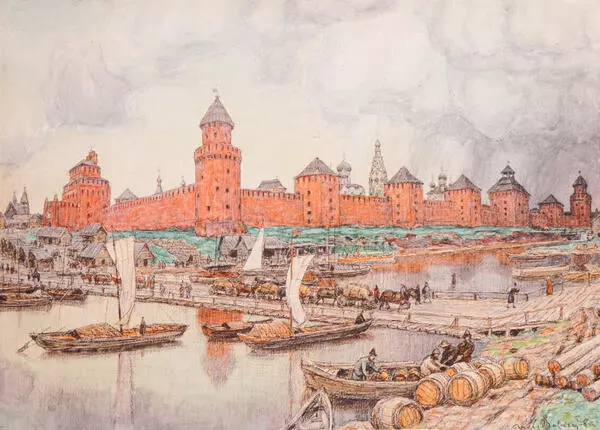
In 1921, the Berendei Publishing Cooperative in Moscow released an album of autolithographs by Apollinariy Mikhailovich Vasnetsov titled “Old Moscow”, with a print run of about 300 copies. The lithographs included in the volume had previously been exhibited at meetings of the Commission for the Study of Old Moscow, a multidisciplinary society comprising architects, artists, politicians, and citizens committed to documenting the city’s vanishing heritage.
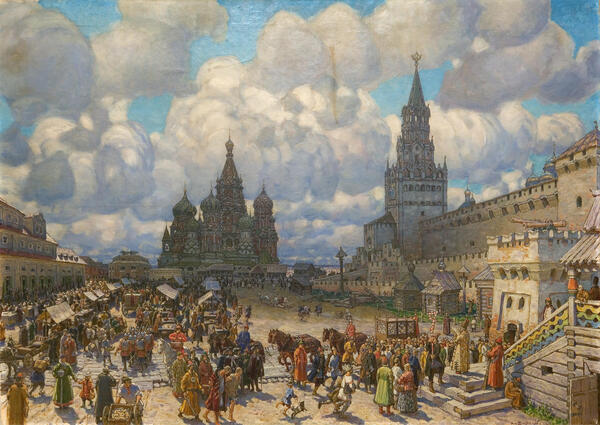
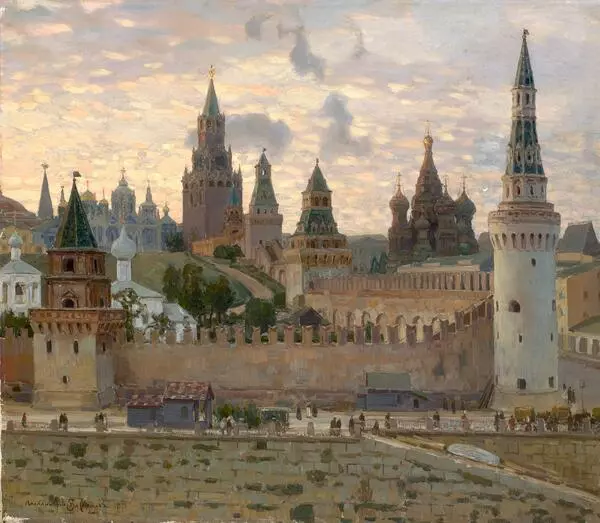
The album presents a sweeping historical panorama of Moscow, drawn from decades of the artist’s meticulous research, spanning from the early 1900s to 1921. Vasnetsov’s vision captures the architecture of the old capital, its daily life and main sights across centuries. Each image was the product of exhaustive archival study: Vasnetsov relied on ancient maps, engravings, chronicles, and firsthand testimonies to reconstruct the city’s vanished buildings and ensembles. As such, his works transcend mere illustration — they stand as authoritative historical reconstructions, invaluable to both art historians and urban scholars.
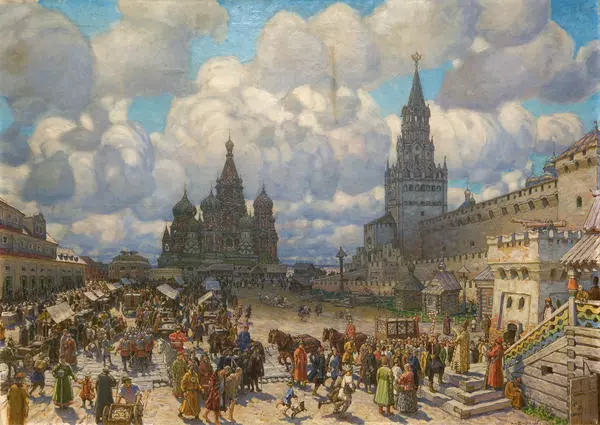
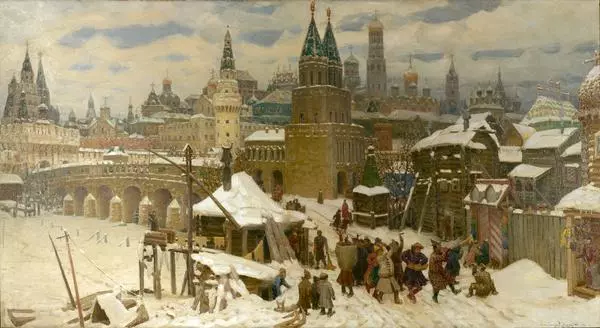
The lithograph on display is based on Vasnetsov’s 1902 watercolor “On the Crossing in Kitay-Gorod”. Here, he portrays Kitay-Gorod (one of Moscow’s oldest districts) not as a distant relic, but as a teeming, vibrant crossroads of medieval life centered around the Monastery of St. Nicholas the Old. The scene bursts with energy: street vendors hawk their wares, boyars move with dignified restraint, funeral processions pause in the open air as the deceased lie in open coffins for identification by grieving relatives, and crowds of itinerant musicians with domras (a long-necked Russian folk string instrument) and horns mingle with beggars pleading for alms. “Death, love, birth, moans and laughter, drama and comedy — all are knotted together in an incomprehensible tangle, living as one in the peculiar rhythm of a medieval folk city,” Vasnetsov wrote.
In the lower left corner of the lithograph, Vasnetsov embedded a small, enigmatic figure — a man in old garb, observing the scene. This detail is known as a remarque; usually, it’s a drawn, etched, or incised scribble or sketch done on the margin of a plate and often removed before the regular printing. Such detail can be present only in the earliest impressions, so here it serves as a telltale marker of the original print run: as the printing process progressed, such subtle, hand-drawn elements were gradually lost in the printing plates.
Vasnetsov masterfully captures the rhythm and cacophony of urban life. His works show everyday mundane scenes with historical accuracy and present a vibrant, almost theatrical image of old Moscow.