#1
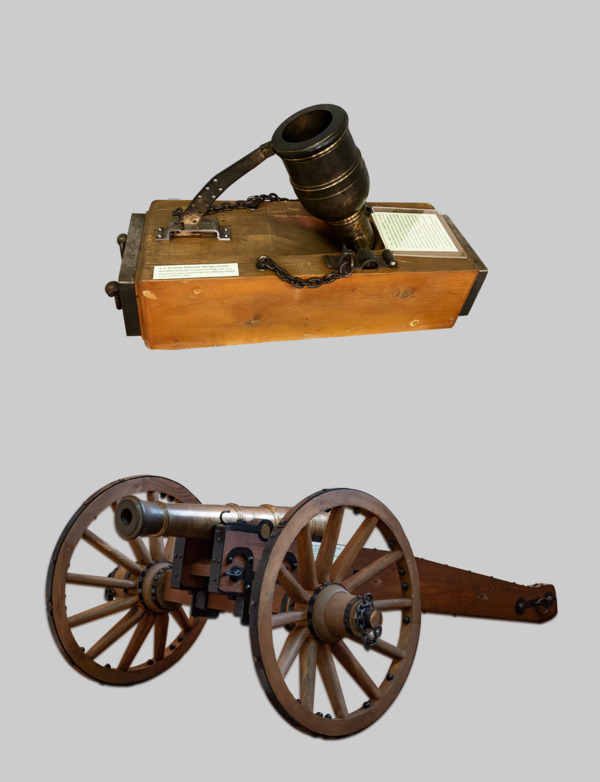
Coehorn mortar, bronze gun
#9
#2
#4
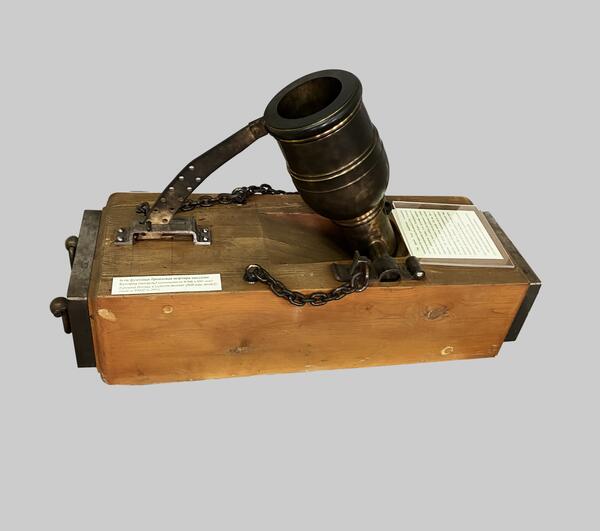
Exact copies of mortars were manufactured at the ZSMK especially for the museum. Significant preliminary work preceded the manufacture: study of the archives and collections of the Museum of Military History of Artillery, Engineering and Signal Troops, measurements were taken, authentic drawings were copied. Now, the collection of Kuznetsk Fortress museum contains 22 accurate copies of the guns and mortars whose prototypes were in operational service in the fortress.
According to the standard munitions list, apart from the guns, there were Coehorn mortars in the fortress. Baron Menno van Coehorn, or Minno de Cohorn, is a Dutch military engineer who did much for the development of fortification and invented an option of a star fort. His work mainly coincided in time with the wars of France with the Netherlands that lasted between 1672 and 1678, 1688 and 1697, and 1702 and 1713 years.
Coehorn who supported active defense in fortress protection was the first to suggest using in the sieges many small size mortars throwing grenades. Those small mortars got their name in his honor, In 1703, 500 such mortars were used against Bonn, and within three days the fortress capitulated.
Coehorn’s ideas had a significant impact on the development of fortification, especially in Russia. Coehorn’s defensive fortifications- — ‘vErki”— were located the way that allowed an intense cross fire on the locality. 6-pounder Coehorn mortars were easy to carry and gave an opportunity of more efficient attacks against the enemy troops.
Ordinary stub-barrelled mortars for angle fire shot heavy bombs of 1 to 6 “poods”(weight measure -16.38 kg). Those were large balls of cast iron filled with explosives and case shot. Such bombs exploded in the air covering a large area near the fortress walls. But heavy mortars were difficult to manoeuvre. They could only be turned a little with the help of levers. Coehorn”s mortars had better mobility – they allowed concentrating fire on those defense areas where it was necessary.
In Russia those mortars were accepted for service during the reign of Peter I. The calibre of Coehorn”s mortars was 104 mm, and their weight with the gun carriage achieved 38-41 kg. They threw grenades weighing ca.3 kg. Each grenade was charged with 130 g of artillery powder, and maximal shooting distance did not exceed 600 m. Coehorn”s mortars were in service with the Russian Army until the World War I.
#5
Full name Coehorn mortar
Author V.A.Golubev, V.YA.Stychinskij, YU.V.Spiglazov, V.S.Dolzhenko, S.V.Nikonenko, N.I.Cukanov, V.M.Pinaev, S.V.Gavrilov, A.N.Anan”eva, N.G.Eryomkina, T.I.Solov”eva
Date 2002 year
Technique factory casting, construction of gun carriage, assembly
Place Novokuznetsk, Russia
Dimensions 86×28,5×48,5 cm
Copyright Kuznetsk fortress
Collection Collection of RMS, Kuznetsk fortress
#8
Bronze gun
#3
#6
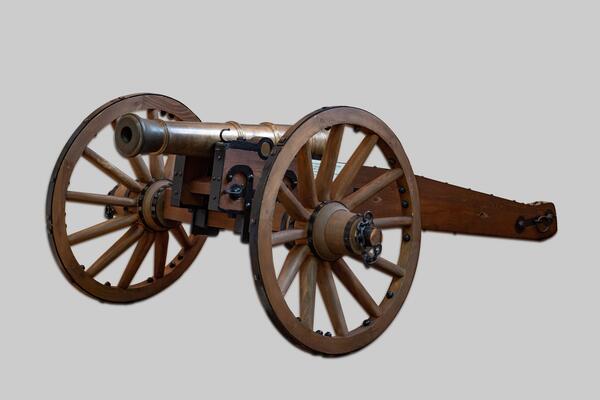
Exact copies of one-pounder cast iron and bronze guns on field carriages that were in service in Kuznetsk were manufactured at ZSMK. The gun is the longest of all cannons. It has no chamber – a special channel for the propelling powder and is designed for firing mainly cannonballs and case shot.
A cylinder channel of such guns has a spherical bottom. The outer surface of the gun consists of three parts – blunt cones with their smaller bases facing the muzzles. Each part has its own name – muzzle, middle or swivel- where the swivels, or pivot pins are located, - and a breech piece. The latter usually had an emblem engraved on it which could help define that it belonged to the state.
One-pounder guns-falconets fired 500 g cannonballs and case shot. They were light field guns. Extra-small gun calibers – below three pounds – remained in the fortress artillery until early XIX century, but they discontinued to be used by the field artillery in Peter I time. Firing distance of such guns was about 300 m.
The gun model from the museum collection is installed on a field carriage. The carriage is a support where the weapon was installed for firing. The carriage was also used for transportation of the gun. Mountain artillery troops transported their guns on the backs of animals.
In accordance with military science of early XX century the carriages were divided into several categories. Sliding mounts or carriages without wheels are types of siege, fortification and coastal mortars. To carry those guns, temporary wheels were attached to the carriages. The coastal gun carriages were installed on revolving frames. Wheeled carriages were used both for firing and transportation to long distances. Those were field, siege, fortification guns and partially, mortar carriages. The carriages of quick firing guns or disappearing turret carriages were designed for firing from the turrets. The guns with such carriages could only be seen by the enemy at the time of aiming at the target and shooting. After the shot the gun was leveled down for reloading.
#7
Full name Bronze gun
Date 2002 year
Technique factory casting, construction of carriage, assembly
Place Novokuznetsk, Russia
Dimensions 176×105×63 cm
Collection Weapon collection of Kuznetsk fortress museum
Copyright Kuznetsk fortress
Date 2002 year
Technique factory casting, construction of carriage, assembly
Place Novokuznetsk, Russia
Dimensions 176×105×63 cm
Collection Weapon collection of Kuznetsk fortress museum
Copyright Kuznetsk fortress
read morehide
00:00
00:00
1x
0
 Point your smartphone camera to open in the app
Open in app
Share