#1
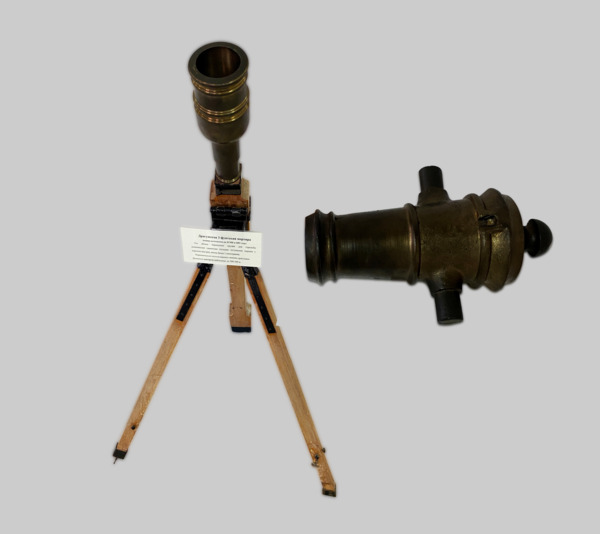
Mortar, dragoon mortar
#8
#2
#4
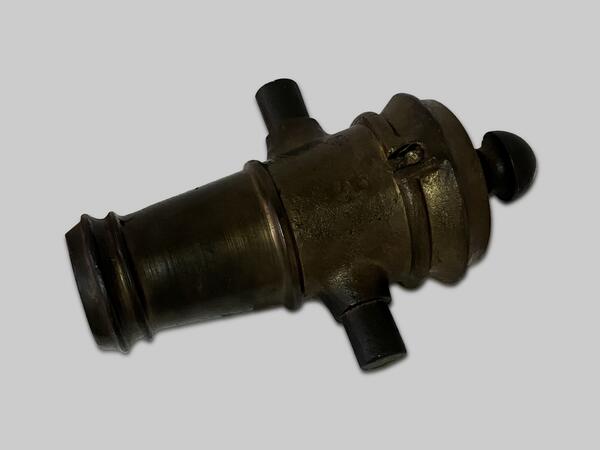
A short bronze gun was found in Novokuznetsk incidentally. It has a wide bore that allows its muzzle-loading, and a semi-sphere cascabel – a knob, allowing, among others, to install the gun on the carriage. For example, the cannon could be dragged by that knob to the location of shooting or installed on the gun carriage. They often has a bizarre shape, or were made as animal heads.
The exhibit has widely protruding trunnions – special axes that fixed the gun on the carriage. There are many caverns on the gun body testifying of the casting defects, and two small decorative belts - thickenings before the trunnions and near the muzzle. The cartridge case vent through which the fire gets from the capsule to the charge, goes towards the bore.
To shoot from smooth-bore muzzle-loaded guns, special accessories were required. No clear rules of action were in place for the gun crew while shooting. After each shot the gun bore was cleaned by a humid fire swab - a cylinder brush on a long stick. Then, using the shUfla, a shovel on a long stick, a kartUz -a small bag with a powder charge -was put there. Shufla was also used to clear the gun. After that, a wad was put into the bore – an interlayer of hay or bast fiber, a wooden plug, another wad, and finally, a cannon ball. The charge in the powder bag and the cannonball were rammed into the gun bore by a ramrod – a stick with cylinder thickening at the end.
After that, the powder bag was pierced through by a protrAvnik– a long graduated needle with a handle- through the firing device, and priming powder was poured into it. Fire came to the charge from the firing device, through the igniting fuse. The fuse was inserted in a special tube with horns and pointed edge, called napAlnik. The remnants of the wads and powder bags were removed from the bore by a metal spiral on a long stick, called pyzhOvnik. After the battle, the bore was thoroughly cleaned with a scraper from powder residue. Skillful joint actions of the gun crew, classroom and practical training of officers determined the success of artillery in the battlefield.
Usually one of the parameters determining the power of the firearms was its caliber – the size of the bore. measured by rifles or fields. Smooth-bore size was measured by the inner diameter of the bore. In Russia, before Peter I, no uniform caliber standards existed. Guns and arquebuses in the service with the army were characterized separately, by the weight of the charge, in Russian national units of measure. Before Peter I, the guns listed in relevant registers had the size from 1/8 grIvenka (pound) to 1 pood (measure of weight, 16.38 kg).
Early in XVIII century, as instructed by Peter I, army general conte Bruse developed a national caliber system based on Hartman’s scale. The guns were divided by the artillery weight of the charge – a cast iron cannonball. The unit of measure was an artillery pound – a 2-inch cast iron ball, 115 zolotniks (4.26 g) of weight, or about 490 g if converted into the contemporary measure of weight. It had no difference what type of charges the gun shot — case shots, bombs or anything else. Only the absolute artillery weight was taken into account of the cannonball that the gun size allowed to shoot.
Tables were also developed of artillery weight-caliber-bore size ratio. Artillery officers had to understand both calibers and bore sizes. The system was introduced by a czar edict in 1707 and remained in force for over a century and a half.
The exhibit has widely protruding trunnions – special axes that fixed the gun on the carriage. There are many caverns on the gun body testifying of the casting defects, and two small decorative belts - thickenings before the trunnions and near the muzzle. The cartridge case vent through which the fire gets from the capsule to the charge, goes towards the bore.
To shoot from smooth-bore muzzle-loaded guns, special accessories were required. No clear rules of action were in place for the gun crew while shooting. After each shot the gun bore was cleaned by a humid fire swab - a cylinder brush on a long stick. Then, using the shUfla, a shovel on a long stick, a kartUz -a small bag with a powder charge -was put there. Shufla was also used to clear the gun. After that, a wad was put into the bore – an interlayer of hay or bast fiber, a wooden plug, another wad, and finally, a cannon ball. The charge in the powder bag and the cannonball were rammed into the gun bore by a ramrod – a stick with cylinder thickening at the end.
After that, the powder bag was pierced through by a protrAvnik– a long graduated needle with a handle- through the firing device, and priming powder was poured into it. Fire came to the charge from the firing device, through the igniting fuse. The fuse was inserted in a special tube with horns and pointed edge, called napAlnik. The remnants of the wads and powder bags were removed from the bore by a metal spiral on a long stick, called pyzhOvnik. After the battle, the bore was thoroughly cleaned with a scraper from powder residue. Skillful joint actions of the gun crew, classroom and practical training of officers determined the success of artillery in the battlefield.
Usually one of the parameters determining the power of the firearms was its caliber – the size of the bore. measured by rifles or fields. Smooth-bore size was measured by the inner diameter of the bore. In Russia, before Peter I, no uniform caliber standards existed. Guns and arquebuses in the service with the army were characterized separately, by the weight of the charge, in Russian national units of measure. Before Peter I, the guns listed in relevant registers had the size from 1/8 grIvenka (pound) to 1 pood (measure of weight, 16.38 kg).
Early in XVIII century, as instructed by Peter I, army general conte Bruse developed a national caliber system based on Hartman’s scale. The guns were divided by the artillery weight of the charge – a cast iron cannonball. The unit of measure was an artillery pound – a 2-inch cast iron ball, 115 zolotniks (4.26 g) of weight, or about 490 g if converted into the contemporary measure of weight. It had no difference what type of charges the gun shot — case shots, bombs or anything else. Only the absolute artillery weight was taken into account of the cannonball that the gun size allowed to shoot.
Tables were also developed of artillery weight-caliber-bore size ratio. Artillery officers had to understand both calibers and bore sizes. The system was introduced by a czar edict in 1707 and remained in force for over a century and a half.
#5
Full name Mortar
Date XVIII-XIX century
Technique casting
Dimensions length - 38 cm, width between trunnion ends - 27 cm, caliber - 6,5 cm
Collection Collection of weapons
Copyright Kuznetsk fortress
Restorers Schegakov A.P.
Goskatalog Number 4565593
Date XVIII-XIX century
Technique casting
Dimensions length - 38 cm, width between trunnion ends - 27 cm, caliber - 6,5 cm
Collection Collection of weapons
Copyright Kuznetsk fortress
Restorers Schegakov A.P.
Goskatalog Number 4565593
#9
Dragoon mortar
#3
#6
Dragoons regiments were one of the first regular troops in Kuznetsk. Olonets dragoon regiment was garrisoned in Kuznetsk for several decenniums.
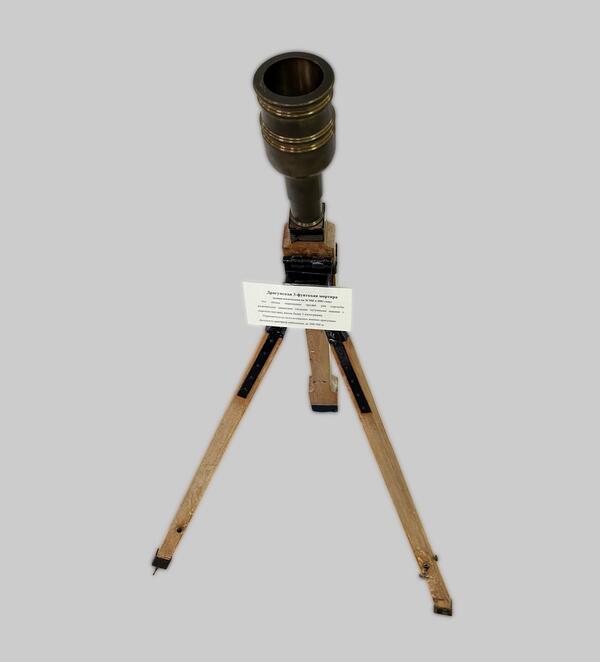
The dragoons, dismounted combatant forces, were armed with petronels, backswords and special dragoon three-pounder mortars. Those mortars were very light, they were installed on a tripod and could fire 1.2 kg fused grenades. They could be easily transported by horses when disassembled. Exact copies of those mortars were manufactured for the museum at the ZMSK complex using the drawings of XVII century.
A grenade launcher firing grenades came into being in Western Europe late in XVII century, and in Russia — early in XVIII century. The specifics of that weapon is the design of the cannon barrel consisting of two parts: a gun chamber where the grenade was seated, and a narrow cylinder charge case.
There existed three types of hand mortars. Bombardiers and grenadiers of infantry troops used brass or iron bore in an ordinary gun stock. Iron-bore mortars with a long gunstock and a rectangular notch were in service with the dragoons. The third type with a brass bore was used by the Navy. The notch in the mortar gunstock was required to lean the mortar against the saddle or to put it into the slot in the deck. For shooting, the mortar was loaded the same way as an ordinary flint-lock gun.
Different mortars had different chamber size: 45-55 mm in bombardier mortars, 65-75 mm in grenadier mortars, and 70-75 mm in dragoon and Navy mortars. The mortar was and different length: 56- 62 cm in bombardier mortars, 80-85 cm in grenadier, dragoon and Navy mortars. The weight of mortars was 3-5 kg.
Depending on the gun chamber size, mortars could throw 1.5 to 3 pound grenades. The shooting range could achieve 100- 150 m. The use of hand mortars was limited in the earlier half of XVIII century. Later they entered service with fortresses where they survived until early XIX century. The weapon again invited attention early in XX century when a short mortar for throwing grenades was attached to the gun barrel. The shots were blank. Such mortars were used during the First World War, and partially, during the Second World War. Then they were replaced by rifle-attached grenade launchers and rifle grenades.
The dragoons, dismounted combatant forces, were armed with petronels, backswords and special dragoon three-pounder mortars. Those mortars were very light, they were installed on a tripod and could fire 1.2 kg fused grenades. They could be easily transported by horses when disassembled. Exact copies of those mortars were manufactured for the museum at the ZMSK complex using the drawings of XVII century.
A grenade launcher firing grenades came into being in Western Europe late in XVII century, and in Russia — early in XVIII century. The specifics of that weapon is the design of the cannon barrel consisting of two parts: a gun chamber where the grenade was seated, and a narrow cylinder charge case.
There existed three types of hand mortars. Bombardiers and grenadiers of infantry troops used brass or iron bore in an ordinary gun stock. Iron-bore mortars with a long gunstock and a rectangular notch were in service with the dragoons. The third type with a brass bore was used by the Navy. The notch in the mortar gunstock was required to lean the mortar against the saddle or to put it into the slot in the deck. For shooting, the mortar was loaded the same way as an ordinary flint-lock gun.
Different mortars had different chamber size: 45-55 mm in bombardier mortars, 65-75 mm in grenadier mortars, and 70-75 mm in dragoon and Navy mortars. The mortar was and different length: 56- 62 cm in bombardier mortars, 80-85 cm in grenadier, dragoon and Navy mortars. The weight of mortars was 3-5 kg.
Depending on the gun chamber size, mortars could throw 1.5 to 3 pound grenades. The shooting range could achieve 100- 150 m. The use of hand mortars was limited in the earlier half of XVIII century. Later they entered service with fortresses where they survived until early XIX century. The weapon again invited attention early in XX century when a short mortar for throwing grenades was attached to the gun barrel. The shots were blank. Such mortars were used during the First World War, and partially, during the Second World War. Then they were replaced by rifle-attached grenade launchers and rifle grenades.
#7
Full name Dragoon mortar
Author Golubev V.A., Stychinskij V.YA., Spiglazov YU.V., Dolzhenko V.S., Nikonenko S.V., Cukanov N.I., Pinaev V.M., Gavrilov S.V., Anan’eva A.N., Eryomkina N.G., Solov’eva T.I.
Date 2002 year
Technique factory casting, construction of carriage, assembly
Place Novokuznetsk, Russia
Dimensions 133*11 cm
Copyright Kuznetsk fortress
Collection Museum collection of weaponry, Kuznetsk fortress
Author Golubev V.A., Stychinskij V.YA., Spiglazov YU.V., Dolzhenko V.S., Nikonenko S.V., Cukanov N.I., Pinaev V.M., Gavrilov S.V., Anan’eva A.N., Eryomkina N.G., Solov’eva T.I.
Date 2002 year
Technique factory casting, construction of carriage, assembly
Place Novokuznetsk, Russia
Dimensions 133*11 cm
Copyright Kuznetsk fortress
Collection Museum collection of weaponry, Kuznetsk fortress
read morehide
00:00
00:00
1x
0
 Point your smartphone camera to open in the app
Open in app
Share