Mortar — an artillery gun with a short barrel for mounted shooting, the name comes from the Latin. mortarium — ‘pestle’. In Russia, the term ‘mortar’ came during the reign of Peter I, when artillery guns were divided into long-barreled (cannons), medium (howitzers) and short-barreled (mortars).
It was intended mainly for mounted shooting at fortresses and fortifications, ship decks and troops behind shelters. Bombards — one of the first artillery pieces used in the siege and defense of fortresses in the XIV-XVI centuries — can be attributed to mortars in the ratio of barrel length to caliber. However, unlike mortars, bombards fired at the walls with direct aiming.
Mounted shooting — shooting from artillery guns on the ground at angles of elevation of the barrel over 20 degrees. The effectiveness of such shooting increases as the elevation angles increase, since the angles of falling projectiles also increase, and, consequently, their fragmentation or high-explosive effect. Shooting at elevation angles above 45 degrees is called a mortar. An additional increase in the steepness of the trajectory is possible due to a decrease in the propellant charge. Therefore, mounted shooting is most characteristic of howitzers and mortars, which, in addition to large elevation angles of the barrel, also have variable charges.
Mortar had a solid structure and fired small cast-iron cores, and from the XVII century — explosive shells. The incendiary mixture was usually filled in from the side of the muzzle, and ignited through a special hole in the lower part of the barrel. Sometimes the gun could reach enormous sizes — in this case it was transported in a special separate cart, from which it was unloaded to the ground to move from the traveling position to the combat one. With relatively low muzzle energy, mortars were lighter than cannons and howitzers of the same caliber.
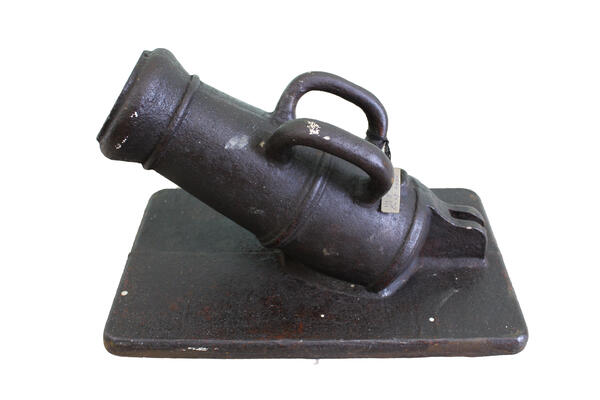
The half-pood mortar exhibited in the Museum’s exposition is considered one of the most common models in the late XVIII — early XIX century. Its mass — 85 kg, firing range — 950 m, caliber — 150 mm, projectile mass — 8.6 kg. This weapon is from the first collections of A. I. Kytmanov, the founder of Yeniseysk Museum of Local History.
It was intended mainly for mounted shooting at fortresses and fortifications, ship decks and troops behind shelters. Bombards — one of the first artillery pieces used in the siege and defense of fortresses in the XIV-XVI centuries — can be attributed to mortars in the ratio of barrel length to caliber. However, unlike mortars, bombards fired at the walls with direct aiming.
Mounted shooting — shooting from artillery guns on the ground at angles of elevation of the barrel over 20 degrees. The effectiveness of such shooting increases as the elevation angles increase, since the angles of falling projectiles also increase, and, consequently, their fragmentation or high-explosive effect. Shooting at elevation angles above 45 degrees is called a mortar. An additional increase in the steepness of the trajectory is possible due to a decrease in the propellant charge. Therefore, mounted shooting is most characteristic of howitzers and mortars, which, in addition to large elevation angles of the barrel, also have variable charges.
Mortar had a solid structure and fired small cast-iron cores, and from the XVII century — explosive shells. The incendiary mixture was usually filled in from the side of the muzzle, and ignited through a special hole in the lower part of the barrel. Sometimes the gun could reach enormous sizes — in this case it was transported in a special separate cart, from which it was unloaded to the ground to move from the traveling position to the combat one. With relatively low muzzle energy, mortars were lighter than cannons and howitzers of the same caliber.
The half-pood mortar exhibited in the Museum’s exposition is considered one of the most common models in the late XVIII — early XIX century. Its mass — 85 kg, firing range — 950 m, caliber — 150 mm, projectile mass — 8.6 kg. This weapon is from the first collections of A. I. Kytmanov, the founder of Yeniseysk Museum of Local History.