Samovar — a metal vessel for boiling water and making tea. Initially, water was heated in an internal firebox — it was a tall tube filled with charcoal. Later there were other types of samovars — kerosene and electric.
Appliances like samovar have long been known in China. They were used for preparing hot water, and also had all the main features of a samovar-combined in one design a water vessel, a brazier for coals and a pipe passing through the vessel. Samovar devices have long been used in Azerbaijan — clay samovars, which are at least 3600 years old, was discovered at archaeological excavations.
In Russia, hot water began to be used for tea as its consumption spread, starting from the XVII century. Tula is considered the homeland of Russian samovars, but historical facts indicate that it belongs to the Ural people — they began to be made between 1738 and 1740 at the Irginsky factory (village of Nizhneirginsky, Sverdlovsk region).
Samovar production turned out to be very profitable. Artisans quickly turned into manufacturers, workshops — into factories. In 1808, eight samovar factories were operating in Tula. In the first half of the XIX century, they began to be made from silver substitutes, and samovars became popular among the middle-class urban population — they were bought by representatives of the bourgeoisie, officials, intelligentsia of various ranks, and nobles.
In the 1840s, the fashion for the so-called ‘second Rococo’ came to Russia, which is characterized by rich, lush ornamentation. The trend also affected household utensils — the base, handles, top of the body and edges of samovars were decorated with borders of intricate plant curls and flowers.
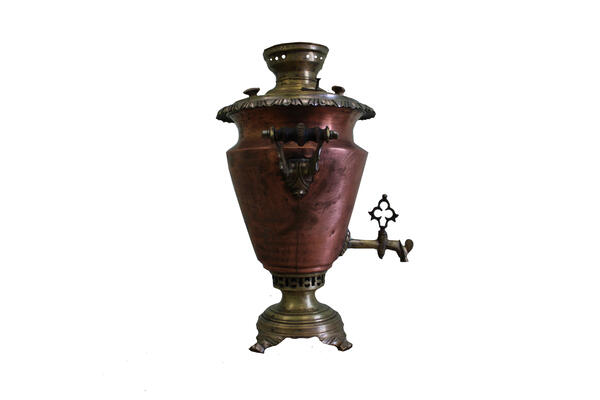
In 1850, there were already twenty eight samovar factories in Tula — they produced about 120 thousand samovars a year and many other copper products. The cone-shaped samovar presented at the Museum is made of copper and from one of the factories in Tula. The lid and handles of the samovar are decorated with floral ornaments. This samovar was purchased at the beginning of the XX century: for a long time it was stored in a barn, then it was transferred to the Museum.
Appliances like samovar have long been known in China. They were used for preparing hot water, and also had all the main features of a samovar-combined in one design a water vessel, a brazier for coals and a pipe passing through the vessel. Samovar devices have long been used in Azerbaijan — clay samovars, which are at least 3600 years old, was discovered at archaeological excavations.
In Russia, hot water began to be used for tea as its consumption spread, starting from the XVII century. Tula is considered the homeland of Russian samovars, but historical facts indicate that it belongs to the Ural people — they began to be made between 1738 and 1740 at the Irginsky factory (village of Nizhneirginsky, Sverdlovsk region).
Samovar production turned out to be very profitable. Artisans quickly turned into manufacturers, workshops — into factories. In 1808, eight samovar factories were operating in Tula. In the first half of the XIX century, they began to be made from silver substitutes, and samovars became popular among the middle-class urban population — they were bought by representatives of the bourgeoisie, officials, intelligentsia of various ranks, and nobles.
In the 1840s, the fashion for the so-called ‘second Rococo’ came to Russia, which is characterized by rich, lush ornamentation. The trend also affected household utensils — the base, handles, top of the body and edges of samovars were decorated with borders of intricate plant curls and flowers.
In 1850, there were already twenty eight samovar factories in Tula — they produced about 120 thousand samovars a year and many other copper products. The cone-shaped samovar presented at the Museum is made of copper and from one of the factories in Tula. The lid and handles of the samovar are decorated with floral ornaments. This samovar was purchased at the beginning of the XX century: for a long time it was stored in a barn, then it was transferred to the Museum.