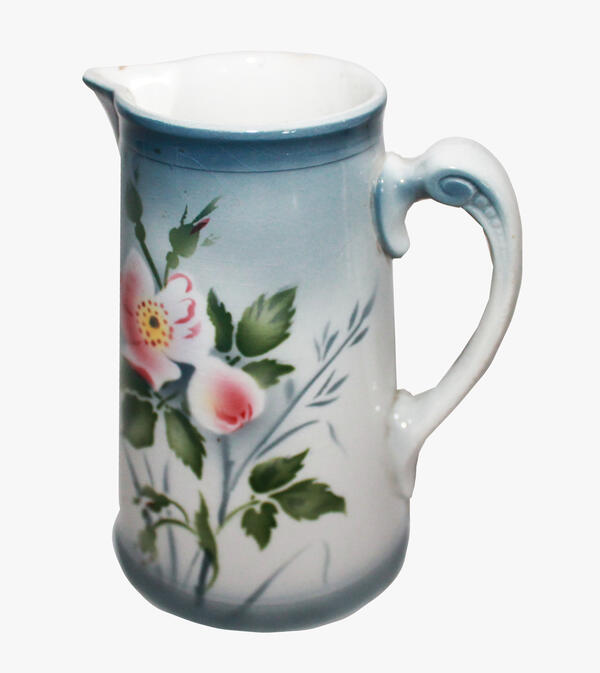
The merchant’s drawing room is full of tableware, among which you can find foreign-made faience items. One such example is a milk jug produced at the Germany-based Villeroy & Boch factory, which is known for its long-standing traditions in the production of ceramics. It was customary for merchants to decorate the interior of their drawing rooms with tableware, which was displayed for everyone to see. The faience milk jug from the collection of the Tomsk History Museum is painted blue and adorned with a floral pattern that was spray painted with a stencil. There is a noticeable gradient in the thickness of the paint layer, with it being dense in some parts of the jug, and more transparent in others. The pattern has a layer of glaze on top.


Milk jug
Creation period
Late 19th century
Place of сreation
Germany
Dimensions
13x8 cm
Technique
Casting
Collection
Exhibition
1
Open in app#1
Milk Jug
#3
#4
The Villeroy & Boch factory was launched in 1836, after renowned faience and porcelain producers Jean-François Boch and Nicolas Villeroy merged their family businesses. However, it is believed that the company is even older than that: its history is traditionally dated back to 1748, when the court steelworker, bearer of the honorary title of royal cannon founder François Boch launched the production of ceramics in the French commune of Audun-le-Tiche. It was a very profitable business, as porcelain was quite a popular commodity in mid-18th century Europe. And François Boch became one of the pioneers of this new industry.
#5
At different times, his ceramics were produced in several European countries, but Germany and France have always remained the main centers for the development of the porcelain industry. Boch’s factory was quick to introduce technical innovations: for instance, in 1784, it was fitted with a new kiln, which increased its operational efficiency thirteenfold. It was the most advanced kiln in Europe and was operated by a team of 300. The factory flourished.
#6
Villeroy & Boch exists to this day. Its products are not limited to stylish tableware, but also include ceramic bathroom fittings, tiles for bathrooms and kitchens, lamps, and other furniture. Today, the company operates factories in eight European countries, as well as Mexico, and Thailand. It is headquartered in Mettlach’s Old Abbey in the German state of Saarland. Jean-François Boch, a third-generation owner of the family pottery business, acquired this Benedictine abbey in 1809.
#7
Tomsk History Museum
read morehide
00:00
00:00
1x
Milk jug
Creation period
Late 19th century
Place of сreation
Germany
Dimensions
13x8 cm
Technique
Casting
Collection
Exhibition
1
 Point your smartphone camera to open in the app
Open in app
Share