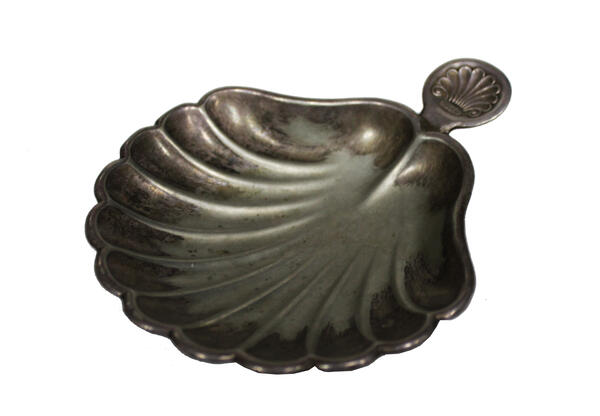
In the early 20th century, this caviar serving dish belonged to the Buff garden restaurant in Tomsk, as evidenced by the ‘TM’ monogram engraved on the reverse side of its handle. These initials belonged to Tamara Morozova, who co-owned the garden with her husband Vasily Morozov. They also jointly managed one of the city’s best hotels, “Evropa” (literally: Europe).


Caviar serving dish
Creation period
Early 20th century
Place of сreation
Tomsk
Dimensions
2x10,5x13 cm
2 х 10.5 х 13 cm
2 х 10.5 х 13 cm
Technique
Industrial production
Collection
Exhibition
1
Open in app#1
Caviar Serving Dish
#3
#4
The history of Tatiana Morozova’s restaurant began with the opening of the Buff garden in 1907. It was located in a former wooded area, which was enclosed by Alexandrovskaya, Torgovaya, Yerlykovskaya, and Zhandarmskaya streets. This land belonged to a Kolyvan merchant Nikolai Plotnikov, who offered the city administration to purchase the plot of land from him. But while the City Duma (legislative council) was haggling over the price, the offer was taken up by Vasily Morozov, a Petersburg restaurateur who had moved to Tomsk. He opened a park and built a summer theater, a shooting range, a café, and a restaurant on the spot that used to be occupied by forest. Contemporaries noted the remarkable business qualities of the Morozovs. For instance, Tatiana Morozova repeatedly appealed to the city administration with a request to reduce the café's inn tax. She argued that the café only brought income in the summertime and in good weather. Also according to her, the garden was rarely visited due to the extremely poor condition of the roads leading there. However, the Buff garden effectively remained one of the most popular summer vacation spots among Tomsk residents up until the revolution of 1917. The restaurant’s tables were almost never vacant. Tatiana Morozova commissioned tableware adorned with her monogram for the restaurant.
#5
Among those items was the silver-plated caviar serving dish, which now belongs to the collection of the Tomsk History Museum. It was designed to resemble a seashell, which was fashionable at the turn of the 20th century. Caviar serving dishes in tsarist-era Russia were made of glass, crystal, and porcelain, as well as silver, which complemented the cutlery and tableware. However, silver was a very expensive metal, which is why owners of restaurants, diners, and cafés resorted to a trick by commissioning silver-plated items instead. They looked well enough, but were much cheaper.
#6
Tomsk History Museum
read morehide
00:00
00:00
1x
Caviar serving dish
Creation period
Early 20th century
Place of сreation
Tomsk
Dimensions
2x10,5x13 cm
2 х 10.5 х 13 cm
2 х 10.5 х 13 cm
Technique
Industrial production
Collection
Exhibition
1
 Point your smartphone camera to open in the app
Open in app
Share