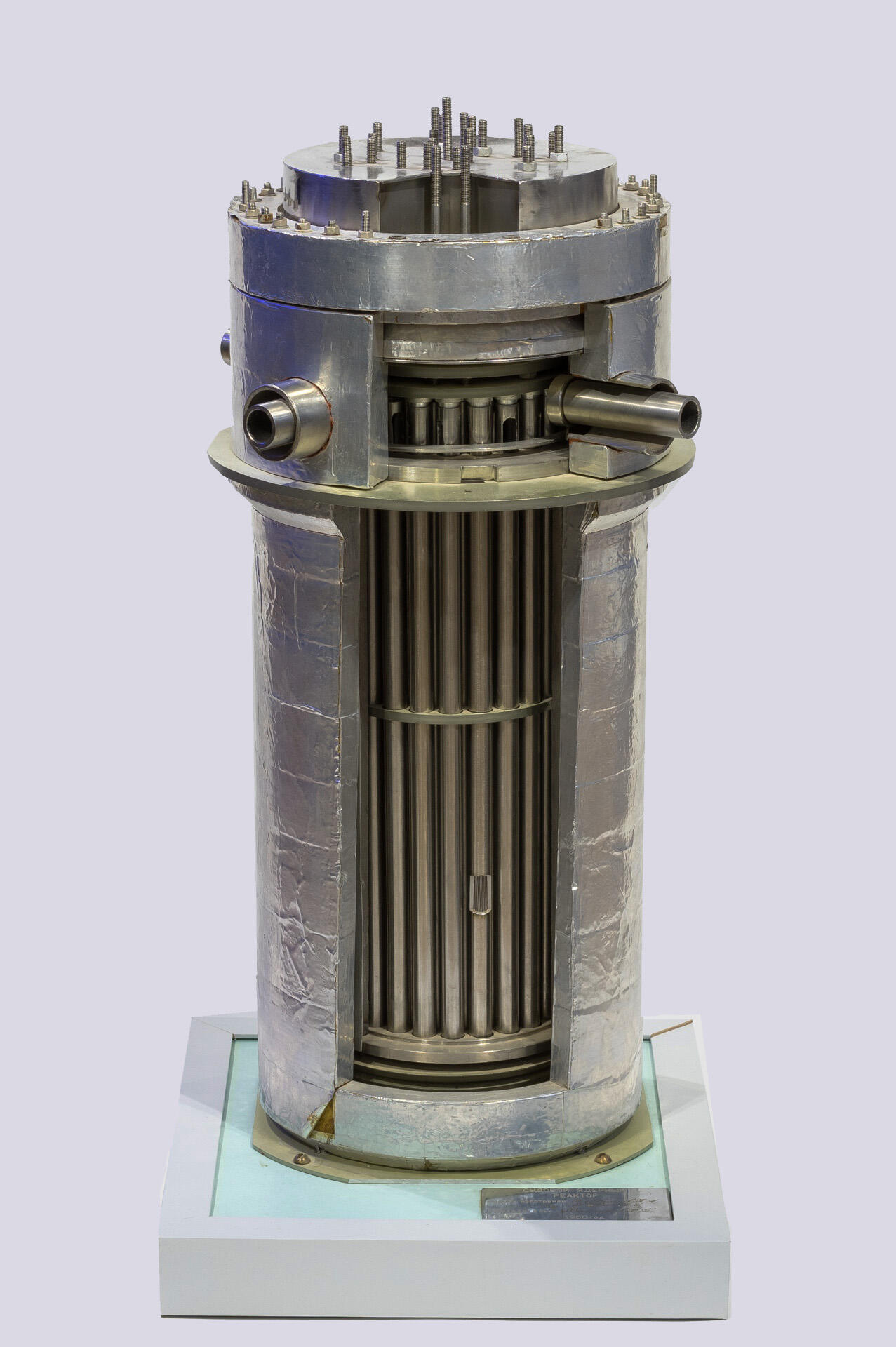


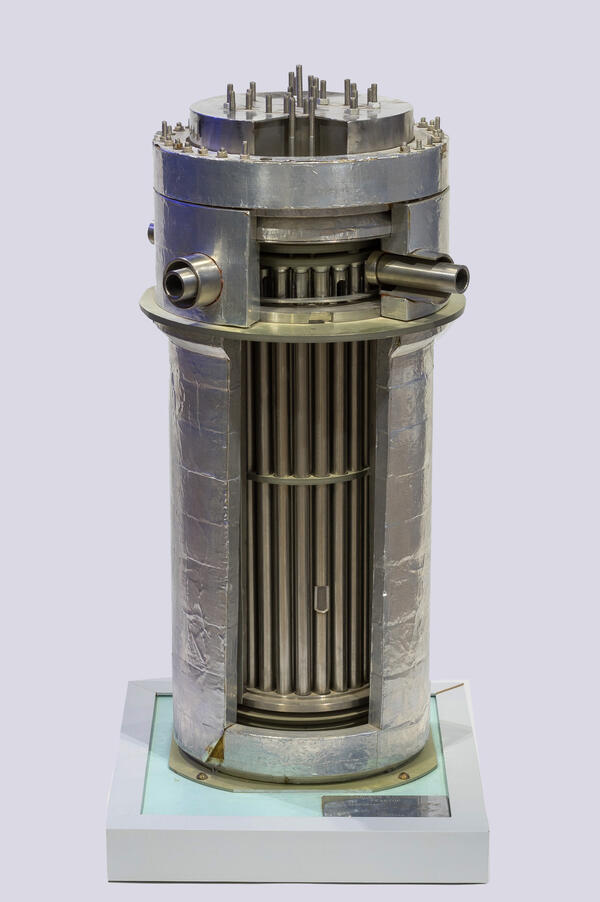
The model of the nuclear reactor was made by the teachers of Sevmashvtuz, a higher technical educational institution in the city of Severodvinsk. The model was used in the classroom as a teaching aid. Using its example, students disassembled the schematic structure of a nuclear reactor, which is part of the ship’s power plant of a nuclear-powered submarine.
On the model, the core of the ship reactors is formed from fuel assemblies, inside which fuel elements are placed (on the model — vertical tubes). It is in them that the fission of heavy uranium or plutonium nuclei takes place, accompanied by the release of thermal energy. This entire system is surrounded by reflector shells and thermal protection. All together it is mounted inside a powerful thick-walled case with a removable top cover.
A nuclear reactor is essentially a steam generating plant. The high-temperature superheated steam generated by the reactor is then sent to steam turbines, which in turn work on the propeller, driving the boat. The development and implementation of a nuclear power plant in shipbuilding has been a big step forward. The nuclear-powered submarines have become superior to their predecessors in a number of tactical and technical characteristics.
The reactor is installed on a submarine in a special room called the enclosure. The reactor compartment on the ship is uninhabited, a radiation-protected tunnel passes through it so that the crew can move freely.
On September 9, 1952, the Resolution of the Council of Ministers of the USSR was issued, signed by Joseph Stalin on the creation of the first Soviet nuclear-powered submarine. The development of a new type of power plant was of great importance. The scientific supervisor of the work on its creation was the Soviet physicist, Doctor of Physical and Mathematical Sciences, Academician of the USSR Academy of Sciences Anatoly Aleksandrov, the chief designer of the installation was the power scientist Nikolai Dollezhal, the chief designer of the boat itself was the shipbuilder, design engineer Vladimir Peregudov.
On the model, the core of the ship reactors is formed from fuel assemblies, inside which fuel elements are placed (on the model — vertical tubes). It is in them that the fission of heavy uranium or plutonium nuclei takes place, accompanied by the release of thermal energy. This entire system is surrounded by reflector shells and thermal protection. All together it is mounted inside a powerful thick-walled case with a removable top cover.
A nuclear reactor is essentially a steam generating plant. The high-temperature superheated steam generated by the reactor is then sent to steam turbines, which in turn work on the propeller, driving the boat. The development and implementation of a nuclear power plant in shipbuilding has been a big step forward. The nuclear-powered submarines have become superior to their predecessors in a number of tactical and technical characteristics.
The reactor is installed on a submarine in a special room called the enclosure. The reactor compartment on the ship is uninhabited, a radiation-protected tunnel passes through it so that the crew can move freely.
On September 9, 1952, the Resolution of the Council of Ministers of the USSR was issued, signed by Joseph Stalin on the creation of the first Soviet nuclear-powered submarine. The development of a new type of power plant was of great importance. The scientific supervisor of the work on its creation was the Soviet physicist, Doctor of Physical and Mathematical Sciences, Academician of the USSR Academy of Sciences Anatoly Aleksandrov, the chief designer of the installation was the power scientist Nikolai Dollezhal, the chief designer of the boat itself was the shipbuilder, design engineer Vladimir Peregudov.