

Tuvans wore traditional national clothes until the 1940s–1950s. But after Tuva became part of the Soviet Union in 1944, national clothes were replaced by clothes of European style. During the Soviet time, some varieties of Tuvan national clothes lost their significance and were forgotten by the people.
A special place among Tuvan women’s clothes is occupied by the robe “edektig ton” (ton with a hem). Edektig ton has another name, terlik ton, which means “luxurious, beautiful”. An edektig ton is a festive dress of a married woman, which she wears for the first time when she gets married. This robe was sewn for a woman’s wedding, after which she wore it only on holidays. As a rule, the expensive wedding garment edektig ton and the wedding headdresses bashtantsgy and dumaalai were kept in an aptara chest after the wedding.
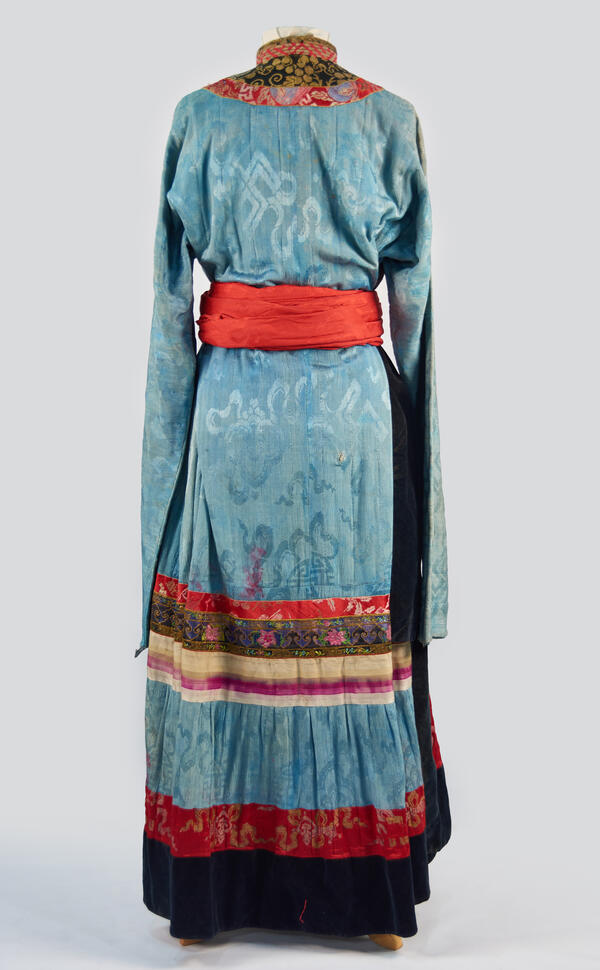
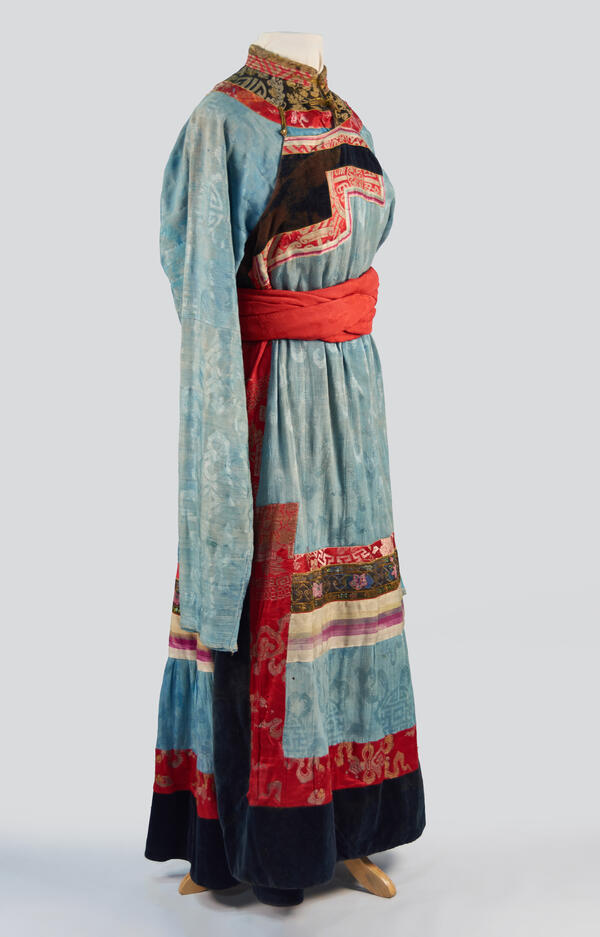
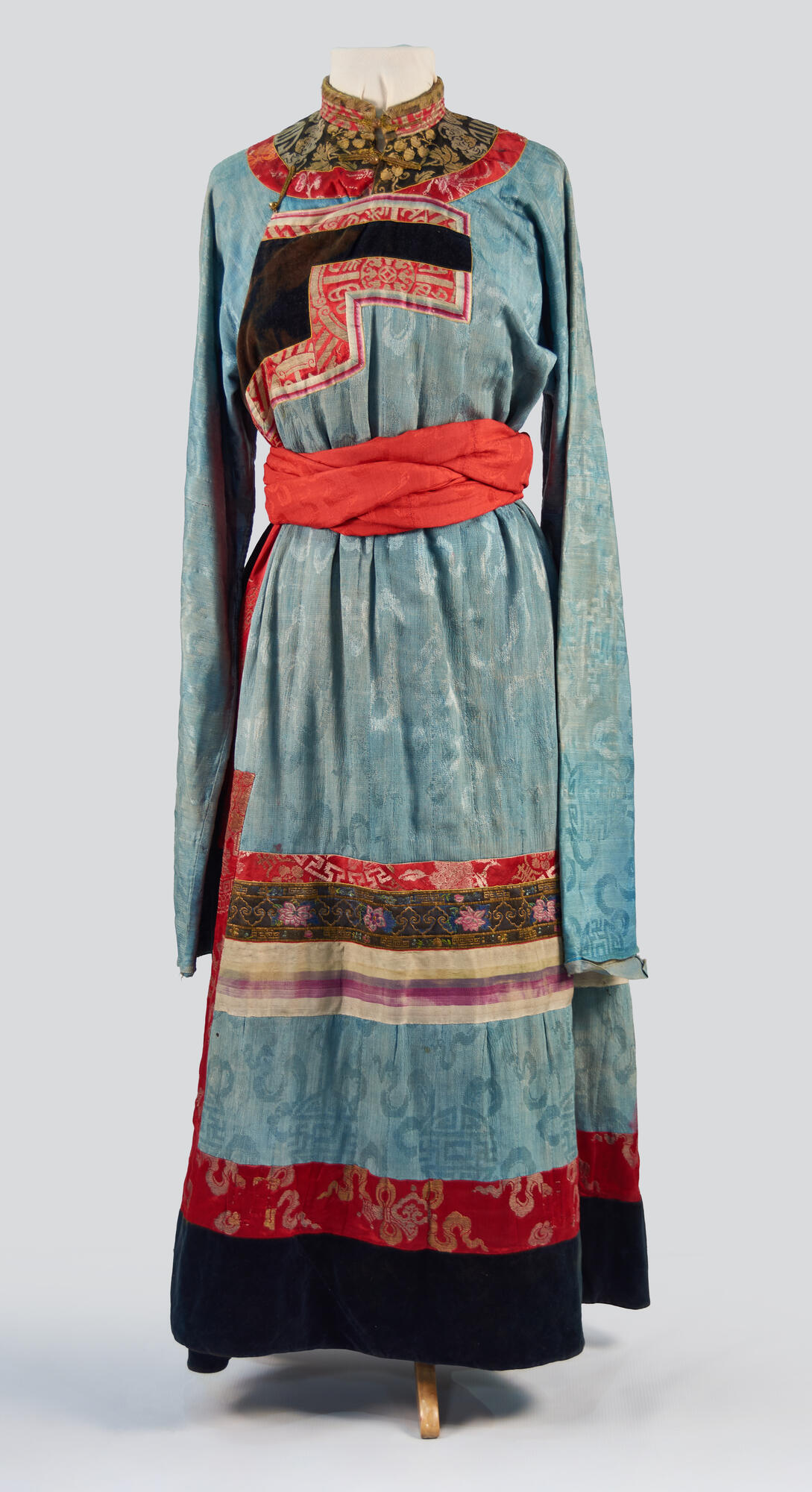
The edektig ton differed from the girls’ shyva ton by the presence of a rounded yoke “tonnun ooruu” on the front and multicolored transverse stripes “bogaa” under the yoke. The yoke changed into a “kydyg” — wide stripes made of velvet on the edges of the left flank. At the level of the hip, two buttons with loops joined the left and the right flanks of the ton. The hem at the knee level had a detail “edektin adaa” (bottom of the flank). It was gathered along the horizontal and sewn to the hem, thus forming a rectangular projection “chirik” along the edge of the left flank. At the level of the cutting line, different-colored horizontal stripes “shalan” were sewn.
A child held on to the chirik bulge of the robe so as not to fall down. A traditional Tuvan blessing associated with this element of women’s edektig ton was: “May the back flank be stomped on by lambs, and the front flank — by children!”
The dress displayed in the museum is of Manchurian origin. It was probably purchased from Chinese merchants. The dress is made of blue brocade, decorated with multicolored stripes of silk and black velvet. The ton is designed on the basis of the traditional classic tunic-shaped, asymmetric, and double-breasted cut. It has a short, stand-up collar. The collar edges are trimmed with gold brocade with black shades. It is made of red brocade with light floral and geometrical patterns. The robe is girdled with a belt (kur) of a long twisted piece of red fabric. The length of the belt is three-four meters.