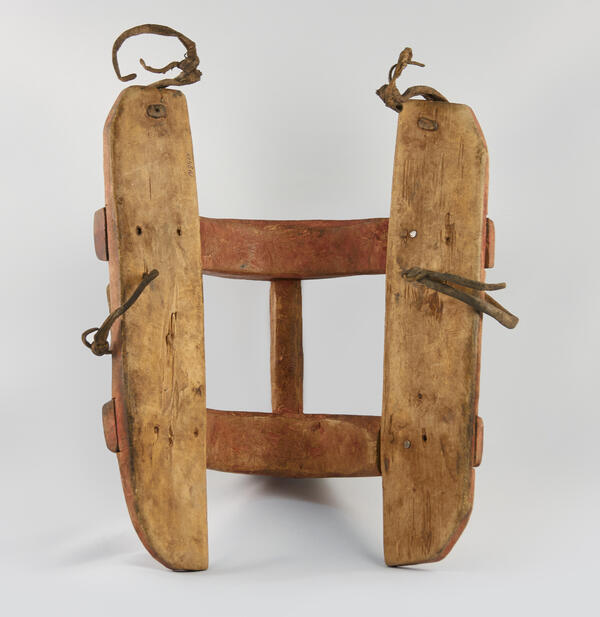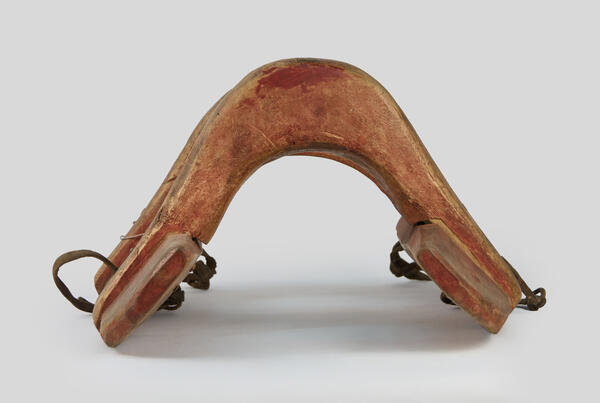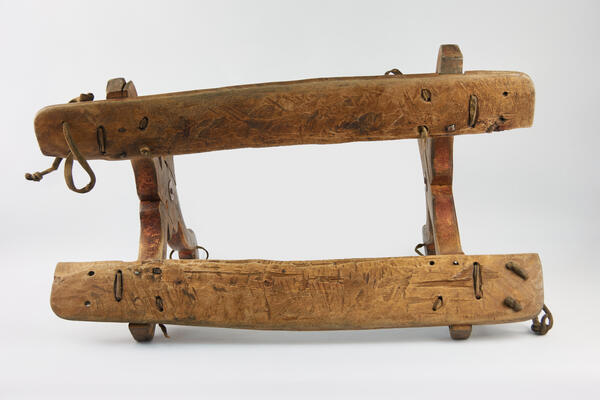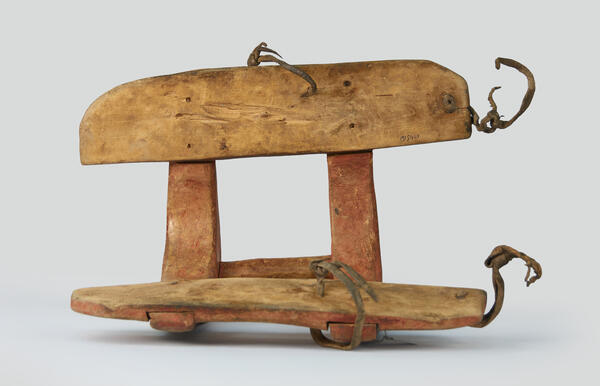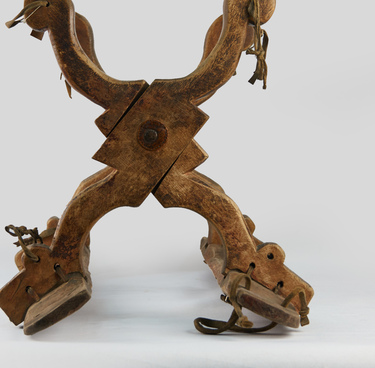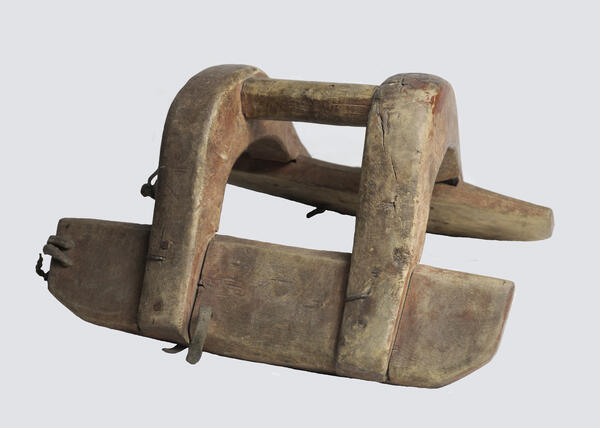
This pack saddle was transferred to the National museum from the Local history museum of the school No.1 of the Chadan town, Dzun-Khemchiksky District.
The pack saddle was used to carry a part of the yurt or chum, utensils, and saddlebags with belongings and foodstuffs.
Todja Tuvans made a reindeer saddle from birch wood, while in the western part of Tuva they mostly made it from poplar wood.
This saddle consists of two wooden shelves (chaaktar), connected by their bows (yngyrzhak) and a longitudinal crossbar (oorg) attached to the front and rear bows. The bows of the saddle are arc-shaped. The ends of the wooden shelves are semicircular, the back boards (chavs) have leather ropes for tying the tailstrap (kudurg). All parts of the saddle were fastened with thin leather straps, for which thin holes were burned in the wooden parts of the saddle.
The boards of the pack saddle were not lined. Usually there was a saddle cloth made of a piece of felt and a piece of leather underneath.
When saddling a deer, the seat was placed in such a way that its front part was almost on the deer’s shoulder blades. This allowed the weight to be moved to a stronger place: if the load was placed on the back, the spine could be broken, because the deer’s spine is considerably weaker than the horse’s one.
An important means of transportation for western Tuvans was the ox, that was used to transport goods, packs and as a draught force in farming. To transport goods on oxen, both pack saddles and “shyrgaa” sled drags were used. The ox was steered with a stick put through the ox’s nose to which a leash was tied.
On the pommel there is a burned brand (sign) called
“koshkar” (ram), which emphasized the legal mark of ownership in traditional
Tuvan culture. The “koshkar” tamga mark was used by the Ondar clan who lived in
central and southern Tuva. Nowadays, tamga and other marks on property items
have been preserved as one of the ancient traditions among Tuvans only
partially and are not so widely spread, and its original meaning, functions and
even names of many tamgas have been already forgotten.