Todja is the largest district in terms of territory out of the 17 districts of the republic. Its total area is 44,800 square kilometers, which is 26.2% of the total area of the republic; the population density is one person per 10 square kilometers. The district is surrounded on all sides by high mountain ranges. The plain part of the land is swampy in some places, 62% of its territory is covered by dense forest, which is 41% of forest resources of the republic. The temperature here ranges from +17 to +35 degrees Celsius in summer and from -18 to -50 degrees Celsius in winter. At the same time, humidity is low.
This is the only region in Tuva where the geographical and natural-climatic conditions are best suited for reindeer breeding. Currently, there are about 5000 Todjin reindeer herders; the vast majority of them live in four settlements — Adyr-Kezhig, Iy, Kham-Syra, and Systyg-Khem.
The Todja-Tuvan reindeer breeding was based on extensive use of pastures and, like hunting, required constant migrations to new areas covered with reindeer moss. The whole annual cycle was connected with the change of reindeer pastures and hunting in different seasons. Therefore, various saddles were used to transport cargo and people.
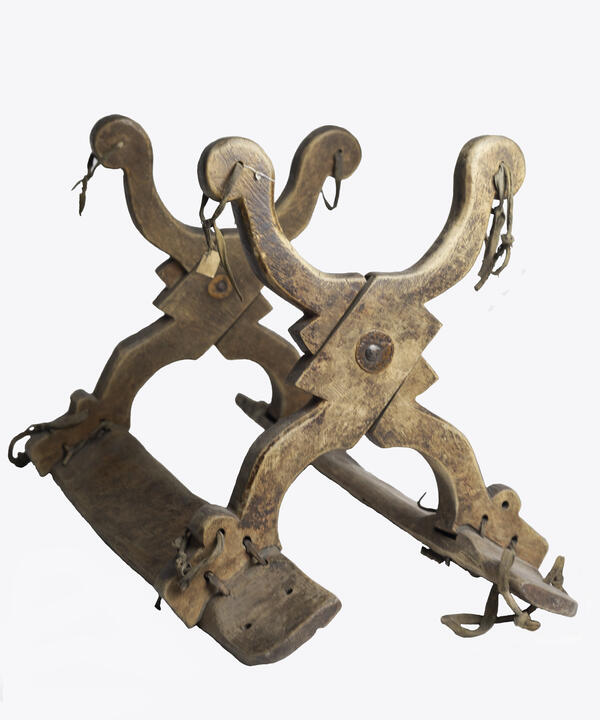
During migrations, children were placed in a special child’s saddle (erimeesh). When saddling a deer, the seat was put in such a way that its front part was almost on the deer’s shoulder blades. It allowed to move weight to a stronger place as a deer’s spine is essentially weaker than that of a horse. People climbed on a deer, as well as on a horse, from the left side, using various elevations in the form of bumps, stumps, fallen trees, sometimes leaning on a staff while getting on. The child was fixed between the bows with leather straps attached to their ends. The saddle was attached to the animal’s back with leather straps fixed to the edges of the planks.
The famous ethnographer Sevyan Weinstein, who described this child’s saddle, came to the conclusion that, unlike other harness associated with horseback riding, the erimeesh has no parallel in the neighboring cattle-breeding Turkic-Mongolian peoples. Such a saddle does not exist among the ones of the steppe Tuvans, Khakasses, Buryats or Mongols. Other reindeer-herding peoples of Siberia do not have it either. Moreover, both Tuvan herders and Tofalars (a Turkic-speaking people of Siberia) used this saddle only on reindeer.