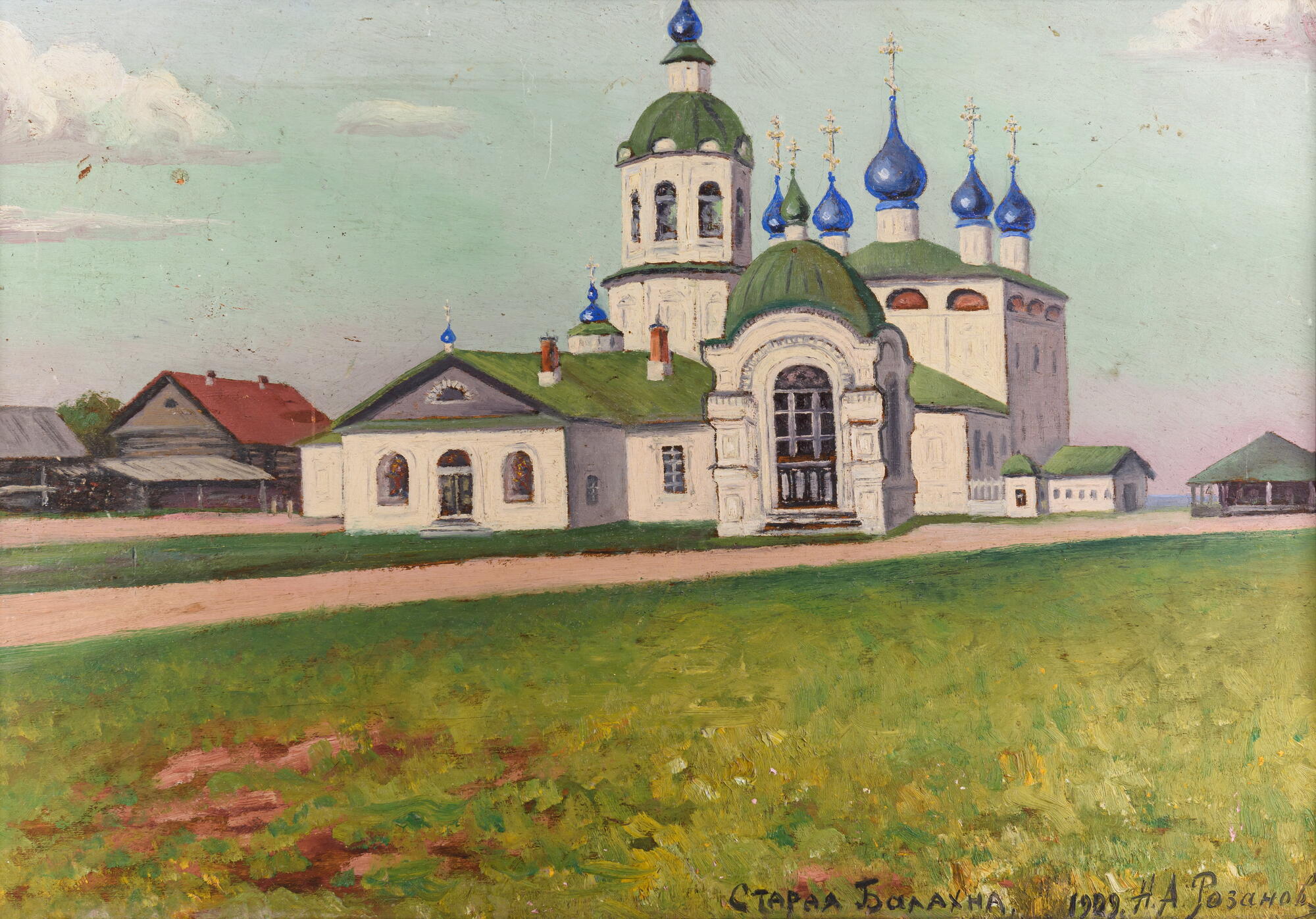


In 1538, a wooden church of the Ascension of the Lord was erected in the center of the Balakhna fortress — the first version of the cathedral that has survived to this day.
In 1690, the wooden church burned down when it was struck by lightning, and in 1727, through the efforts of Balakhna residents, a cold (without heating) stone church, also consecrated in honor of the Ascension, was built in its place. Two years later, a side chapel in honor of Metropolitan Alexius was added to it from the west side.
In June 1750, a new, warm, stone church with a stone bell tower was built. Surviving documents mention the names of the donors: Valentin Polyektovich Osokin and his wife Ekaterina Yakovlevna. The cathedral had two piers and five domes and was decorated quite modestly.
In 1930, the church was demolished, and a school was erected in its place, using original stones.
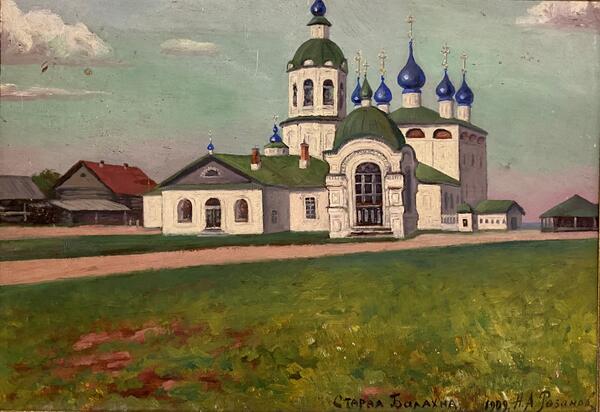
The displayed painting was created by the Balakhna artist Nikolay Alexandrovich Rozanov. The son of a priest, he was fond of drawing from early childhood. His father, who was himself no stranger to painting, supported the boy’s interests, but nevertheless enrolled him in a theological school in the hope that he would continue the family tradition. According to the memoirs of Nikolay Alexandrovich, studying there “was an overwhelming rather than positive experience”; moreover, the future artist became infatuated with Leo Tolstoy’s philosophy and revolutionary ideas. In 1886, Rozanov entered the Orenburg Pedagogical Institute, and three years later — the St. Petersburg Academy of Arts, where, judging by archival documents, he focused on both painting and graphics. He graduated with the title of artist of the 3rd class, signed by Ilya Yefimovich Repin and Vladimir Yegorovich Makovsky.
Returning to Balakhna, Nikolay Rozanov settled not far from the Intercession Monastery and began to lead a life that bewildered and upset many: he was considered a Tolstoyan and a freethinker.
The artist was attracted by public and educational activities, however, according to his memoirs, he did not possess a pedagogical talent and later completely devoted himself to art. Rozanov’s graphic works have not been preserved. In painting, he gravitated to the landscape genre, combining landscapes with depictions of architectural landmarks.
In 1690, the wooden church burned down when it was struck by lightning, and in 1727, through the efforts of Balakhna residents, a cold (without heating) stone church, also consecrated in honor of the Ascension, was built in its place. Two years later, a side chapel in honor of Metropolitan Alexius was added to it from the west side.
In June 1750, a new, warm, stone church with a stone bell tower was built. Surviving documents mention the names of the donors: Valentin Polyektovich Osokin and his wife Ekaterina Yakovlevna. The cathedral had two piers and five domes and was decorated quite modestly.
In 1930, the church was demolished, and a school was erected in its place, using original stones.
The displayed painting was created by the Balakhna artist Nikolay Alexandrovich Rozanov. The son of a priest, he was fond of drawing from early childhood. His father, who was himself no stranger to painting, supported the boy’s interests, but nevertheless enrolled him in a theological school in the hope that he would continue the family tradition. According to the memoirs of Nikolay Alexandrovich, studying there “was an overwhelming rather than positive experience”; moreover, the future artist became infatuated with Leo Tolstoy’s philosophy and revolutionary ideas. In 1886, Rozanov entered the Orenburg Pedagogical Institute, and three years later — the St. Petersburg Academy of Arts, where, judging by archival documents, he focused on both painting and graphics. He graduated with the title of artist of the 3rd class, signed by Ilya Yefimovich Repin and Vladimir Yegorovich Makovsky.
Returning to Balakhna, Nikolay Rozanov settled not far from the Intercession Monastery and began to lead a life that bewildered and upset many: he was considered a Tolstoyan and a freethinker.
The artist was attracted by public and educational activities, however, according to his memoirs, he did not possess a pedagogical talent and later completely devoted himself to art. Rozanov’s graphic works have not been preserved. In painting, he gravitated to the landscape genre, combining landscapes with depictions of architectural landmarks.