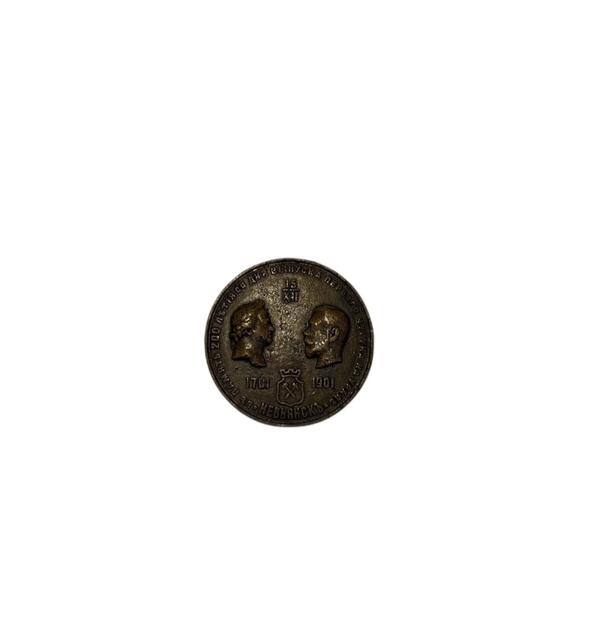
The commemorative medal “200th Anniversary of the First Cast Iron Production in the Urals” was cast at the Kasli plant in 1901. This is a rare medal, and the material from which it was made is also unusual. Traditionally medals are made of brass or bronze, but this medal is dedicated to cast iron production and so it is made of this material. The medal was cast, since cast iron is a brittle material that cannot be hammered into shape.
On the obverse, there are two profiles of the emperors Peter I and Nicholas II facing each other, and the circumference bears the inscription “In memory of the 200th anniversary of the production of the first cast iron in the Urals*Nevyansk.” The reverse side features a view of the plant with the Nevyansk tower, there are two branches — a laurel and an oak one — around the entire circumference of the medal.
On December 15, 1701, an iron-smelting and iron-production plant was founded on the Nevya River, which provided the military department with ammunition, weapons and anchors. The Nevyansk plant was the first to start smelting high-quality pig iron in the Urals. By decrees of Peter I of May 10 and June 15, 1697, the governor of Verkhoturye was instructed to “build and start a large iron plant” on the Neiva River in order to cast “cannons, grenades and all kinds of guns, to make connected, wrought, sheet, cast and roofing iron”. In January 1700, 1,500 peasants from 15 settlements began construction. In March 1700, “the blast-furnace craftsman Yakov Fadeev, the fur master Ivan Yanver and the blast-furnace, cannon and grenade craftsman Philip Dementyev” came to the construction site, as well as hammer and coal craftsmen and apprentices, ore specialists and blacksmiths. By the end of 1701, a dam blocking the Neiva River was erected. The dam formed a big pond that was 5.5 versts long. The water from the pond set the wooden wheels of numerous mechanisms in motion: they included blowing bellows, 20-pood hammers, drilling and turning machines, cutting discs and other devices. Below, near the dam, a blast furnace that was 9.6 m high was built, as well as a refinery with two hearths and one hammer, a forge, barns and huts for artisans.
The history of Nevyansk is usually counted from December 15, 1701 — the date when the first cast iron was produced at the Nevyansk plant. A year after the start-up, the state-owned plant was transferred to the industrialist Nikita Antufiev, who became the founder of the famous Demidov dynasty. This was how the history of the Ural Demidov factories began, with Nevyansk being the first of them.
On the obverse, there are two profiles of the emperors Peter I and Nicholas II facing each other, and the circumference bears the inscription “In memory of the 200th anniversary of the production of the first cast iron in the Urals*Nevyansk.” The reverse side features a view of the plant with the Nevyansk tower, there are two branches — a laurel and an oak one — around the entire circumference of the medal.
On December 15, 1701, an iron-smelting and iron-production plant was founded on the Nevya River, which provided the military department with ammunition, weapons and anchors. The Nevyansk plant was the first to start smelting high-quality pig iron in the Urals. By decrees of Peter I of May 10 and June 15, 1697, the governor of Verkhoturye was instructed to “build and start a large iron plant” on the Neiva River in order to cast “cannons, grenades and all kinds of guns, to make connected, wrought, sheet, cast and roofing iron”. In January 1700, 1,500 peasants from 15 settlements began construction. In March 1700, “the blast-furnace craftsman Yakov Fadeev, the fur master Ivan Yanver and the blast-furnace, cannon and grenade craftsman Philip Dementyev” came to the construction site, as well as hammer and coal craftsmen and apprentices, ore specialists and blacksmiths. By the end of 1701, a dam blocking the Neiva River was erected. The dam formed a big pond that was 5.5 versts long. The water from the pond set the wooden wheels of numerous mechanisms in motion: they included blowing bellows, 20-pood hammers, drilling and turning machines, cutting discs and other devices. Below, near the dam, a blast furnace that was 9.6 m high was built, as well as a refinery with two hearths and one hammer, a forge, barns and huts for artisans.
The history of Nevyansk is usually counted from December 15, 1701 — the date when the first cast iron was produced at the Nevyansk plant. A year after the start-up, the state-owned plant was transferred to the industrialist Nikita Antufiev, who became the founder of the famous Demidov dynasty. This was how the history of the Ural Demidov factories began, with Nevyansk being the first of them.