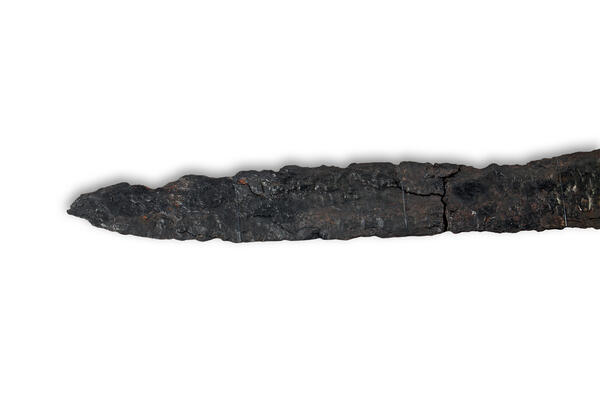
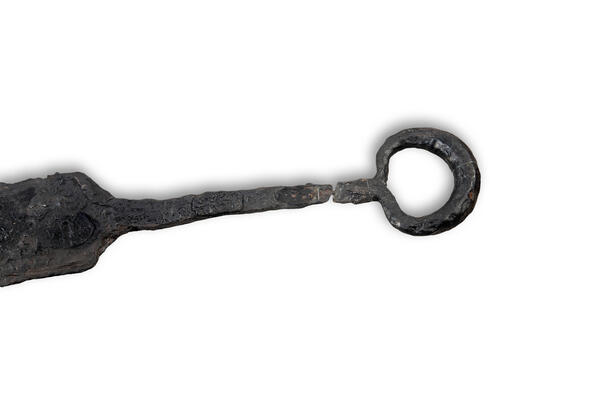
The artifact was transferred to the collections of the Kursk Museum of Archaeology in 2012. It is a straight blade, 75 centimeters long, with a maximum blade width of 4 centimeters. The crossguard is missing. The handle is narrow, 2–2.5 centimeters wide. The pommel of the sword is a round ring with a diameter of 5.5 centimeters. This type of weapon was used by the nomadic Sarmatians, an ancient people consisting of Iranian-speaking nomadic tribes. From the 3rd century BCE to the 4th century CE, they inhabited the steppe region of Eurasia from the Danube to the Aral Sea — the territory of modern-day Russia, Ukraine, and Kazakhstan.
Originating from the central regions of the Eurasian steppe, the Sarmatians were part of the broader Scythian culture. They began migrating westward around the 4th and 3rd centuries BCE, and by 200 BCE, they had become dominant among the closely related Scythians. At their peak, around 100 BCE, these tribes spread from the Vistula to the mouth of the Danube, and eastward to the Volga, bordering the shores of the Black and Caspian Seas, as well as the Caucasus in the south.
Initially, Sarmatian swords resembled Scythian models. In the 6th century BCE, the Sarmatians began to use longer swords, which by the 4th century BCE had become predominant, though they did not completely replace the akinakes. Many long swords featured antenna-shaped pommels. In the 4th century BCE, the antenna shape of the pommel gave way to the arched and disc-shaped varieties. The ring-shaped pommel was forged as an integral part of the hilt and became the most common type among Sarmatian swords. The ring likely formed from the merging of two “antennas” in the 3rd century BCE and remained prevalent from the 2nd century BCE until the 3rd century CE. The earliest dated example of a sword with a ring pommel was found in the Akkermen I burial ground and dates to the 2nd–1st centuries BCE. Most other examples are difficult to date more precisely than the 1st century to the first half of the 2nd century CE.
Among swords with a ring-shaped pommel, there were
variants with long and short blades. The “short” blade measured 50–60
centimeters in length. The rarer “long” specimens ranged from 70 to 130
centimeters in length.