Font
Color
Graphics
Изображение точки

To see AR mode in action:

1. Install ARTEFACT app for iOS or Android;

2. Find the exhibition «The Gold of the Huns»

3. Push the «Augmented reality» button and point your phone's camera at the exhibit;

Скрыть точки интересаПоказать точки интереса
Показать в высоком качестве

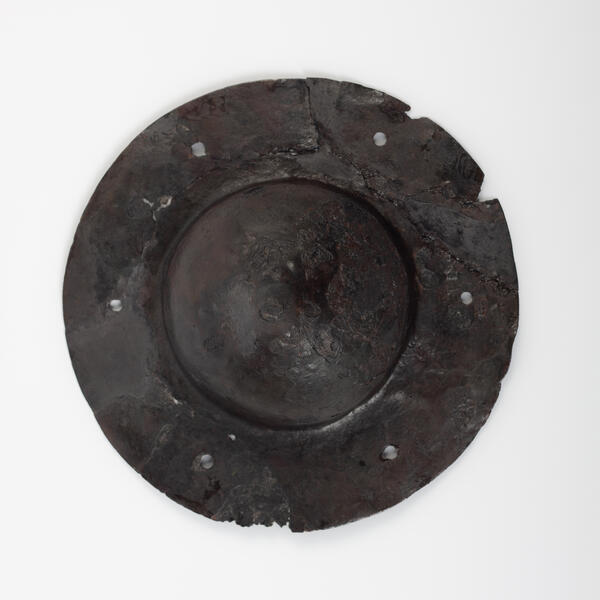
Umbo with rivets

Creation period
the 1st century BCE — 1st century CE
Place of сreation
Dnieper’s Left and Right Banks
Dimensions
8x21 cm
Technique
iron, forging
1
Open in app
#1

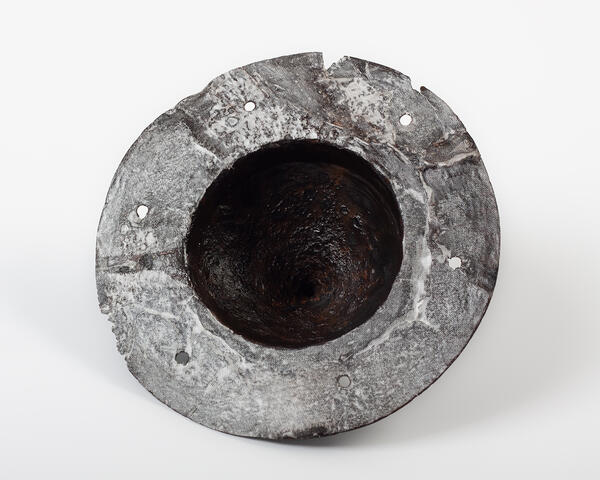
The artifact presented in the collection is made from an iron sheet 1.5–2 millimeters thick. It features a convex-conical dome with a low solid spike (the spike is broken off) and broad fields with six holes through which the umbo was attached to the shield by six symmetrically arranged convex rivets with large heads, each with a diameter of five centimeters. The umbo was found together with a spearhead in the village of Troitskoye in the Sovetsky district of the Kursk region in 2019. Both finds come from a destroyed warrior burial that was performed according to the cremation rite and belong to the Grossromstedt chronological horizon, marking the transition from the La Tène period to Roman times.

This artifact belongs to the subculture of those Germanic warbands that participated in the campaigns of Ariovistus, fought against Roman generals such as Drusus, Ahenobarbus, Tiberius, and Germanicus, and were predominantly from the northeastern regions of Germany. The closest parallel to this artifact is a completely identical umbo from a warrior burial discovered at the end of 2009 on the right bank of the Seym River, between the villages of Mutin and Kamen in the Krolevetsky district of the Sumy region of Ukraine.
#4
Umbo with rivets
#5

The burial was also performed according to the rite of cremation and was accompanied by expensive grave goods. Along with the umbo, the following items were found: a black-burnished ceramic vessel with a wide mouth, a situla (a bronze bucket) used as an urn for calcined bones, a bent sword with fragments of its scabbard, a spearhead and its socket, a knife, spurs, paired late La Tène pin-fibulae, and other items.

The features of the burial rite, the goods, and the functional purpose of the situla have parallels with the Przeworsk and Oksywski burials from Poland. A complete set of military equipment indicates a very high social status of the buried. Considering the details of the burial rite and the nature of the accompanying artifacts, the ethnic affiliation is most likely to be identified as Germanic. Thus, in the borderlands of the forest and forest-steppe zones of the Dnieper Left Bank in pre-Roman times, a number of ethnocultural impulses associated with the Western circle of artifacts can be noted, having distinct parallels in the material culture of the Przeworsk and Yastorf archaeological cultures.

#3
Umbo with rivets
#2
View in the State Catalogue
read morehide
00:00
00:00
1x

Umbo with rivets

Creation period
the 1st century BCE — 1st century CE
Place of сreation
Dnieper’s Left and Right Banks
Dimensions
8x21 cm
Technique
iron, forging
1
Point your smartphone camera to open in the app
Share
VkontakteOdnoklassnikiTelegram
Share on my website
Copy linkCopied
Copy
Open in app
To see AR mode in action:
  1. Install ARTEFACT app for 
  2. iOS or Android;
  3. Find and download the «Paintings in Details» exhibition
  4. Push the «Augmented reality» button and point your phone's camera at the painting;
  5. Watch what happens on your phone screen whilst you flip through the pictures.
 
We use Cookies
Cookies on the Artefact Website. We use cookies to ensure that we give you the best experience on our website. If you continue without changing your settings, we'll assume that you are happy to receive all cookies on the Artefact website. However, if you would like to, you can change your cookie settings at any time.
Learn more about useHide
Content is available only in Russian

X

Нашли опечатку?...

%title%%type%