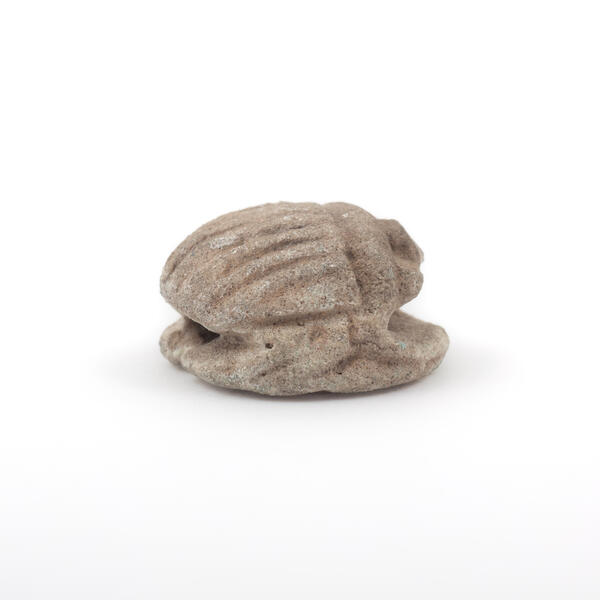
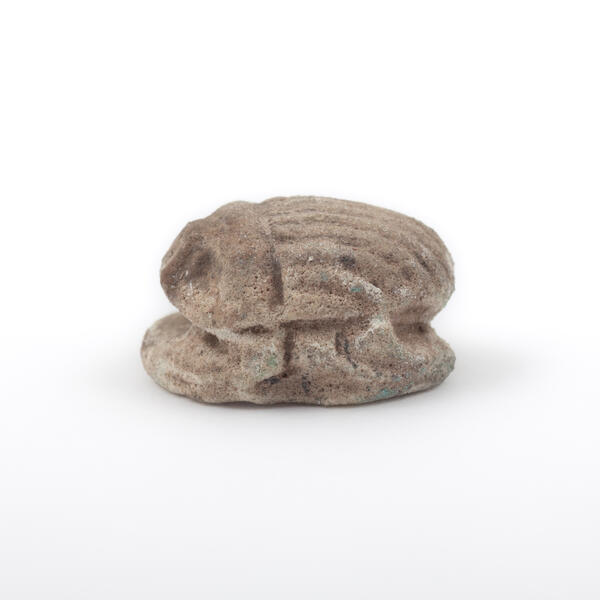
The bead from the museum’s collection was discovered during excavations of the Ratskoye settlement near the village of Gorodishche in the Kursk district of the Kursk region, where the Posemye Expedition, led by Vladimir Vasilyevich Enukov, worked from 1990 to 1992. In 1994, the item was transferred to the collections of the Kursk Museum of Archaeology. Such jewelry entered the territory of the Kursk region through import and was very popular among the Scythoid population of Eastern Europe from the 6th century BCE to the 2nd century CE.
The figured faience pendants mainly depict Egyptian motifs and attributes of the cults that arose from the merging of two great cultures — Ancient Greek and Egyptian. Images of Bes, Harpocrates, the sphinx, the infant Horus, numerous scarabs, and frogs became widespread in the art of ancient Egypt. The scarab was considered a symbol of rebirth; in Egypt, scarab-shaped objects served as personal seals, with the owner’s name carved in hieroglyphs. The first examples of what is considered “Egyptian faience” were found in layers dating back to the Early Kingdom era — toward the end of the 4th millennium BCE.
The first faience products began to arrive in the Northern Black Sea region in the late 6th — early 5th century BCE. These objects were likely produced in Naucratis, a city in northern Egypt, where a large glass and ceramics workshop operated. In the 5th century BCE, the influx of jewelry to the northern shores of the Pontus stopped, likely due to the Persian conquest of Egypt. The period of mass distribution of faience beads and pendants occurred during the 1st–2nd centuries CE. At that time, they could be found across vast territories from the Urals to the Dniester, and sometimes even in Kazakhstan, India, and Central Europe. However, the highest concentration of such artifacts is noted in the Crimea, the Kuban region, and the Lower Don. In more northern regions of Russia, such as the Kursk region, this type of import is rare.
There is a simple explanation for this fact: the
inhabitants of these regions received jewelry from ancient centers —
Panticapaeum, Chersonesus, Tanais, and other Greek poleis, located on the
northern and eastern shores of the Black Sea. The further away from the
developed Greek polis, the fewer faience artifacts are discovered.