Font
Color
Graphics
Изображение точки

To see AR mode in action:

1. Install ARTEFACT app for iOS or Android;

2. Find the exhibition «Mamin-Sibiryak Memorial House-Museum»

3. Push the «Augmented reality» button and point your phone's camera at the exhibit;

Скрыть точки интересаПоказать точки интереса
Показать в высоком качестве

Furnishing of the room of the writer's mother

0
Open in app
#1
Furnishing of the room of the writer’s mother
#13
Furniture set
#19
There is a furniture set along the perimeter of Anna Mamina’s room, mother of Dmitry Mamin-Sibiryak. It was made by the “Gambs” company in the middle of the 19th century.

The set is in the Rococo style. It was characterized by graceful shapes, curved contours and rich finishes. Such furniture was made of precious wood — oak or walnut — and decorated with gilding. It was often found in the palaces of aristocrats and in the homes of wealthy townspeople.

The history of the “Gambs” company began in 1790, when a young furniture maker, Heinrich Daniel Gambs, arrived in St. Petersburg from Prussia. There, he opened his own workshop. It was used to make ornate bureaux, cabinets, tables, mahogany fireplace screens and chests of drawers decorated with gilt bronze, ivory, embroidery and stones. There was a company store not far from the workshop.

Gambs’s five sons also became furniture makers and worked with their father in the factory. Their products were famous for their quality, they were durable and stable. The company supplied furniture for the imperial family: to the Mikhailovsky Castle, the Winter Palace and the Tsars’ suburban residences. In 1810, Heinrich Gambs was promoted to the rank and position of “court mechanic” and became chief furniture maker.

The Gambs’s furniture was not only notable for its quality and elegant forms. Masters often built complex mechanisms, sliding secret drawers and even music boxes into the interior objects.

Furniture from Gambs was often given at weddings or housewarming parties. The company’s most popular line was mahogany sets with gilded brass overlays, made in the French Jacobean style. It was characterized by rectangular shapes, rounded corners and upholstered backs of chairs and armchairs.

A set of furniture from the company “Gambs”, which is housed in the museum, consists of a sofa, two armchairs, and four chairs, covered in burgundy velour.

There are carved armchairs with high figured quilted backs and a curved top to the left, in the corners, by the door and by the window of the room. They are decorated with carved flowers and shell-shaped elements. The armrests and legs are crowned with curls.
#3
Полное наименование: Furniture set by “Gambs” company
Дата создания: the mid-19th century
Техника: walnut, velour, cotton cord, carving, joinery
Размеры: sofa — 101×130×59 cm; chair — 89×49×45 cm; armchair — 93×53×60 cm
Коллекция: United Museum of Ural Writers (UMUW)
Правообладатель изображений: United Museum of Ural Writers (UMUW)
Место создания: Yekaterinburg
#14
Magazine rack
#20
The magazine rack is displayed at the House-Museum in Anna Mamina’s room. She was the mother of Dmitry Mamin-Sibiryak. The item is covered with dark burgundy leather and decorated with two embroideries with a floral ornament.

The newspapers were temporarily put into the rack in order to clear the space at the coffee table. The Mamins’ read a lot; they received press from St. Petersburg and Moscow. Among the publications were the “Herald of Europe” [“Vestnik Evropy”], “Northern Herald” [“Severny Vestnik”], “Russian Wealth” [“Russkoye Bogatstvo”], and “Observer” [“Nablyudatel”]. The Mamins also subscribed to the Urals periodical publications, like “Yekaterinburg Week” [“Yekaterinburgskaya Nedelya”] and other magazines.

In the 19th century, newspapers were the main source of news, so they were always eagerly awaited. In Dmitry Mamin-Sibiryak’s story “In Bad souls”, the characters discussed how valuable the press was:
#21
…It seems that you live in a place to where even the raven would not bring the bones, but look — nothing of the sort. Yes!.. Before, I”ve never even picked up these newspapers, except to read about the war, and now no… I can’t wait for the issue, like it’s Christ’s day. Not the old days… Even the most ingnorant men like to read newspapers.
#23
In Anna Mamina’s room, the museum staff recreated an authentic interior with items that belonged to the writer’s family. On the perimeter, there is a furniture set from the prestigious St. Petersburg company “Gambs”. On the walls, in addition to the magazine rack, there are photos of children, grandchildren and the father of the family — Narkis Mamin.

Anna Mamina (née Stepanova) met her future husband when she was 17 years old. Narkis Mamin had just graduated from the Perm Theological Seminary at the time. For a long time, they lived in the village of Eghva, where their first son Nikolay was born. Then the family moved to the work settlement of Visimo-Shaitansky plant. There, they had three more children: Dmitry, Vladimir, and Yelizaveta.

In 1876, the Mamins moved to Nizhnyaya Salda, where the father of the family died at the age of 50. Dmitry Mamin Sibiryak maintained a close relationship with mother throughout his life. Even when he moved to St. Petersburg, Anna Mamina came every year from the Urals to visit him.

Every Sunday Mamin-Sibiryak sent a letter to his mother. It was a kind of ritual: he sat down at the big desk, took a paper, wound up the family clock and started writing. He shared his news, problems and experiences with Anna Mamina.

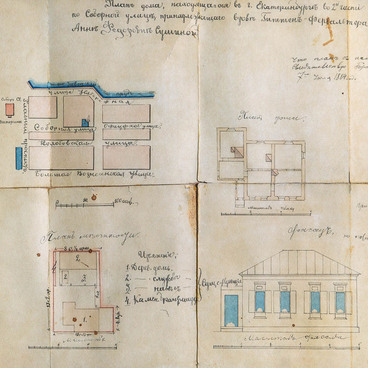
Mamina lived at 27, Sobornaya Street (now Pushkina street) and died in 1910. Now, there is a museum, which tells about the life of the writer Dmitry Mamin-Sibiryak.
#5
Полное наименование: Magazine rack
Дата создания: the late 19th century — the early 20th century
Техника: cardboard, beads, thread, leather
Размеры: 33×43 cm
Коллекция: United Museum of Ural Writers (UMUW)
Правообладатель изображений: United Museum of Ural Writers (UMUW)
Место создания: Yekaterinburg
#15
Table for needlework
#24
In the room of Anna Mamina, the mother of the writer Dmitry Mamin-Sibiryak, there is a small table for needlework next to the window. At the table, the room owner embroidered in various techniques: cross stitching, beadwork, satin stitching; she also crocheted and sewn.
#25
I saw neither my father nor my mother idle. Their day was always full of work,
recalled Mamin-Sibiryak about his parents.
#26
The dark wood table was made at the beginning of the 19th century. It is lacquered on top. It has a semi-circular table top, its lid is hinged, and inside, there are nine compartments for thread, yarn, braid, and working tools.

The table stands on four high shaped legs with a curved top part, decorated with carvings. In between, there are two shelves.

Similar pieces of furniture began to be used in the 18th century. The light and sturdy table quickly became popular because of its small size and versatile purpose. It was referred to as a type of movable furniture: it was often placed by the window during the day, closer to the light, and transferred to the study in the evening.

At such tables, people were engaged in needlework, writing letters, reading and looking at albums. They were often made in composing technique — several wood species were used, and richly decorated. The drawings and patterns on tabletop varied: baskets of fruit, vases of flowers, garlands of wild and garden flowers, views of estates and romantic landscapes, antique ruins and city panoramas.

Anna Mamina was born in Gorny Shchit, in the family of the village priest Semyon Stepanov. When she was 17, she married Narkis Mamin, a graduate of the Perm Theological Seminary. The couple had four children: Nikolay, Dmitry, Vladimir, Yelizaveta. At the age of 46, Anna Mamina became a widow.

In August 1878, the family moved from a small factory settlement to Yekaterinburg. Anna Mamina and her children lived for seven years in private apartments, which Dmitry Mamin-Sibiryak rented for them. In March 1885, he bought a house at 27, Sobornaya street (now Pushkina street) with the royalties from the publication of the book.

Anna Mamina lived in this house for 25 years. Dmitry Mamin-Sibiryak maintained a friendly relationship with his mother until the end of her life. The archives hold more than 450 letters that her son wrote to her.
#7
Полное наименование: Table for needlework
Дата создания: the early 19th century
Техника: wood, varnish, carving
Размеры: 75×64×47 cm
Коллекция: United Museum of Ural Writers (UMUW)
Правообладатель изображений: United Museum of Ural Writers (UMUW)
Место создания: Yekaterinburg
#17
Embroidery “Butterfly”
#27
The collection of the house-museum contains an unfinished embroidery “Butterfly”, which was made by Anna Mamina, the mother of the writer Dmitry Mamin-Sibiryak. In the center of the piece is a butterfly, embroidered with dense tapestry stitch using colored wool threads: black, red, yellow, pink, brown, blue and white. The embroidery is decorated with a blue border along the edges.

In the house where the museum is located, Anna Mamina lived the last 25 years of her life, from 1885 to 1910. One of the parts of the exhibition is her room with the reconstructed furnishings of the 19th century. On the table, there is a family album with photographs, letters, receipts of money transfers from his son, and hand embroidery on a small piece of a white translucent fabric.

On the floor of the room, there is a rug, bought by the mistress of the house, on the wall, there are portraits of her children, grandchildren, and husband — Narkis Mamin, and there is a small table near the window. At this table, Anna Mamina was usually engaged in needlework. She embroidered in various techniques — cross stitching, beadwork, satin stitching — and also crocheted and sewed.

The writer Dmitry Mamin-Sibiryak left this house in 1891 for St. Petersburg. His brothers, sister, nephews, and mother remained here. He always maintained a close relationship with her, despite the distance.

After his departure, Mamin-Sibiryak wrote letters to his mother on a weekly basis. Each envelope he signed “To Her High Honor A. S. Mamina”. In total, the archives have more than 450 letters from Dmitry Mamin-Sibiryak, which he sent to his mother in different years. Her son shared everything with her: creative plans, experiences, family joys and problems.

Anna Mamina died in 1910, at the age of 79. The writer could not come to the Urals for his mother’s funeral and was very worried about that.
#28
You will always remember the loving wing of your grandmother and tell your children what a Russian woman should be like and what she can be like.
Dmitry Mamin-Sibiryak wrote to his nephew Boris Udintsev
#29
Dmitry Mamin-Sibiryak dedicated several works to his mother: “Happy Mother”, “Departure”, “Family and School”, and “From the Distant Past”. Her image became the prototype for many characters in other works of the writer.
#9
Полное наименование: Embroidery “Butterfly”
Автор: Anna Semyonovna Mamina
Дата создания: the early 20th century
Техника: fabric, woolen thread, tapestry embroidery
Размеры: 10.5×8 cm
Коллекция: United Museum of Ural Writers (UMUW)
Правообладатель изображений: United Museum of Ural Writers (UMUW)
Место создания: Yekaterinburg
#18
Photo album
#30
The old photo album belonged to Yelizaveta Mamina (married name — Udintseva), the sister of Dmitry Mamin-Sibiryak. It was kept in the owner’s family for a long time, and in 1978, Mamina’s daughter Natalia gave the heirloom to the museum.

The album was made in the 1880s. It consists of 16 cardboard sheets with photos and autographs left by the Mamins. Each picture was framed with painted flowers.

The cover is made of leather and has worn off over the years. The last page bears the stamp of the manufacturer, “Zakho Shop in Yekaterinburg”.

In the late 19th century, photographs were rare. One had to go to the photographer’s parlor to make portrait photos — it became a memorable event. Only wealthy families could afford professional photography. At that time, the picture cost about a tenth of the average salary of a clerk.

The album is displayed opened at the exhibition. The top photo was taken in 1882; it depicts Anna Mamina with her son Vladimir, a gymnasium student.

At that time, photos could only be taken if models sat motionless for a long time. So, photographers chose comfortable poses: Anna Mamina sits, and Vladimir stands, leaning on a carved table with a mirror. The faces of the models retain their seriousness. On the bottom page, there is a photographic portrait of the young Dmitry Mamin.

Such albums served as interior decorations. A book with pictures printed on heavy paper was placed on a special metal stand and located in a visible place.

In the 19th century, there were all sorts of stands: gilded, silvered, with unusual ornaments. Mamina’s album is located on a metal figured stand. In the center, there are two angels holding a medallion with a grid pattern that resembles an Easter egg. The composition is crowned by a floral ornament.

Now, stands for albums can only be seen in the museums’ collections, for example, in the “Peterhof” Museum-Reserve and the Alexander Radishchev State Art Museum in Saratov.
#11
Полное наименование: Photo album. Personal item of Yelizaveta Mamina
Дата создания: the 1880s
Техника: heavy paper, cardboard, metal, leather, gluing, mixed technique.
Размеры: 21.5×31×7 cm
Коллекция: United Museum of Ural Writers (UMUW)
Правообладатель изображений: United Museum of Ural Writers (UMUW)
Место создания: Russian empire, city of Yekaterinburg, manufacturer “Zakho store”
#12
read morehide
00:00
00:00
1x

Furnishing of the room of the writer's mother

0
Point your smartphone camera to open in the app
Share
VkontakteOdnoklassnikiTelegram
Share on my website
Copy linkCopied
Copy
Open in app
To see AR mode in action:
  1. Install ARTEFACT app for 
  2. iOS or Android;
  3. Find and download the «Paintings in Details» exhibition
  4. Push the «Augmented reality» button and point your phone's camera at the painting;
  5. Watch what happens on your phone screen whilst you flip through the pictures.
 
We use Cookies
Cookies on the Artefact Website. We use cookies to ensure that we give you the best experience on our website. If you continue without changing your settings, we'll assume that you are happy to receive all cookies on the Artefact website. However, if you would like to, you can change your cookie settings at any time.
Learn more about cookie useHide
Content is available only in Russian

X

Нашли опечатку?...

%title%%type%