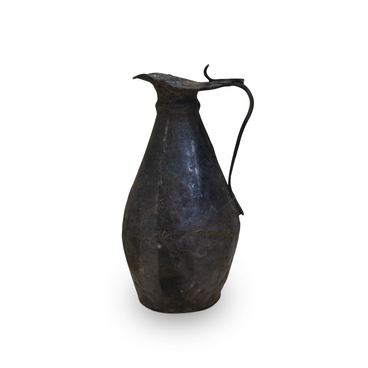
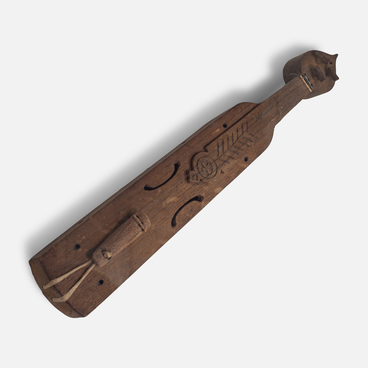
The ethnographic collection of the Museum of the History of the Resort City of Sochi contains a wide variety of household items that belonged to the settlers who developed the Sochi region in the period following the end of the Caucasian War.
In the 1880s and 1890s, the Hamshen Armenians settled in the Sochi District, and by the beginning of the 20th century, they were living in twenty-two villages, including Loo, Uch-Dere, Vardane, Veranda, and Khobza. Due to the similarity of the natural and climatic conditions of the Caucasian Riviera to their previous homes in Turkey, from which many refugees arrived after the bloody pogroms, the Armenians quickly adapted to their new surroundings. The economic activities of the district’s population in the late 19th and early 20th centuries were, to some extent, regulated by national traditions.
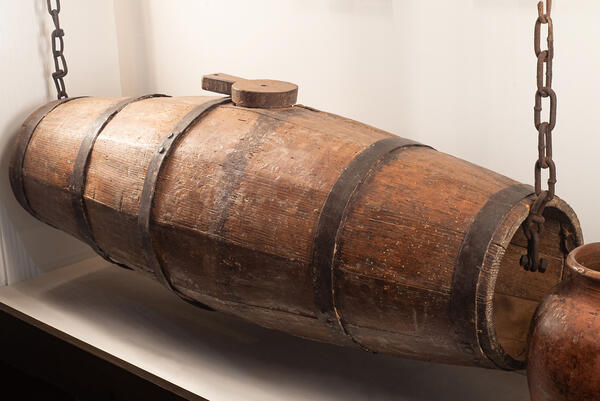
Among the grain crops, the Armenians cultivated corn and various types of Turkish tobacco, while cattle and horse breeding were primarily for domestic use. Traditional dishes have been preserved, including shashlik, khashlama, khash, dolma, pilaf with raisins, lobi, gata, tursha, matzoon, corn and wheat flatbreads, and lavash. Traditional Armenian butter churns, known as “khnotsi, ” were used to make butter from milk, matzoon, cream, or sour cream; one of these churns is on display in the museum.
From the time of the ancient state of Urartu (which was located in Western Asia on the territory of the Armenian Highlands), Armenian women made butter by hand using the “khnotsi”. The churn is a wooden vessel with an oval, barrel-shaped form, made from cooper’s staves and bordered with metal hoops, along with metal fasteners for hanging it from ceiling beams with chains. In the center, there is a hole for pouring in milk; after filling the churn, it was shaken until butter was obtained. The resulting butter was then re-melted to produce clarified butter. Traditionally, women were responsible for churning the butter.
This churn was transferred to the museum from the collection of the local historian Igor Konstantinovich Nedolya. He initiated the establishment of a museum in the Adler district of Sochi in 1989.