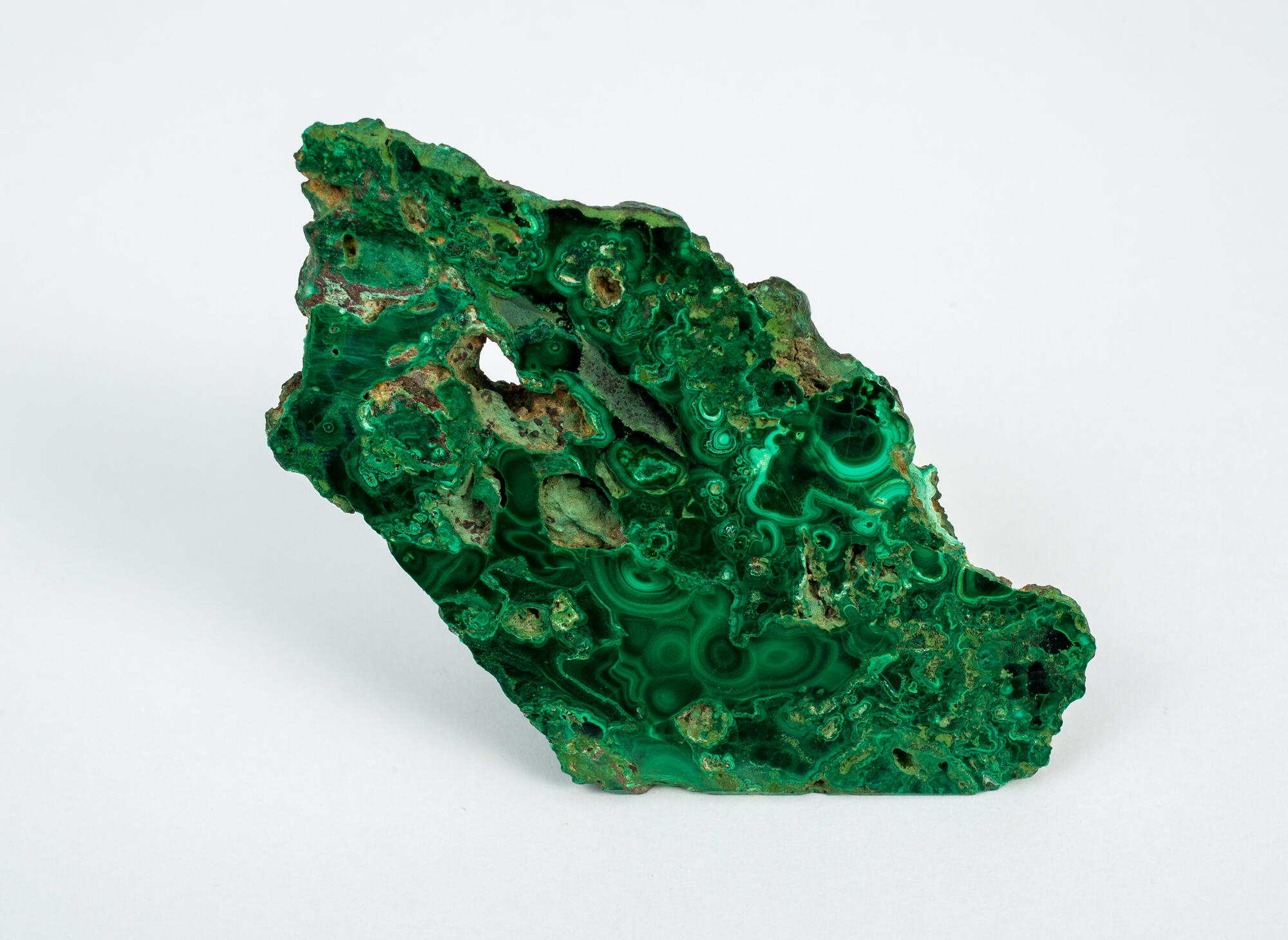


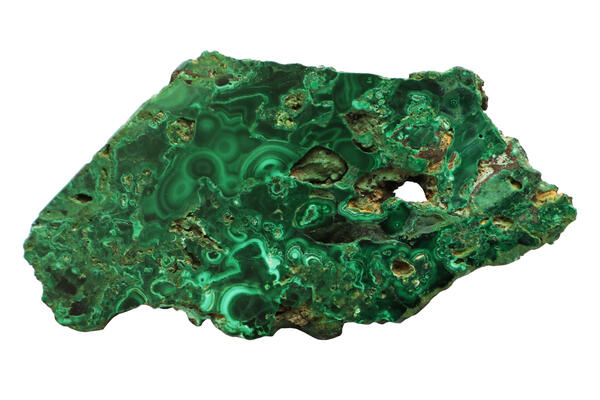
The collection of the Verkhnyaya Pyshma Historical Museum houses a sample of the Ural malachite measuring 9 by 14 centimeters. The deep green stone is called the symbol of the Urals, since many gem deposits have been discovered in the region.
Malachite is found at numerous copper deposits. The underground water that passes through the copper ore turns into a solution with metal ions. It slowly seeps through the porous limestone and forms copper carbonate — the malachite stone.
The name of the mineral is of Greek origin. According to one of the versions, the word was formed from ‘malake’, meaning ‘green flower’, according to the other version it originated from ‘malakos’, meaning ‘soft’.
The stone is really very soft and fragile, it is vulnerable to external environmental factors. However, for jewelers, this texture became an advantage — due to its softness, malachite is easy to polish and grind in order to be used for jewelry.
There are three main malachite colors: yellow-green, deep green and translucent colorless. Sometimes miners find unique malachite of turquoise and emerald shades.
The mineral has been known since ancient times. The most ancient malachite jewelry was found by archaeologists on the territory of Iraq — it is estimated that it was created 10.5 thousand years ago. In Ancient Rome, malachite was used to create amulets, and in Egypt it was added to dyes and eyeshadows.
In Russia, the mineral became popular in the middle of the 18th century after several malachite deposits had been discovered in the Urals. The first of these was the Gumeshevskoe deposit at the source of the Chusovaya River. The gems found there were used for rings, beads, earrings and pendants; most often, they were combined with other precious stones.
In past centuries, the Ural malachite was mined in large quantities. It was used to make vases, clocks, snuff and jewelry boxes, fireplaces and tabletops. Malachite crumbs were used to cover the pits in the pavements. By the early 1970s, malachite deposits were nearly depleted, and now it is considered a rare and expensive gem. Most malachite is mined in Africa these days.
Malachite is found at numerous copper deposits. The underground water that passes through the copper ore turns into a solution with metal ions. It slowly seeps through the porous limestone and forms copper carbonate — the malachite stone.
The name of the mineral is of Greek origin. According to one of the versions, the word was formed from ‘malake’, meaning ‘green flower’, according to the other version it originated from ‘malakos’, meaning ‘soft’.
The stone is really very soft and fragile, it is vulnerable to external environmental factors. However, for jewelers, this texture became an advantage — due to its softness, malachite is easy to polish and grind in order to be used for jewelry.
There are three main malachite colors: yellow-green, deep green and translucent colorless. Sometimes miners find unique malachite of turquoise and emerald shades.
The mineral has been known since ancient times. The most ancient malachite jewelry was found by archaeologists on the territory of Iraq — it is estimated that it was created 10.5 thousand years ago. In Ancient Rome, malachite was used to create amulets, and in Egypt it was added to dyes and eyeshadows.
In Russia, the mineral became popular in the middle of the 18th century after several malachite deposits had been discovered in the Urals. The first of these was the Gumeshevskoe deposit at the source of the Chusovaya River. The gems found there were used for rings, beads, earrings and pendants; most often, they were combined with other precious stones.
In past centuries, the Ural malachite was mined in large quantities. It was used to make vases, clocks, snuff and jewelry boxes, fireplaces and tabletops. Malachite crumbs were used to cover the pits in the pavements. By the early 1970s, malachite deposits were nearly depleted, and now it is considered a rare and expensive gem. Most malachite is mined in Africa these days.