Dmitry Lazarevich Kuchkin was a well-known manufacturer and merchant of the second guild. He might have come from a family of Old Believers. In 1898, Kuchkin founded a metal products factory in Moscow, on 4th Meshchanskaya Street in 2nd Lavrsky Passage. This factory had a branch in Kazan. It is possible that everything happened the other way around: the Kazan factory could have been founded earlier, and after Kuchkin became rich, his production was transferred to Moscow.
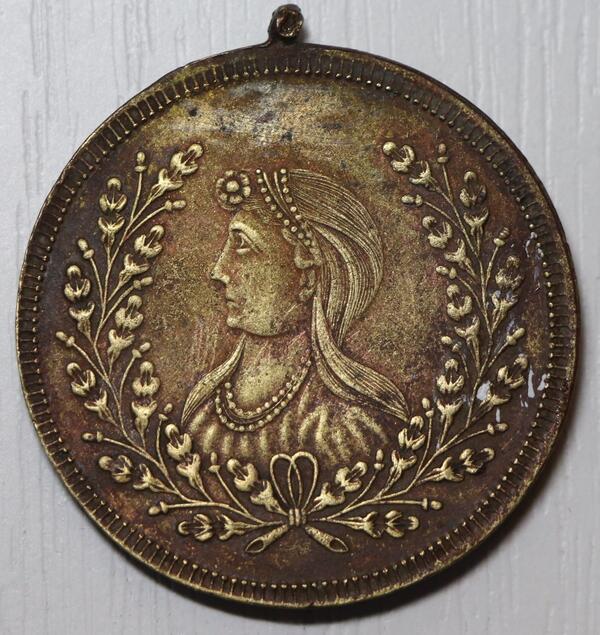
The Kuchkin factory produced small items made of brass, tin, steel and wire. The factory products included numerous commemorative tokens that commemorated the centenary of the Patriotic War of 1812, as well as those associated with the imperialist war and the February Revolution. The most common type of Kuchkin’s products were coin-like imitations, of which many were signed as “D. Kuchkin” or “Fact. D. Kuchkin M”, and sometimes — “Fact. D. Kuchkin Moscow” and Fabrikant DL Kutschkin. These coin-like tokens were sold for those peoples whose women’s costume included jewelry made of coins. These “coins” could be used as pendants. Most of them featured a female head, surrounded by the French inscription “ornements des femmes” (decoration for women). The other side most often featured the image of a double-headed eagle.
In the 19th century, merchants sold such coins to “non-believers” for 3 kopecks per 10 pieces. Thus, the production of coin-like tokens and “dukachi” (from “D. Kuchkin”) prevented the withdrawal of silver coins from circulation (holes had previously been maid in coins which served as part of women’s jewelry).
The story of the token that is on display in the museum is known. The exhibit was part of the monisto necklace, which a loving Tatar husband bought for his wife for the 25th anniversary of their marriage. The husband, who was engaged in trade, traveled to many Russian cities on business, and bought a monisto necklace in Kazan. On the obverse, there is a female head surrounded by the inscription in French meaning “Jewelry for women”. On the reverse, there is a double-headed eagle and the inscription “Fabrikant D.L. Kuchkin.”
Metal noise-making pendants that were produced in large numbers were prevalent in Tatar women’s jewelry. When the wearer moved and the pendants touched each other, they made a sound. It was believed that this sound could scare away evil spirits. There is a saying that “a Tatar woman can first be heard, and only then seen.”
The Kuchkin factory produced small items made of brass, tin, steel and wire. The factory products included numerous commemorative tokens that commemorated the centenary of the Patriotic War of 1812, as well as those associated with the imperialist war and the February Revolution. The most common type of Kuchkin’s products were coin-like imitations, of which many were signed as “D. Kuchkin” or “Fact. D. Kuchkin M”, and sometimes — “Fact. D. Kuchkin Moscow” and Fabrikant DL Kutschkin. These coin-like tokens were sold for those peoples whose women’s costume included jewelry made of coins. These “coins” could be used as pendants. Most of them featured a female head, surrounded by the French inscription “ornements des femmes” (decoration for women). The other side most often featured the image of a double-headed eagle.
In the 19th century, merchants sold such coins to “non-believers” for 3 kopecks per 10 pieces. Thus, the production of coin-like tokens and “dukachi” (from “D. Kuchkin”) prevented the withdrawal of silver coins from circulation (holes had previously been maid in coins which served as part of women’s jewelry).
The story of the token that is on display in the museum is known. The exhibit was part of the monisto necklace, which a loving Tatar husband bought for his wife for the 25th anniversary of their marriage. The husband, who was engaged in trade, traveled to many Russian cities on business, and bought a monisto necklace in Kazan. On the obverse, there is a female head surrounded by the inscription in French meaning “Jewelry for women”. On the reverse, there is a double-headed eagle and the inscription “Fabrikant D.L. Kuchkin.”
Metal noise-making pendants that were produced in large numbers were prevalent in Tatar women’s jewelry. When the wearer moved and the pendants touched each other, they made a sound. It was believed that this sound could scare away evil spirits. There is a saying that “a Tatar woman can first be heard, and only then seen.”