

The kalfak has always occupied a special place among the traditional women’s headdresses widespread among the Tatars. The oldest surviving kalfak dates back to the 18th century, and scientists claim that the headdress had appeared even earlier. Today, a kalfak is a kind of decoration: it is worn on stage, used during photo shoots, national events, and in everyday life. Many women wear its variation of the skullcap type called takyya.
Nikolay Vorobyov, a well-known specialist in Tatar history, ethnographer and teacher, wrote about the importance the Tatars attached to kalfaks. In 1953, he published the fundamental study “Kazan Tatars”, in which he dwelled in detail on the history of this headdress, described its appearance and the rules that Tatar women followed when wearing it. Kalfaks were common primarily among the Kazan Tatars. They became widespread among other groups of Tatars in the end of the 19th century.
Kalfak patterns were inspired by nature and most often featured floral motifs. Images of mountain ash, wild rose and juniper were believed to bring happiness. Roses were embroidered to attract love and preserve beauty. The tulip, which was often featured in Tatar embroidery, symbolized renewal. Various wishes, amulets, and prayers were often depicted on ancient kalfaks, which gave the headdress some magical meaning. At the end of the 18th century, women wore high pyramidal hats that were completely studded with coins. The forehead part of the headdress was embroidered with silver and gold threads. There were diverse types of embroidery: satin stitch, tambour stitch, carpet technique, gold embroidery, pearl embroidery, and “ear” technique (much less common than pearl embroidery). The headdress made in the “ear” technique turned out to be elegant, but very expensive since the manufacturing process was laborious, the skill level had to be extremely high and the cost of the fabric was high.
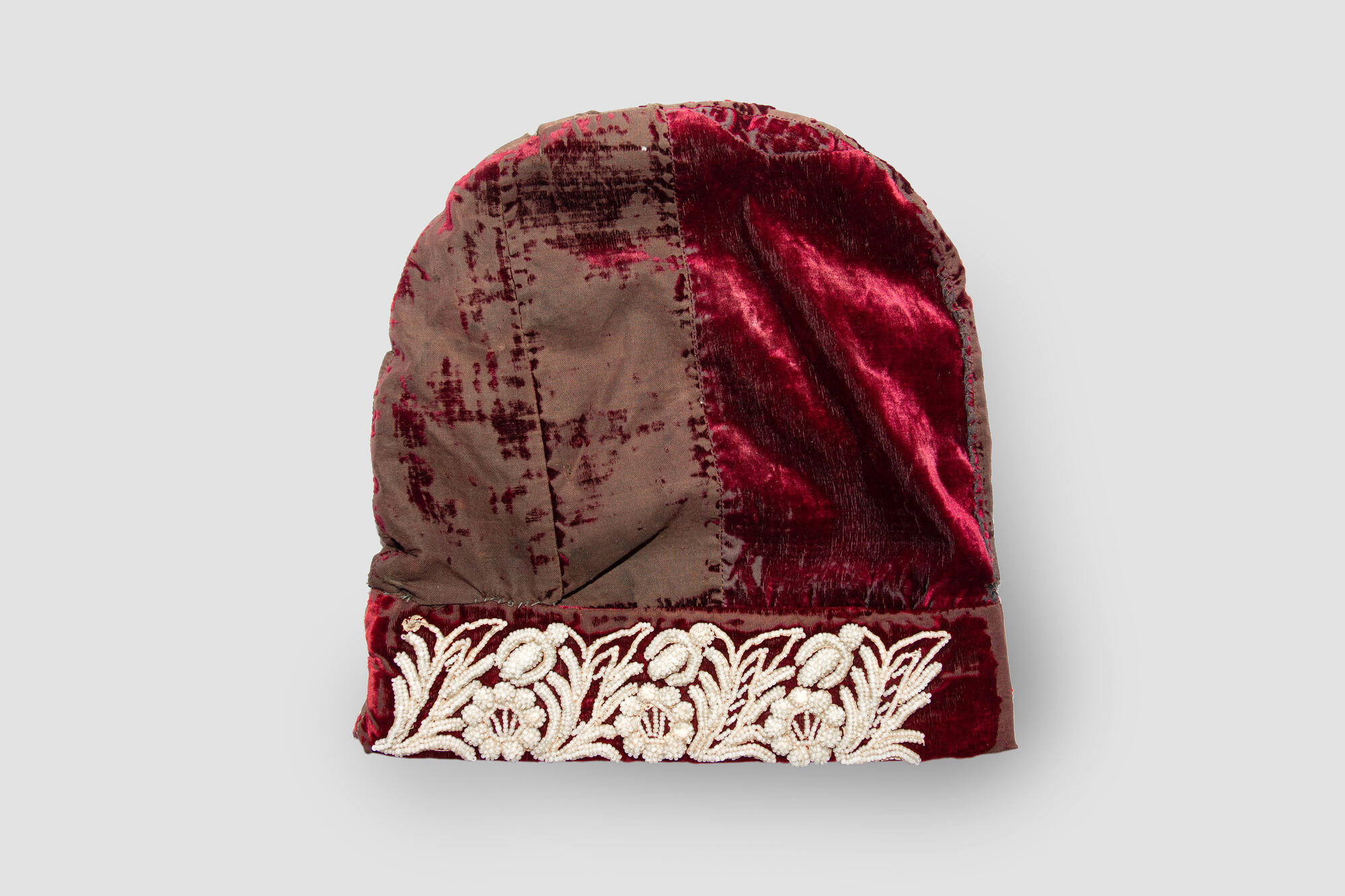
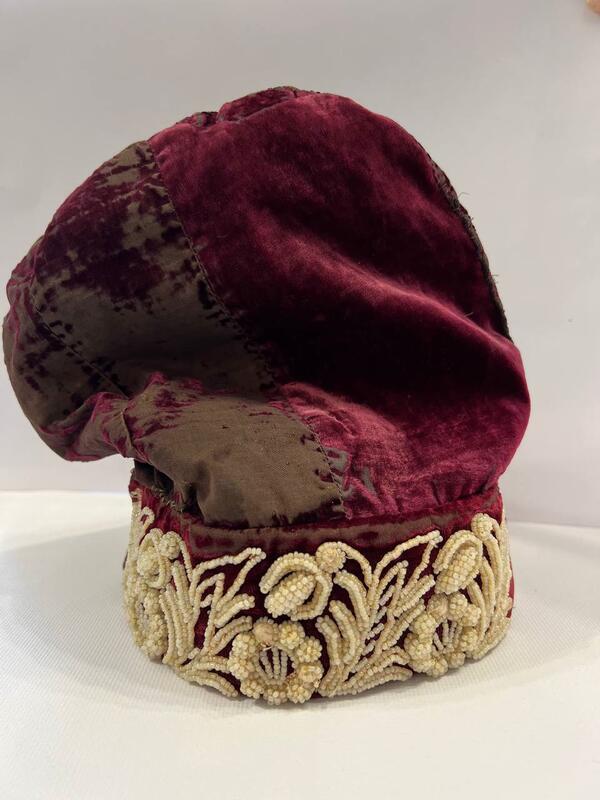
At the bottom of the burgundy velvet kalfak is a luxurious embroidery of stylized flowers, leaves and buds. The embroidery is made with white beads.
Nikolay Vorobyov, a well-known specialist in Tatar history, ethnographer and teacher, wrote about the importance the Tatars attached to kalfaks. In 1953, he published the fundamental study “Kazan Tatars”, in which he dwelled in detail on the history of this headdress, described its appearance and the rules that Tatar women followed when wearing it. Kalfaks were common primarily among the Kazan Tatars. They became widespread among other groups of Tatars in the end of the 19th century.
Kalfak patterns were inspired by nature and most often featured floral motifs. Images of mountain ash, wild rose and juniper were believed to bring happiness. Roses were embroidered to attract love and preserve beauty. The tulip, which was often featured in Tatar embroidery, symbolized renewal. Various wishes, amulets, and prayers were often depicted on ancient kalfaks, which gave the headdress some magical meaning. At the end of the 18th century, women wore high pyramidal hats that were completely studded with coins. The forehead part of the headdress was embroidered with silver and gold threads. There were diverse types of embroidery: satin stitch, tambour stitch, carpet technique, gold embroidery, pearl embroidery, and “ear” technique (much less common than pearl embroidery). The headdress made in the “ear” technique turned out to be elegant, but very expensive since the manufacturing process was laborious, the skill level had to be extremely high and the cost of the fabric was high.
At the bottom of the burgundy velvet kalfak is a luxurious embroidery of stylized flowers, leaves and buds. The embroidery is made with white beads.