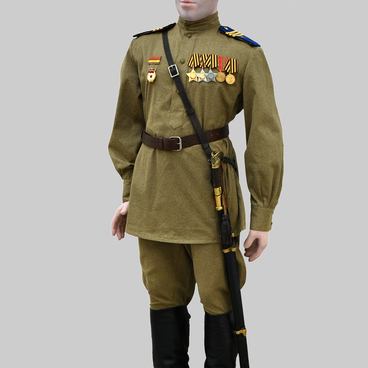
At the outbreak of the Great Patriotic War, military uniforms were produced and worn in accordance with Order No. 176 of 3 December 1935. There were three types of uniforms for officers and soldiers — service, guard and dress uniforms. All of them had winter and summer versions.
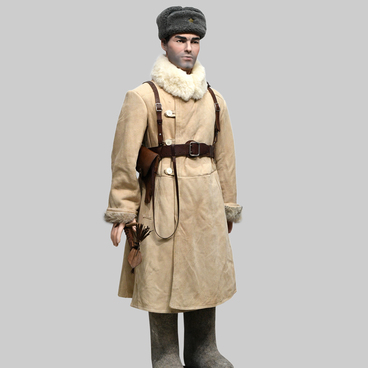
The 112th Bashkir Cavalry Division was being formed during winter — from November 1941 to March 1942. The government of the Republic of Bashkortostan and the regional committee of the Communist party obliged local authorities to supply conscripts with uniforms and equipment. The kit included a sheepskin coat, a hat with earflaps, a pair of boots, wadded trousers, a military shirt, two pairs of underwear, two pairs of warm footwraps, a pair of woolen gloves, a pair of mittens, two towels, some handkerchiefs, waist belts and belts for trousers, a duffel bag, as well as a mess kit, a flask, a mug, a spoon and a shaving razor. All this was provided by individuals, collective farms and local authorities.
The soldier’s 1935 military shirt was made of cotton fabric dyed in different colors. The winter uniform was made of woolen fabric, which had richer, darker colors. The shirt was fastened with buttons hidden under the button placket. There were two breast pockets, and the shirt had elbow patches made of an additional layer of fabric. The shirt had a turndown collar and collar tabs that indicated the branch of the armed forces. Officers used a wide leather belt with a brass buckle adorned with a five-pointed star. Soldiers, on the other hand, wore a simpler belt with a conventional open buckle.
The duffel bag received a nickname — the soldiers called it “sidor” (a traditional Russian male name). It was a simple bag with a strap that was tied with a rope. The bag had only one compartment. The process of manufacturing a duffel bag was simple so it became the main container used by the Red Army soldiers during the Great Patriotic War for carrying their personal belongings.
The 112th Bashkir Cavalry Division was being formed during winter — from November 1941 to March 1942. The government of the Republic of Bashkortostan and the regional committee of the Communist party obliged local authorities to supply conscripts with uniforms and equipment. The kit included a sheepskin coat, a hat with earflaps, a pair of boots, wadded trousers, a military shirt, two pairs of underwear, two pairs of warm footwraps, a pair of woolen gloves, a pair of mittens, two towels, some handkerchiefs, waist belts and belts for trousers, a duffel bag, as well as a mess kit, a flask, a mug, a spoon and a shaving razor. All this was provided by individuals, collective farms and local authorities.
The soldier’s 1935 military shirt was made of cotton fabric dyed in different colors. The winter uniform was made of woolen fabric, which had richer, darker colors. The shirt was fastened with buttons hidden under the button placket. There were two breast pockets, and the shirt had elbow patches made of an additional layer of fabric. The shirt had a turndown collar and collar tabs that indicated the branch of the armed forces. Officers used a wide leather belt with a brass buckle adorned with a five-pointed star. Soldiers, on the other hand, wore a simpler belt with a conventional open buckle.
The duffel bag received a nickname — the soldiers called it “sidor” (a traditional Russian male name). It was a simple bag with a strap that was tied with a rope. The bag had only one compartment. The process of manufacturing a duffel bag was simple so it became the main container used by the Red Army soldiers during the Great Patriotic War for carrying their personal belongings.