The wedding ceremony in the Khakass society is one of the most important events of the life circle. It was believed that during a wedding, as well as birth and funeral, a person passes from one life to another. And these events were accompanied by special rituals. At a wedding, the matchmaker was the central figure, she was responsible for the welfare of the young family for life.
Khakass people were allowed to marry or be married by the age of 16-18.
The traditional Khakass society was patriarchal: a man was given the leading role in it. Family and kinship relations also reflected the patriarchal clan structure. For example, a clear division of relatives by father and mother, wife and husband was preserved.
Marriages between members of the same seok, a lineage in the male line, were not allowed. Sometimes marriages were also forbidden between members of different seoks who had a common ancestor.
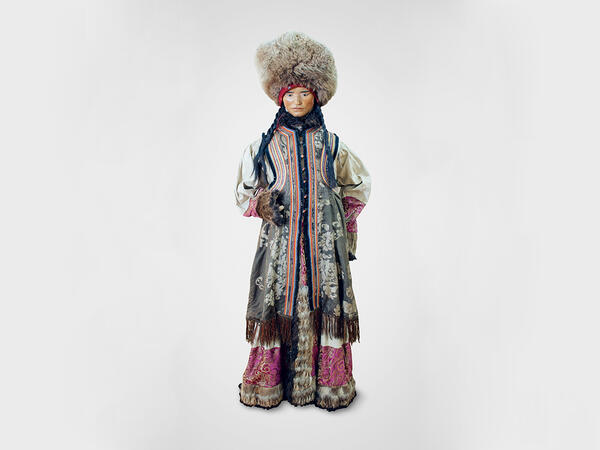
Matchmakers usually handled wedding arrangements. They wore a special national costume: a fur coat with an overlapped hem, a sleeveless jacket (segedek), and a headdress with high margins made of black fox fur, worn over a scarf.
A woman’s fur coat was considered the most elegant and honorable garment of the Khakass people. The matchmaker’s coat was straight cut, sewn from the white skins of autumn lambs — meringues, and then covered with high-quality Chinese silk.
The coat’s sides were trimmed with a broad trimming of sable paws. This was followed by a wide silk border, which differed in texture from the main fabric. On the left flap was a quadrangular protuberance ‘payir’, which on the chest was decorated with several tracks of the rainbow border — ‘cheyek’. On both sides of the coat loops were attached, to which silk scarves were tied.
Its peculiar hem distinguished the coat of a matchmaker, hence the name ‘idektig’ — the hem. At the knee level, on the sides and behind, the hem was quilted with 9, 11, or 13 rows of sinew or silk threads. Around the hem assemblies were obtained, which were called ‘toorym’.
The lower part of the coat, covered with folds, formed a kind of a skirt. They were called ‘hondyrykh’. In such skirts, it was comfortable to sit with legs tucked in, and in winter they also warmed, as the folded fabric protected from the wind. But walking in a wedding coat (idektig ton) was uncomfortable because the constricted hem limited the width of the step.
The sleeveless jacket must have been worn over the idektig ton. It was sewn open, with a straight cut. The flaps met in the middle and were tied at the collar. The saddleback frame was glued together with four layers of cloth so that it retained its shape well.
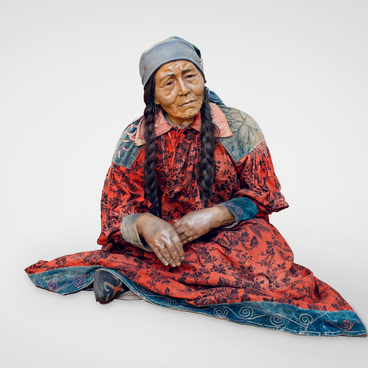
According to the tradition, widowed old women were not allowed to take part in weddings or be matchmakers. Widows were also not allowed to wear a festive coat and a sleeveless segedek. Only rich married women wore such clothes.
Khakass people were allowed to marry or be married by the age of 16-18.
The traditional Khakass society was patriarchal: a man was given the leading role in it. Family and kinship relations also reflected the patriarchal clan structure. For example, a clear division of relatives by father and mother, wife and husband was preserved.
Marriages between members of the same seok, a lineage in the male line, were not allowed. Sometimes marriages were also forbidden between members of different seoks who had a common ancestor.
Matchmakers usually handled wedding arrangements. They wore a special national costume: a fur coat with an overlapped hem, a sleeveless jacket (segedek), and a headdress with high margins made of black fox fur, worn over a scarf.
A woman’s fur coat was considered the most elegant and honorable garment of the Khakass people. The matchmaker’s coat was straight cut, sewn from the white skins of autumn lambs — meringues, and then covered with high-quality Chinese silk.
The coat’s sides were trimmed with a broad trimming of sable paws. This was followed by a wide silk border, which differed in texture from the main fabric. On the left flap was a quadrangular protuberance ‘payir’, which on the chest was decorated with several tracks of the rainbow border — ‘cheyek’. On both sides of the coat loops were attached, to which silk scarves were tied.
Its peculiar hem distinguished the coat of a matchmaker, hence the name ‘idektig’ — the hem. At the knee level, on the sides and behind, the hem was quilted with 9, 11, or 13 rows of sinew or silk threads. Around the hem assemblies were obtained, which were called ‘toorym’.
The lower part of the coat, covered with folds, formed a kind of a skirt. They were called ‘hondyrykh’. In such skirts, it was comfortable to sit with legs tucked in, and in winter they also warmed, as the folded fabric protected from the wind. But walking in a wedding coat (idektig ton) was uncomfortable because the constricted hem limited the width of the step.
The sleeveless jacket must have been worn over the idektig ton. It was sewn open, with a straight cut. The flaps met in the middle and were tied at the collar. The saddleback frame was glued together with four layers of cloth so that it retained its shape well.
According to the tradition, widowed old women were not allowed to take part in weddings or be matchmakers. Widows were also not allowed to wear a festive coat and a sleeveless segedek. Only rich married women wore such clothes.