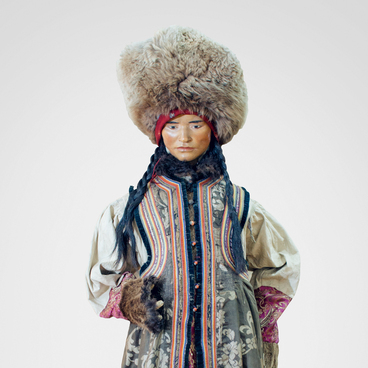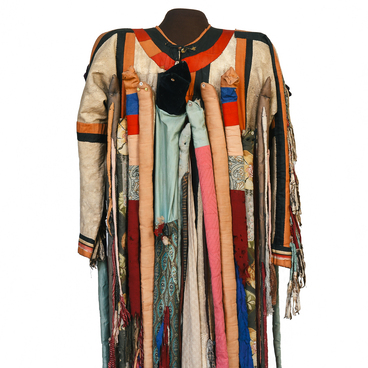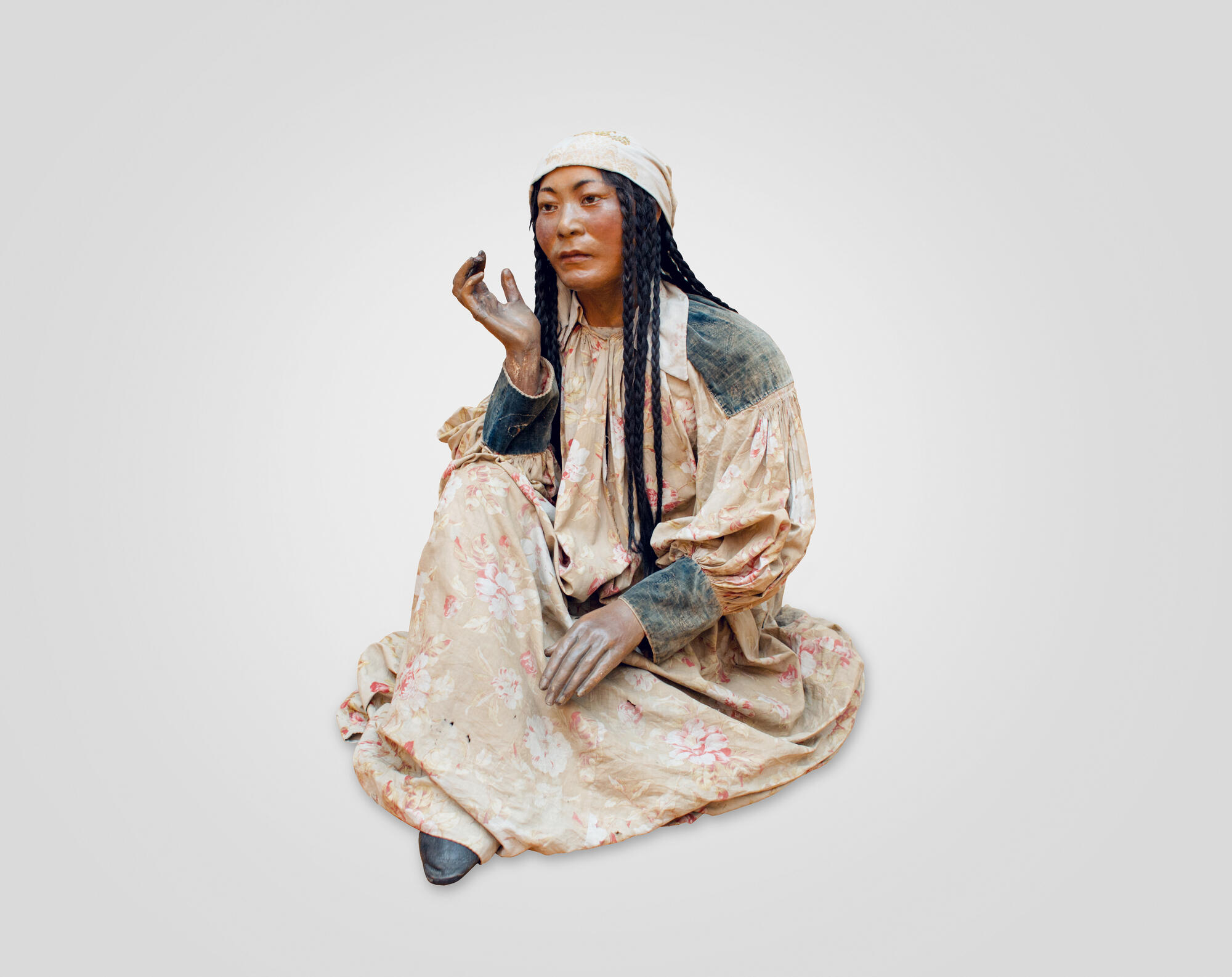


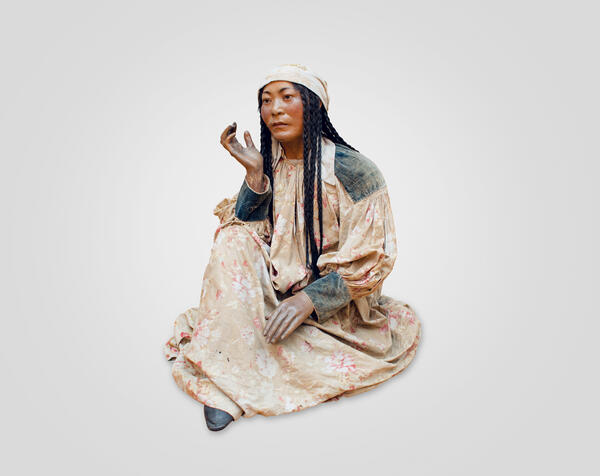
The doll of a Khakass girl is one of the most ancient exhibits of the ethnographic collection. Along with other dolls, it was made by a St. Petersburg artist-sculptor, whose name has not survived, from photographs of the indigenous population.
The Khakass girl was in a group of exhibits that depicted a shamanistic ritual — communication with spirits. They were housed in the Asian Russia pavilion at the 1900 World’s Fair in Paris.
The girl is dressed in a traditional floor-length shirt of light-colored fabric, with soft black leather boots on her feet.
Women’s everyday shirts were usually made of soft cotton cloth, while holiday shirts were made of silk. The collar was sewn to the shirt first, and then the sleeves. At the armhole, under the arms, sleeves were attached to the main product loosely, leaving small strips. They were called ‘hut syngchan, ” which meant “the place of attraction of the human soul”. They were sewn up only after the death of a person, at a funeral.
The skirting, hem, or shoulders of the shirt were decorated with a material of a different color. Festive dresses were additionally embroidered with patterns, completed with shells or buttons. Only widows had their shirts belted.
The hair of the doll was braided into special plaits — surmes. They indicated that the girl was unmarried. A shawl, a universal female headdress, covers her head.
Everyday shawls, like shirts, were made of plain cloth, chintz, or wool, and festive shawls were made of silk. The Khakass tied them in a special way. The shawl was folded in half diagonally, then made a headband (folded the fabric over the forehead), and the two loose ends were tied at the back of the head.
The Khakass had winter and summer shoes. The winter boots were made of fur, while the summer ones were made of leather. For women’s boots, they used horse or tanned calfskin, seasoned in a decoction of dried and crushed bark of willow shrubs or larch. If the boot’s cuff was high, unmarried girls tied it up with a special metal buckle. The soles of shoes were reinforced with a double thread made of cattle tendons.
Khakass associated many traditions and beliefs with clothing. It could not be sold, otherwise, happiness would leave the house. For the same reason, things were not altered. Before wearing a new costume, it was always fumigated with bogorod herb (thyme), so that evil forces would not settle in it.
The Khakass girl was in a group of exhibits that depicted a shamanistic ritual — communication with spirits. They were housed in the Asian Russia pavilion at the 1900 World’s Fair in Paris.
The girl is dressed in a traditional floor-length shirt of light-colored fabric, with soft black leather boots on her feet.
Women’s everyday shirts were usually made of soft cotton cloth, while holiday shirts were made of silk. The collar was sewn to the shirt first, and then the sleeves. At the armhole, under the arms, sleeves were attached to the main product loosely, leaving small strips. They were called ‘hut syngchan, ” which meant “the place of attraction of the human soul”. They were sewn up only after the death of a person, at a funeral.
The skirting, hem, or shoulders of the shirt were decorated with a material of a different color. Festive dresses were additionally embroidered with patterns, completed with shells or buttons. Only widows had their shirts belted.
The hair of the doll was braided into special plaits — surmes. They indicated that the girl was unmarried. A shawl, a universal female headdress, covers her head.
Everyday shawls, like shirts, were made of plain cloth, chintz, or wool, and festive shawls were made of silk. The Khakass tied them in a special way. The shawl was folded in half diagonally, then made a headband (folded the fabric over the forehead), and the two loose ends were tied at the back of the head.
The Khakass had winter and summer shoes. The winter boots were made of fur, while the summer ones were made of leather. For women’s boots, they used horse or tanned calfskin, seasoned in a decoction of dried and crushed bark of willow shrubs or larch. If the boot’s cuff was high, unmarried girls tied it up with a special metal buckle. The soles of shoes were reinforced with a double thread made of cattle tendons.
Khakass associated many traditions and beliefs with clothing. It could not be sold, otherwise, happiness would leave the house. For the same reason, things were not altered. Before wearing a new costume, it was always fumigated with bogorod herb (thyme), so that evil forces would not settle in it.