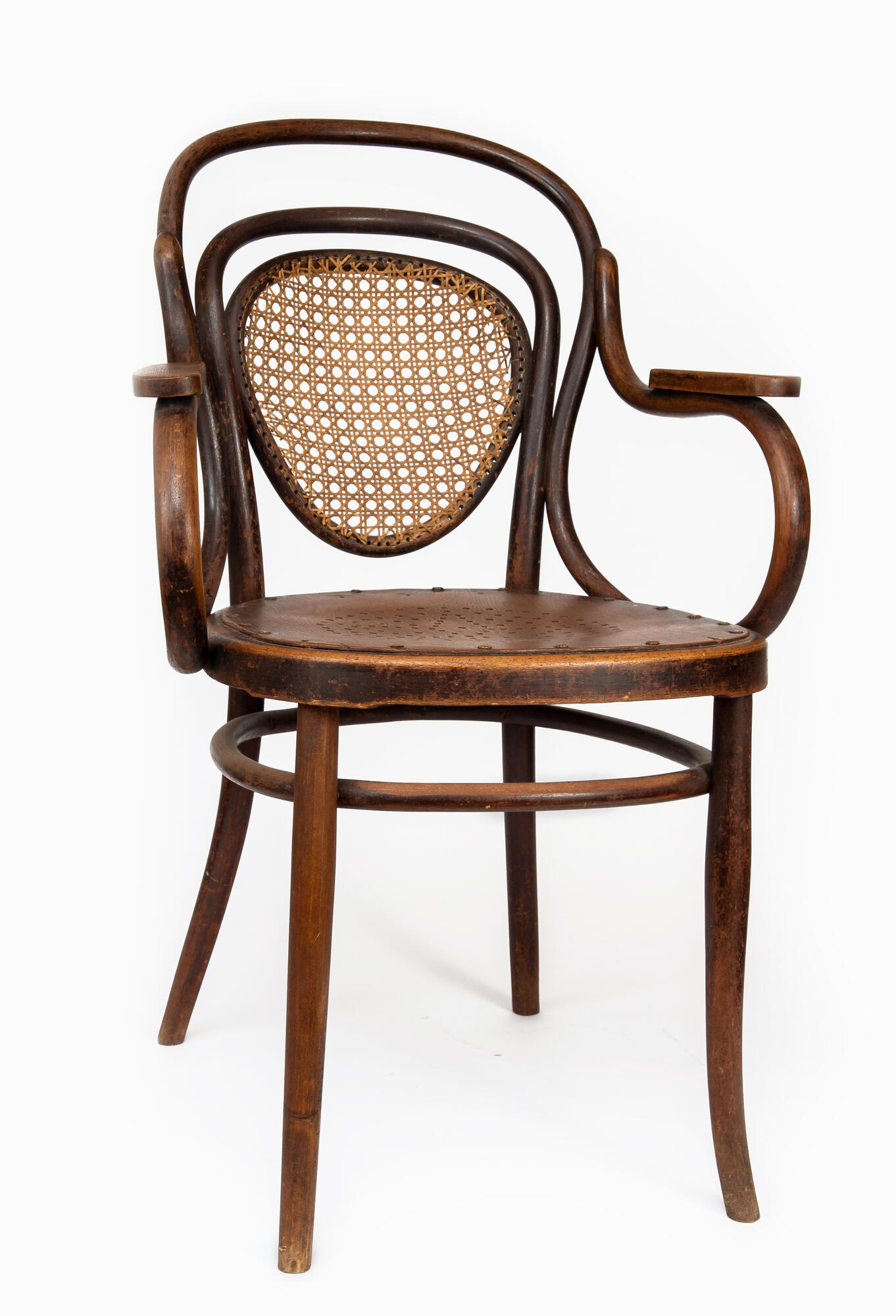


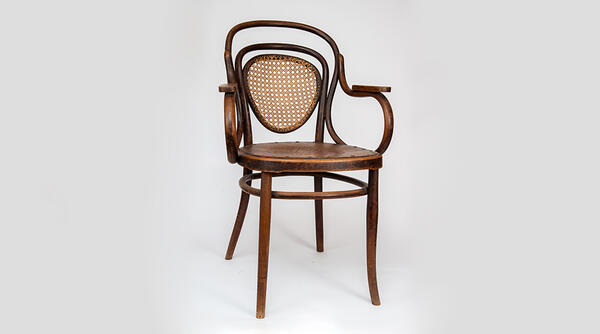
The bentwood armchair from the collection of the Verkhnyaya Pyshma Historical Museum belonged to the revolutionary Fyodor Syromolotov. The piece of furniture was given to him as a present in 1918. The chair was ordered from the Moscow Kremlin particularly for Syromolotov.
Armchairs and chairs made of thin bent beech wood were called Viennese. Such furniture was both light and durable. It was often used in living rooms and offices, where the owners had to sit at the table for a long time talking with guests or working.
The seat of the chair is made of plywood and attached to the base with metal nails. It has a star-shaped pattern of holes. The oval on the back is covered with an elastic mesh, and there are wooden pads on the armrests, which made sitting in this armchair even more comfortable.
The owner of the chair, Fyodor Syromolotov, was a revolutionary, a Soviet party and state leader, and a publicist. He managed the Pyshminsko-Klyuchevsky copper mine and a copper smelting plant, heading the enterprises from 1901 to 1905.
Syromolotov was born on May 1 (on May 13 according to the new style), 1877 in the city of Zlatoust, Ufa governorate (it is Chelyabinsk region). He graduated from the Ural Mining School, and then began working at mining enterprises.
When Fyodor Syromolotov became employed at the Pyshminsko-Klyuchevsky copper mine, Russia was in a state of turmoil. The workers were preparing for the First Russian Revolution of 1905-1907. The manager received the nickname Fedich and became one of the organizers of the Central Ural Committee of the RSDLP (Russian Social Democratic Labor Party). According to his technical drawings, the craftsmen assembled a printing press and made a typography at the copper mine, where they printed campaign materials.
Contemporaries recalled that Fyodor Syromolotov quickly gained the trust of the mine’s engineers through his hard work. His working day began at six in the morning and ended late in the evening. In the morning, the manager checked the safety measures at the mine: he went down into the mines and, together with the miners, monitored whether all the supports were securely fixed and whether the pumps that pumped out water were working. Then he went to the plant and visited the copper smelting facility.
Under the management of Syromolotov, new mines were opened and two shaft furnaces were installed. At the same time, he carried on with his underground revolutionary activities. He was under secret police surveillance, and in March 1906, Syromolotov was arrested during the investigation of the Yekaterinburg Committee of the RSDLP. He was released, but in 1909 he was arrested again and sentenced to one year in prison.
After his release, Syromolotov continued his campaigning activities. During the revolution he was in Petrograd, and then went to the Urals — there he participated in the Civil War, fought with the Cossacks, and then worked in the mining industry.
Armchairs and chairs made of thin bent beech wood were called Viennese. Such furniture was both light and durable. It was often used in living rooms and offices, where the owners had to sit at the table for a long time talking with guests or working.
The seat of the chair is made of plywood and attached to the base with metal nails. It has a star-shaped pattern of holes. The oval on the back is covered with an elastic mesh, and there are wooden pads on the armrests, which made sitting in this armchair even more comfortable.
The owner of the chair, Fyodor Syromolotov, was a revolutionary, a Soviet party and state leader, and a publicist. He managed the Pyshminsko-Klyuchevsky copper mine and a copper smelting plant, heading the enterprises from 1901 to 1905.
Syromolotov was born on May 1 (on May 13 according to the new style), 1877 in the city of Zlatoust, Ufa governorate (it is Chelyabinsk region). He graduated from the Ural Mining School, and then began working at mining enterprises.
When Fyodor Syromolotov became employed at the Pyshminsko-Klyuchevsky copper mine, Russia was in a state of turmoil. The workers were preparing for the First Russian Revolution of 1905-1907. The manager received the nickname Fedich and became one of the organizers of the Central Ural Committee of the RSDLP (Russian Social Democratic Labor Party). According to his technical drawings, the craftsmen assembled a printing press and made a typography at the copper mine, where they printed campaign materials.
Contemporaries recalled that Fyodor Syromolotov quickly gained the trust of the mine’s engineers through his hard work. His working day began at six in the morning and ended late in the evening. In the morning, the manager checked the safety measures at the mine: he went down into the mines and, together with the miners, monitored whether all the supports were securely fixed and whether the pumps that pumped out water were working. Then he went to the plant and visited the copper smelting facility.
Under the management of Syromolotov, new mines were opened and two shaft furnaces were installed. At the same time, he carried on with his underground revolutionary activities. He was under secret police surveillance, and in March 1906, Syromolotov was arrested during the investigation of the Yekaterinburg Committee of the RSDLP. He was released, but in 1909 he was arrested again and sentenced to one year in prison.
After his release, Syromolotov continued his campaigning activities. During the revolution he was in Petrograd, and then went to the Urals — there he participated in the Civil War, fought with the Cossacks, and then worked in the mining industry.