The lzhitsa, or spoon, is one of the most valuable items of church utensils. This is a small spoon with a long handle in the form of a cross, which is used for the Eucharist, that is, Communion, for receiving the Holy Mysteries.
The Museum Complex of Kuybyshev houses such a spoon made of copper alloy. According to a hypothesis, it was used in the Cathedral of Christ the Savior of Kainsk — former name of Kuybyshev until 1935 — to perform Communion.
For several decades, the Savior Cathedral was the center of spiritual and cultural life of the town of Kainsk. It was destroyed in 1939. Townspeople accidentally discovered and preserved this spoon as a relic. Many years after the destruction of the cathedral, the spoon was donated to the museum and is now on display.
This ritual spoon was produced in the late 19th century. Neither the master nor the place where it was made are unknown.
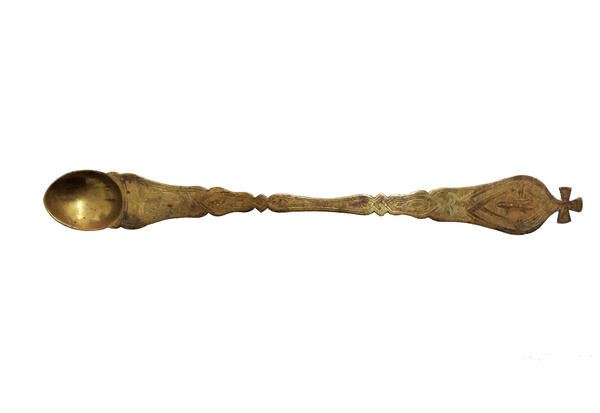
The displayed artifact is a spoon of complex shape. Its handle narrows to the middle and expands at the ends, visually forming two parts: the upper one, with which the priest holds the spoon during Communion, and the lower one, which ends as an oval bowl. The rounded upper end of the spoon is decorated with an engraved ornament along its entire length. It is crowned by a smooth four-pointed cross with wide crossbars.
The lower part of the handle smoothly transitions into the bowl. An eight-pointed cross is engraved in the center of it. The upper end of the cross points towards the bowl. There is no figure of the crucified Jesus on the cross, but it features the Instruments of the Passion: on both sides of the cross are a spear and a cane with a sponge. The inscriptions usually accompanying the cross are absent on this spoon. The reverse side is smooth.
The Eucharist, or Communion, is performed by a bishop or priest. Wine and bread are mixed in a special cup — chalice, which are transubstantiated into the body and blood of Jesus Christ. At the end of the liturgy, with the help of the spoon, the priest serves the parishioners wine from the chalice, combined with bread. Having received communion, the believer becomes spiritually closer to God. For Christians, the Eucharist is a way to connect with the Lord through the union with Christ.
The Museum Complex of Kuybyshev houses such a spoon made of copper alloy. According to a hypothesis, it was used in the Cathedral of Christ the Savior of Kainsk — former name of Kuybyshev until 1935 — to perform Communion.
For several decades, the Savior Cathedral was the center of spiritual and cultural life of the town of Kainsk. It was destroyed in 1939. Townspeople accidentally discovered and preserved this spoon as a relic. Many years after the destruction of the cathedral, the spoon was donated to the museum and is now on display.
This ritual spoon was produced in the late 19th century. Neither the master nor the place where it was made are unknown.
The displayed artifact is a spoon of complex shape. Its handle narrows to the middle and expands at the ends, visually forming two parts: the upper one, with which the priest holds the spoon during Communion, and the lower one, which ends as an oval bowl. The rounded upper end of the spoon is decorated with an engraved ornament along its entire length. It is crowned by a smooth four-pointed cross with wide crossbars.
The lower part of the handle smoothly transitions into the bowl. An eight-pointed cross is engraved in the center of it. The upper end of the cross points towards the bowl. There is no figure of the crucified Jesus on the cross, but it features the Instruments of the Passion: on both sides of the cross are a spear and a cane with a sponge. The inscriptions usually accompanying the cross are absent on this spoon. The reverse side is smooth.
The Eucharist, or Communion, is performed by a bishop or priest. Wine and bread are mixed in a special cup — chalice, which are transubstantiated into the body and blood of Jesus Christ. At the end of the liturgy, with the help of the spoon, the priest serves the parishioners wine from the chalice, combined with bread. Having received communion, the believer becomes spiritually closer to God. For Christians, the Eucharist is a way to connect with the Lord through the union with Christ.