

A commemoration book, also called “Pomyannik”, “Synodic” or “Diptych”, is a small book in which the names of the living and the deceased are written down. They are then read out during prayer at the liturgy. Many believers own such personal notebooks for recording the names of loved ones, following the example of the church diptych, which lists the leaders of autocephalous, that is, independent, churches.
Believers order prayer services for someone’s health or the memory of a deceased person, and write down their names on the pages of the commemoration book.
The “Commemoration Book” from the collection of the Kuybyshev Museum Complex was printed in 1904 in Moscow by the printing house of Ivan Dmitrievich Sytin, a notable publisher and educator. The tin binding of the book was stamped at the Bonacœur Factory.
It is unknown who owned the book, as the sheets with this information were cut out.
The commemoration book has two tin covers and a brown tin binding. To make it more rigid, thick cardboard is inserted into the covers from the inside. The covers feature color images of saints.
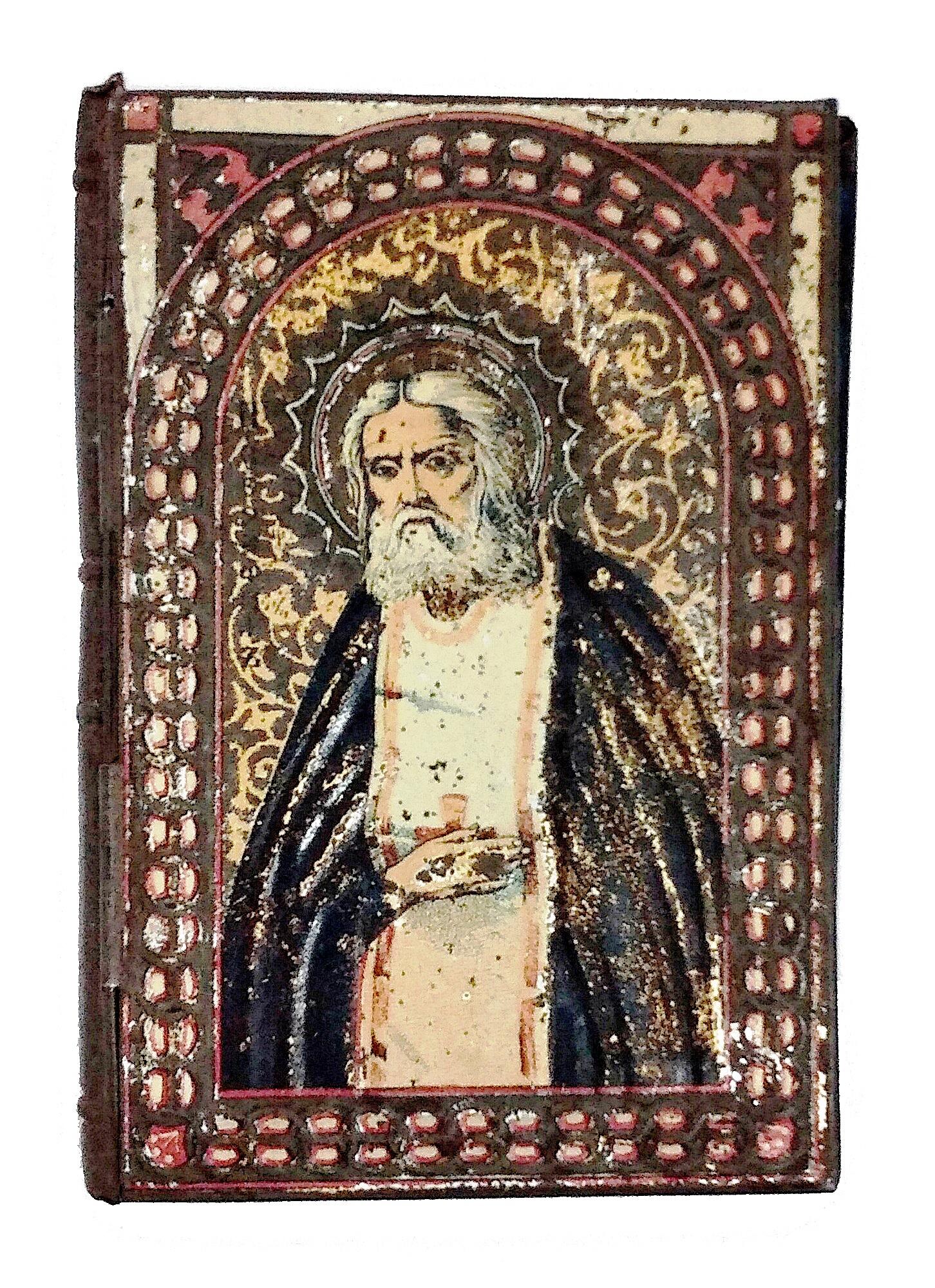
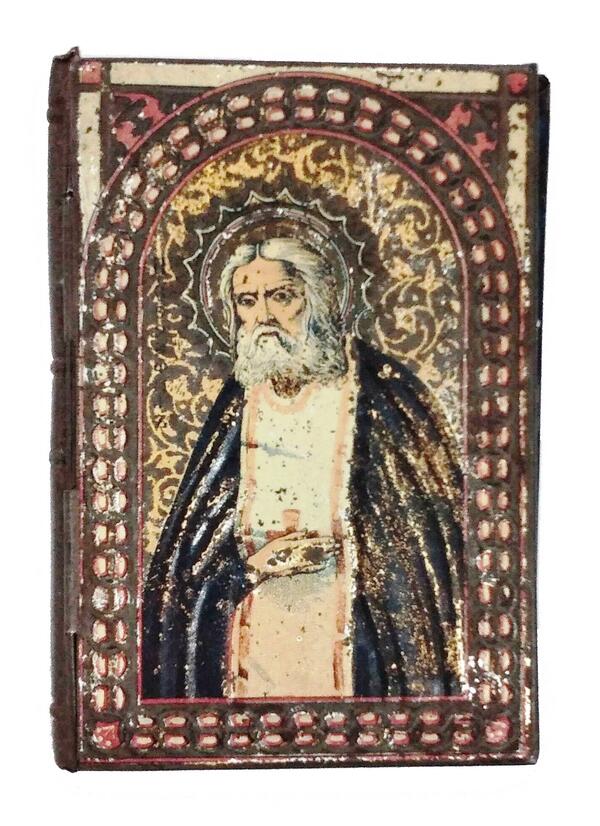
The top cover is decorated with a printed half-length image of Seraphim of Sarov. The venerable elder Seraphim was the hieromonk of the Sarov Monastery, the founder of the Trinity Diveyevo Convent, a revered ascetic and miracle worker.
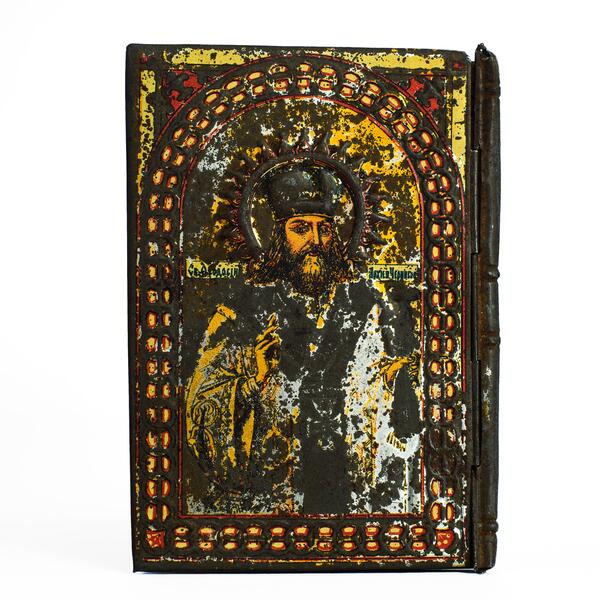
The reverse side of the book features a depiction of St. Theodosius of Uglich, Archbishop of Chernihiv. Theodosius is included in the list of those who adorn and glorify the Russian Church. He is known for his numerous prophecies. The process of reunification of the Kyiv and Moscow branches of the Russian Orthodox Church took place with his participation.
The covers are fastened to the tin spine with hinges. The pattern of the stamped tin spine imitates leather binding.
The pages of the book are typographically printed. The first page features its title. The sheets are decorated by a red frame with a geometric pattern, in the corners — an ornament resembling a lily.
The book contains only 32 pages. However, only two sections have been preserved: “For Health” and the text “The Days Established by the Holy Orthodox Church for the Commemoration of the Dead”.
The book is illustrated. Both red and black ink is used. The illustrations are printed in black.
Believers order prayer services for someone’s health or the memory of a deceased person, and write down their names on the pages of the commemoration book.
The “Commemoration Book” from the collection of the Kuybyshev Museum Complex was printed in 1904 in Moscow by the printing house of Ivan Dmitrievich Sytin, a notable publisher and educator. The tin binding of the book was stamped at the Bonacœur Factory.
It is unknown who owned the book, as the sheets with this information were cut out.
The commemoration book has two tin covers and a brown tin binding. To make it more rigid, thick cardboard is inserted into the covers from the inside. The covers feature color images of saints.
The top cover is decorated with a printed half-length image of Seraphim of Sarov. The venerable elder Seraphim was the hieromonk of the Sarov Monastery, the founder of the Trinity Diveyevo Convent, a revered ascetic and miracle worker.
The reverse side of the book features a depiction of St. Theodosius of Uglich, Archbishop of Chernihiv. Theodosius is included in the list of those who adorn and glorify the Russian Church. He is known for his numerous prophecies. The process of reunification of the Kyiv and Moscow branches of the Russian Orthodox Church took place with his participation.
The covers are fastened to the tin spine with hinges. The pattern of the stamped tin spine imitates leather binding.
The pages of the book are typographically printed. The first page features its title. The sheets are decorated by a red frame with a geometric pattern, in the corners — an ornament resembling a lily.
The book contains only 32 pages. However, only two sections have been preserved: “For Health” and the text “The Days Established by the Holy Orthodox Church for the Commemoration of the Dead”.
The book is illustrated. Both red and black ink is used. The illustrations are printed in black.