Skiing is one of the oldest means of transportation in Western Siberia, which has long helped to overcome considerable distances in the snow-covered taiga. The researchers of the Khanty way of life and culture Vladislav Mikhailovich Kulemzin and Nadezhda Vasilyevna Lukina quote the words of the Khanty who are not used to swimming,


Podvoloki skis
Creation period
the 20th century
Place of сreation
Russia
Dimensions
169x18x6,5 cm
Technique
wood, deer kamus, aluminum, leather; wood carving
2
Open in app #3
#4
In winter we use skis, in summer — an oblas [boat]. When would one swim?
#5
From the age of six or seven, boys were taught how to ski and how to make their own skis. The Khanty never used someone else’s skis or sleds. Both skis and sleds had to match the height and strength of the owner — mainly the hunter — and his dog. Not only the success of his fishing trip, but sometimes the life of the fisherman itself directly depended on the quality and convenience of his equipment. In addition, the width of the skis and sleds had to match so that the latter would not leave their own tracks.
Golitsy skis were used for crossing crust and unreliable spring ice; for winter hunting, both men and women needed podvoloki skis lined with kamus. The wooden base of these skis with a thickness of one and a half to three millimeters was made of pine, cedar, spruce or aspen. Tanned deer or elk kamus (dense skin from the lower leg of an animal) was glued to the bottom of the skis. In the past, otter fur was used instead of kamus.
Glue was made from fish scales (“even better — from winter carp”), bones, elk horns and deer skin without pile.
In the middle part, the skis were curved. The finished product had to taper towards the front and sometimes ended with a bulge.
The skis were secured to the feet with a double strap made of bird cherry and a leather loop attached to them. To protect the shoes from getting wet, a bag made of light fabric was nailed around the strap. In the olden days, a special heel was made on skis, a “stepping pad”, thanks to which the foot remained elevated above the snow, and the stuck snow was knocked off the shoes with a special bone hook.
The pile was put in such a way as to facilitate sliding forward and prevent sliding backward when climbing in hilly terrain. Damp snow did not stick to the skis, and they slid easily and silently. Sometimes, a spruce staff with a ring at one end and a shovel for snow at the other was used instead of a pole.
With proper maintenance and careful storage, podvoloki skis could last for more than twenty years.
#7
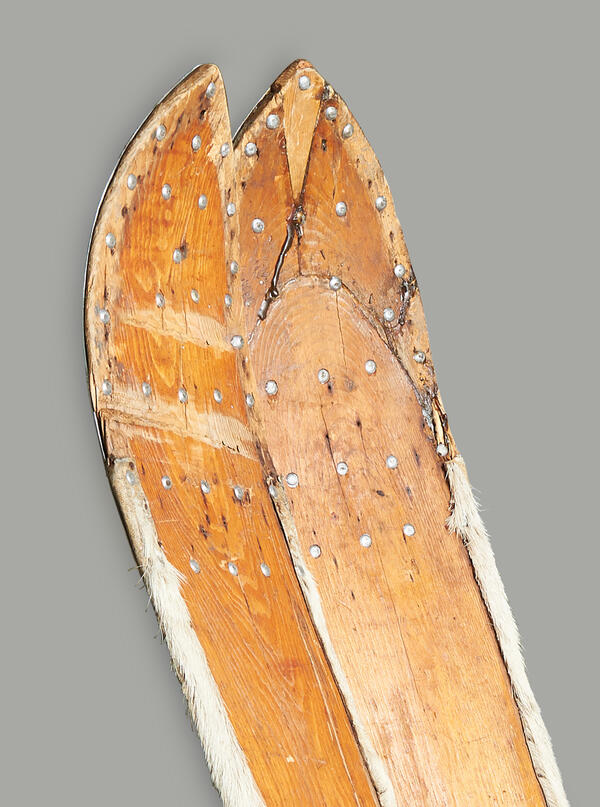
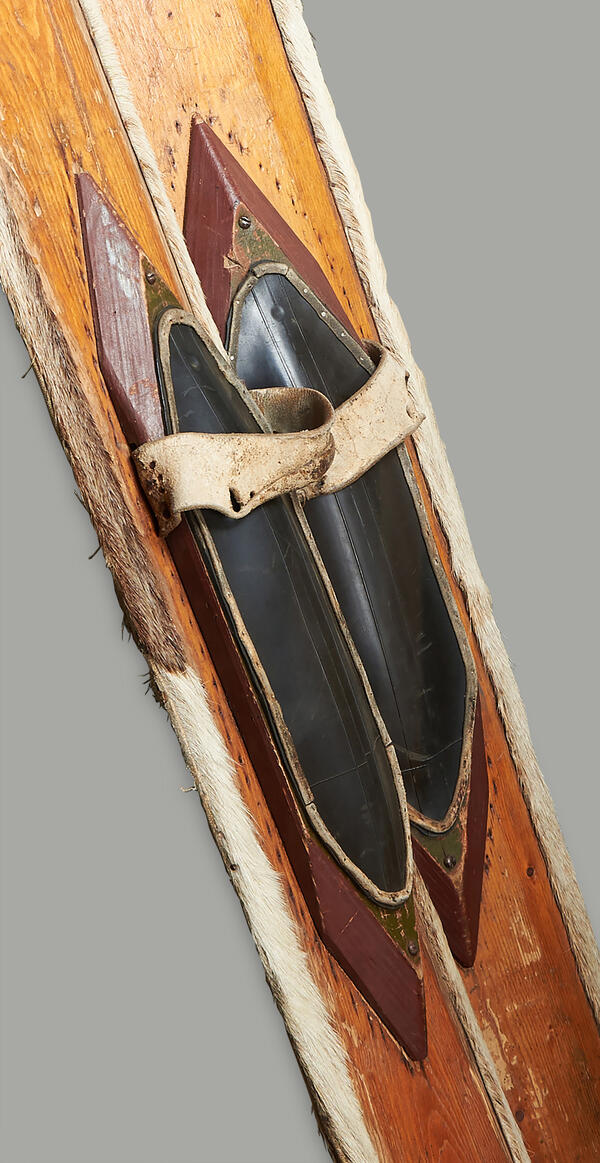
Podvoloki skis
#6
Ministry of Culture of the Russian Federation
read morehide
00:00
00:00
1x
Podvoloki skis
Creation period
the 20th century
Place of сreation
Russia
Dimensions
169x18x6,5 cm
Technique
wood, deer kamus, aluminum, leather; wood carving
2
 Point your smartphone camera to open in the app
Open in app
Share