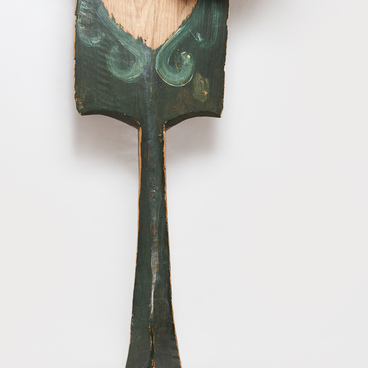
In the olden days, a roller and a rubel were used for pressing and ironing clothes. The roller was a kind of rolling pin, and the rubel was a wooden board with carved cross grooves or ribs.
The washed and wrung out, but still damp linen was wound onto the roller, trying not to go beyond its edges, and rolled with force several times along the ribbed side of the rubel. Such work required considerable physical effort from the ironer, but in the end the fabric became not only soft and smooth, but also perfectly clean: the remaining dirt, along with the water was removed (the expression “if not by washing, then by rolling” refers to this particular household chore, it means “to achieve one’s goal in one way or another”).
Since the rubel had to withstand a heavy load, it was made from a single piece of solid wood (oak, birch, maple, beech, and mountain ash), by hand or using a machine. The sharp edges were rounded off with a file so that the tool would not damage the laundry.
Then parallel lines were drawn on the lower side of the board with an interval of 15 millimeters and hollows of about 7 millimeters deep were cut through them. Excess wood was removed from the edges with a chisel in the direction of the cut and rounded rollers were formed. The edges were smoothed out. The smooth, non-working side of the rubel was often decorated with intricate carvings.
The decor and shape of the rubels vary depending on the region. In the Vladimir Governorate, they were made very long and decorated with geometric patterns. In the Yaroslavl Governorate, rubels featured three-dimensional figures that protruded above the carved surface and could be used as an additional handle.
The rubel is also known as a musical instrument. The musical rubel was made somewhat differently: it was shorter, completely hollow, and the sound hole cavity was cut out in one of the sides. The ribs were made sharper, as they were not intended for squeezing water. The performer ran a spoon or a wooden stick over the ribs, making a crackling sound.
The musical rubel has not lost its significance: it is still used by ensembles of folk instruments.