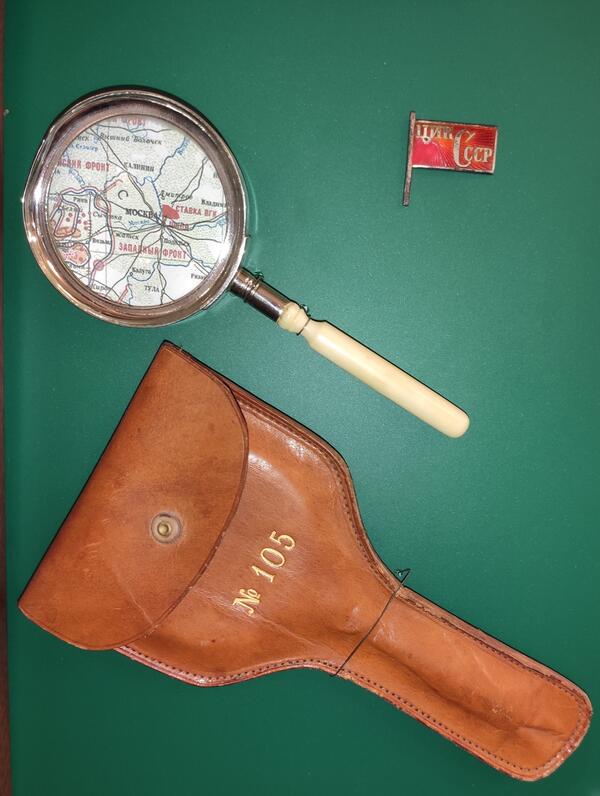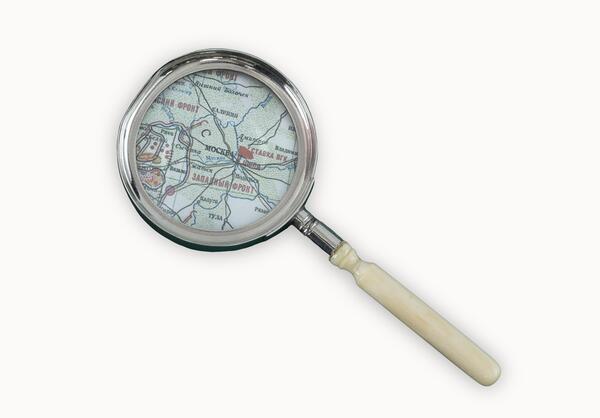
This round magnifying glass is enclosed in a nickel-plated metal frame. It has a white bone handle. The magnifying glass is supplied in a leather case, there is a gold stamping “№105” on the flap. It belonged to Marshal of the Soviet Union and a Zlatoust native Boris Mikhailovich Shaposhnikov.
Boris Shaposhnikov was born in Zlatoust in 1882. He was one of the major prewar military strategists of the USSR. Starting in 1901, he devoted almost his entire life to military service.
In 1903, Boris Shaposhnikov graduated from the Moscow Military School, and in 1910, he finished the General Staff Academy. He participated in the First World War and rose to the rank of colonel. In December 1917, he was elected the commander of the Caucasian Grenadier Division.
In May 1918, Shaposhnikov voluntarily joined the Red Army: he served in the operations department of the Supreme Military Council Headquarters, headed the intelligence department and the operations department of the Revolutionary War Council Field Headquarters, and was the first assistant headquarters commander of the People’s Commissariat for Military and Naval Affairs of Ukraine.
Boris Mikhailovich Shaposhnikov was among those who came up with the plans for the counteroffensive against Denikin’s troops (October 1919) and the 1920 campaign on the Southwestern and Western fronts in Crimea. From May 1937, he served as Chief of the General Staff, and in August 1940, he became the Deputy People’s Commissar of Defense of the USSR.
With the beginning of the Great Patriotic War, Shaposhnikov became the head of the General Staff once again; in May 1942, he was appointed as the Deputy People’s Commissar of Defense, and from 1943, he led the Voroshilov Higher Military Academy.
On March 26, 1945, Boris Shaposhnikov passed away, a month and a half before the Victory. The marshal was buried in Moscow, on Red Square near the Kremlin wall. He was awarded three Orders of Lenin, two Orders of the Red Banner, two Orders of the Red Star, the Order of Suvorov, 1st Class, and medals.
The “Vystrel” Higher Officer Training Courses, as well as streets in Moscow and Zlatoust were named after Shaposhnikov. The magnifying glass was donated to the museum by Marshal’s son, Lieutenant General, and Doctor of Military Sciences Igor Borisovich Shaposhnikov in 1982.
Boris Shaposhnikov was born in Zlatoust in 1882. He was one of the major prewar military strategists of the USSR. Starting in 1901, he devoted almost his entire life to military service.
In 1903, Boris Shaposhnikov graduated from the Moscow Military School, and in 1910, he finished the General Staff Academy. He participated in the First World War and rose to the rank of colonel. In December 1917, he was elected the commander of the Caucasian Grenadier Division.
In May 1918, Shaposhnikov voluntarily joined the Red Army: he served in the operations department of the Supreme Military Council Headquarters, headed the intelligence department and the operations department of the Revolutionary War Council Field Headquarters, and was the first assistant headquarters commander of the People’s Commissariat for Military and Naval Affairs of Ukraine.
Boris Mikhailovich Shaposhnikov was among those who came up with the plans for the counteroffensive against Denikin’s troops (October 1919) and the 1920 campaign on the Southwestern and Western fronts in Crimea. From May 1937, he served as Chief of the General Staff, and in August 1940, he became the Deputy People’s Commissar of Defense of the USSR.
With the beginning of the Great Patriotic War, Shaposhnikov became the head of the General Staff once again; in May 1942, he was appointed as the Deputy People’s Commissar of Defense, and from 1943, he led the Voroshilov Higher Military Academy.
On March 26, 1945, Boris Shaposhnikov passed away, a month and a half before the Victory. The marshal was buried in Moscow, on Red Square near the Kremlin wall. He was awarded three Orders of Lenin, two Orders of the Red Banner, two Orders of the Red Star, the Order of Suvorov, 1st Class, and medals.
The “Vystrel” Higher Officer Training Courses, as well as streets in Moscow and Zlatoust were named after Shaposhnikov. The magnifying glass was donated to the museum by Marshal’s son, Lieutenant General, and Doctor of Military Sciences Igor Borisovich Shaposhnikov in 1982.