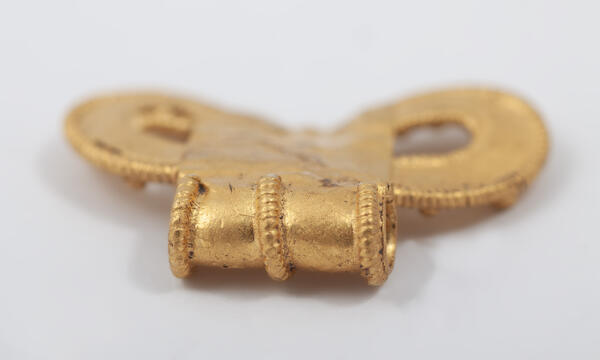
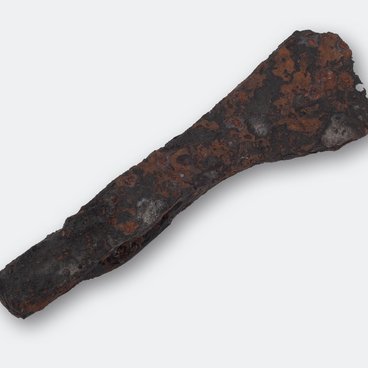
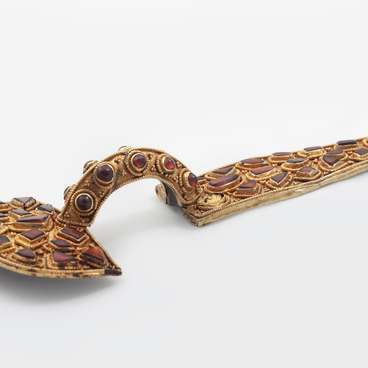
The decoration was found near the village of Zabolotye in the Kursky district of the Kursk region in 2019, during the surveys conducted by the Seym-Sudzha Expedition of the Institute of Archaeology of the Russian Academy of Sciences, led by Oleg Alexandrovich Radyush. In the same year, it was transferred to the collections of the Kursk Museum of Archaeology. This piece of jewelry, a lunula, was made of gold and weighs 1.85 grams. The lunula is a flat gold pendant with a wide loop, formed from a flat rectangular plate, the lower edge of which is soldered to the back of the horns and forms the central part of the piece.
The front side of the lunula is adorned with granules scattered randomly across the surface and features a central longitudinal decorative embossed ridge that mirrors the shape of the entire decoration. The edges of the lunula are bordered with filigree — a ribbed embossed wire, which also marks the center of the loop. The lunula is dated to the late 4th — early 5th century and belongs to the Chernyakhov archaeological culture. Its bearers were Germanic tribes — the Goths — who inhabited the territory from the Lower Danube in the west to the Seversky Donets in the east during the 2nd–4th centuries. In the late Roman and Migration periods, the Gothic costume was a complex symbolic system, including headdress, clothing, shoes, jewelry, accessories, equipment, hairstyles, and tattoos. Lunulas were an essential attribute of women’s attire.