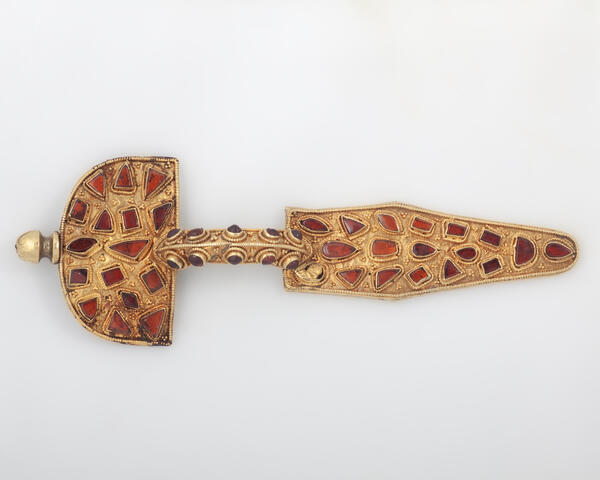
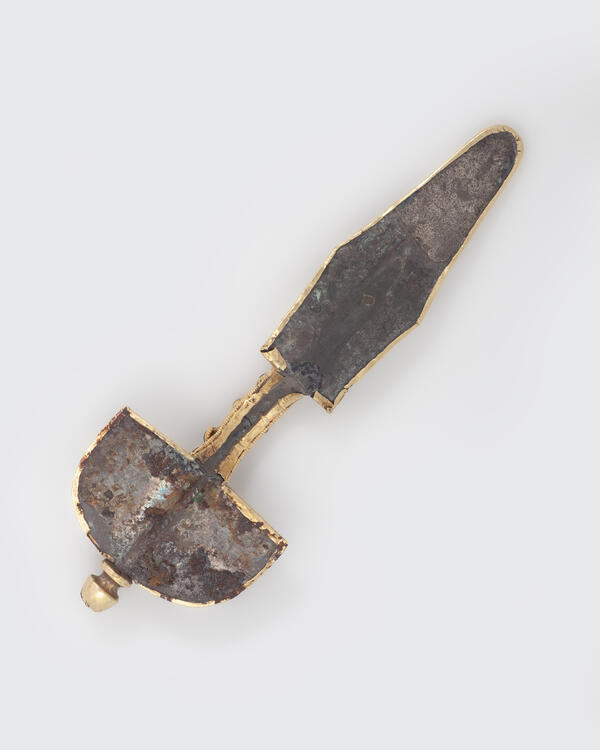
This fibula was accidentally discovered by a resident of the village of Konevo. During surveys in the Kursk region, the Seym-Sudzha Expedition of the Institute of Archaeology of the Russian Academy of Sciences, led by Oleg Alexandrovich Radyush, transferred the decoration to the collections of the Kursk Museum of Archaeology. The decorative clasp has an elongated rhomboid shape, a rounded head at the top, an arched bow, and a semicircular shield. The head and shield are flat, while the bow is triangular in cross-section. The base of the item is cast in silver and covered with gold foil, the edges of which are folded onto the reverse side of the decoration.
The front side of the fibula is decorated with flat
garnet inserts of various shapes, and the bow is decorated with round
cabochons; in total, there are 44 inserts — 43 with garnets, and one empty
setting. The bezels for the stones are made of a narrow, edge-soldered gold
strip with closed ends. The fibula and bezels are bordered with granulation,
with a line of granules marking the ridge of the bow, and rosettes of three
granules scattered across the entire field of the item between the inserts. The
shield is topped with a hemispherical button on a stem with a flat round base.
The button is covered with yellow metal foil, and the top of the button is
open.