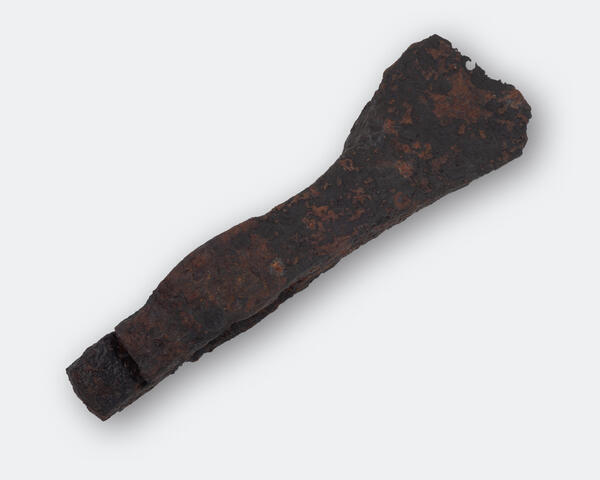
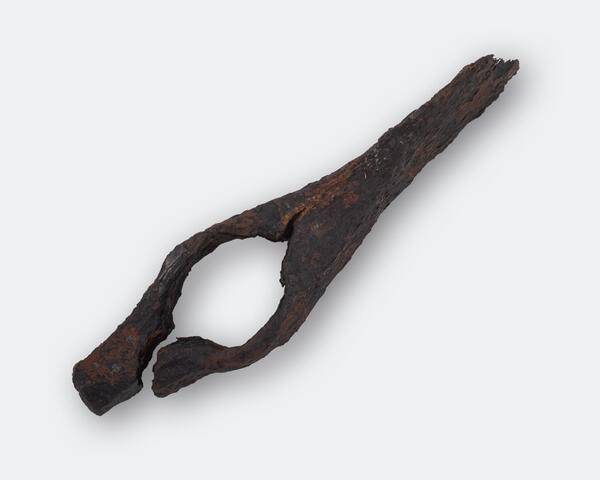
The battle ax with a pronounced butt was discovered in the Kurchatovsky District of the Kursk Region near the village of Razdolye during the surveys conducted by the Middle Seym Expedition of the Institute of Archaeology of the Russian Academy of Sciences in 2008–2009. The study was led by Oleg Alexandrovich Radyush. The find was transferred to the collections of the Kursk Museum of Archaeology in 2010. The artifact is dated to the early 5th century.
The manufacturing process of such items differed from modern production methods. The iron strip used as a blank for the ax was carburized on one side. After thorough forging, the blank was bent in half on a mandrel so that the steel end protruded as the blade. The two strips were then welded together, forming the eye socket and blade. A smooth transition from the socket to the blade was achieved by inserting an iron wedge between the metal strips during welding. After hammering out the blade and giving the item its final shape, the blacksmith finished the work by refining the exterior of the ax and sharpening the blade.
To date, about three dozen Chernyakhov axes are known. These axes were made from well-forged steel with a low carbon content, and the quality of the blacksmith’s work was high. Their sizes ranged from 7.5 to 18 centimeters. Almost all of them are of the same type — featuring a straight upper edge and an asymmetrical, widened blade. In the literature, such axes are known as “companions.”