Numerous WW2 veterans in Russia recalled that, apart from their weapons, all soldiers appreciated three things — an entrenching shovel, a spoon, and a mess tin. In his book ‘Not Mentioned in Reports… Life and Death of a Soldier in the Great Patriotic War of 1941–1945’, Russian writer, journalist, and historian Sergey Mikheyenkov reflected the words of one of the soldiers,


Spoon
Creation period
1942
Place of сreation
Kotovsk, Tambov Oblast
Dimensions
18,5x6 cm
Technique
stamping
Collection
Exhibition
1
Open in app#4
Spoon
#6
#8
A shovel, a spoon, and a mess tin. I have never seen in all that time — and I came as far as Berlin! — that a soldier abandoned either his shovel, spoon, or mess tin. They could leave everything behind, but those things — never.
#7
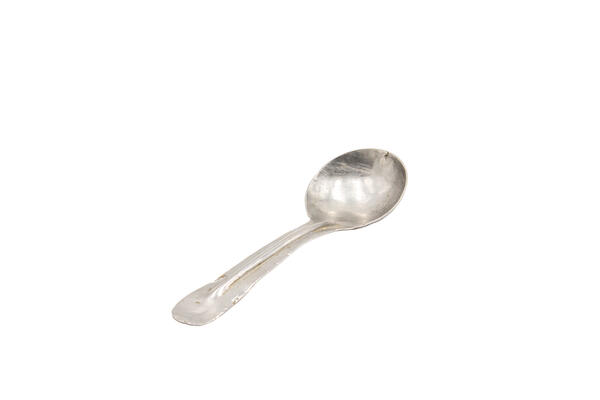
The museum houses a spoon from the Great Patriotic War period that a soldier from Kotovsk Nikolay Serebryakov received as he was leaving Plant No. 204 (nowadays known as the Tambov Gunpowder Factory) to go to the front. The spoon was donated to the museum by his wife Yuliya Serebryakova.
Spoons, that were usually distributed among recruits along with mess tins, were made from aluminum and were plain. To add a personal touch to the spoons, the soldiers made engravings on them, as well as used needles to scratch or emboss military mottoes, such as ‘Death to fascism! ’
Spoons, that were usually distributed among recruits along with mess tins, were made from aluminum and were plain. To add a personal touch to the spoons, the soldiers made engravings on them, as well as used needles to scratch or emboss military mottoes, such as ‘Death to fascism! ’
Whenever there was a halt, a spoon was put in a mess tin, so that it could not be lost and there was more free space in a rucksack. However, during marching and combat activity, spoons could treacherously clink against tins and give out the location to the enemy. To avoid this, experienced soldiers hid spoons in bootlegs or tuck them into their belts. This way, spoons were always within easy reach, but at the same time did not distract soldiers or produce any unnecessary sound.
The Red Army did not issue metal dog tags to its troops, common in the Wehrmacht or the Allies troops. Instead, soldiers were given small black Bakelite cylinders containing a slip of paper with a soldier’s particulars written on it. However, it was considered bad luck to fill the tags out. That is why soldiers embossed their personal information on spoons, which became dog tags of their own. It was that tradition that allowed to identify most of the fallen soldiers, as well as gain information as to what happened to their units. From 1942 to 1944, such spoons were produced at the Tambov Gunpowder Factory for four evacuation hospitals located in Kotovsk.
The Red Army did not issue metal dog tags to its troops, common in the Wehrmacht or the Allies troops. Instead, soldiers were given small black Bakelite cylinders containing a slip of paper with a soldier’s particulars written on it. However, it was considered bad luck to fill the tags out. That is why soldiers embossed their personal information on spoons, which became dog tags of their own. It was that tradition that allowed to identify most of the fallen soldiers, as well as gain information as to what happened to their units. From 1942 to 1944, such spoons were produced at the Tambov Gunpowder Factory for four evacuation hospitals located in Kotovsk.
#5
Ministry of Culture of the Russian Federation
read morehide
00:00
00:00
1x
Spoon
Creation period
1942
Place of сreation
Kotovsk, Tambov Oblast
Dimensions
18,5x6 cm
Technique
stamping
Collection
Exhibition
1
 Point your smartphone camera to open in the app
Open in app
Share