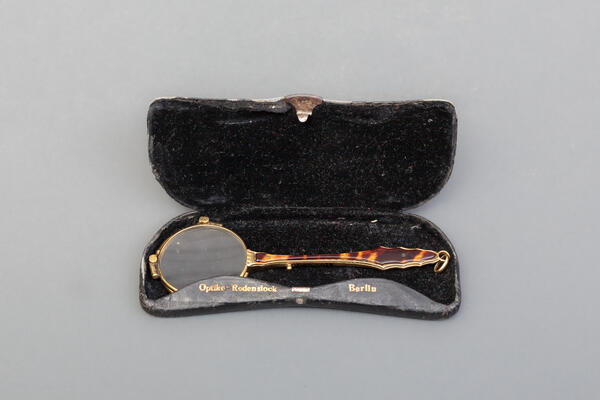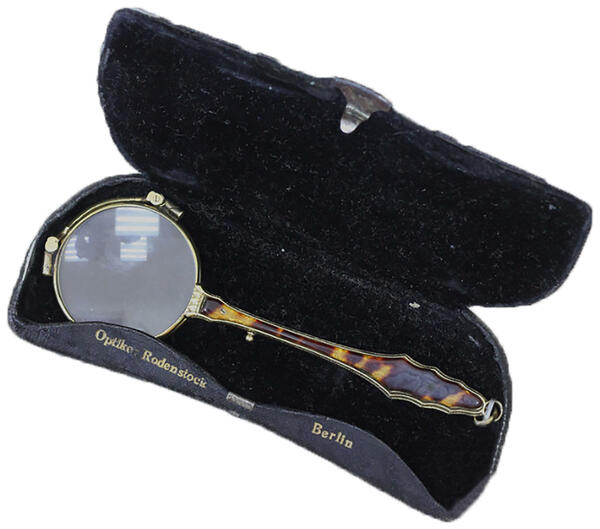
In the late 18th — early 19th centuries, the lorgnette was very popular in Russia. It was a pair of folding spectacles with lenses held before the eyes by a handle. The term “lorgnette” came from the French language and was coined in Russian as “lornetka”.
The first models of lorgnettes had metal circular rims for the lenses connected by a semicircular bridge, with a hinged handle attached to the rim. Later, a folding design developed: the lenses were hidden in a slit inside the handle.
The most widely accepted version suggests that they were invented in 1780 by the English optical scientist George Adams as an elegant version of spectacles for the aristocracy. Poor eyesight was a common problem among the nobility, who read a lot in dim light, but the use of spectacles was considered almost a mauvais ton. The lorgnette, however, with its obvious practical function was seen as a fashion accessory and, unlike spectacles, was displayed rather than hidden. Men usually wore a lorgnette on a waistcoat chain or in their pockets, while ladies attached it to their necklaces, belts or bracelets. These items were indispensable when visiting theaters, and were needed during intermissions no less than during performances. A socialite could not let himself, even due to poor eyesight, fail to notice or recognize a dignitary.
The use of the fashionable accessory gave rise to a salon custom called “lornering” (from the French “lorgner” meaning “to squint, to steal glances”). This is how a direct look through a lorgnette was called. Whereas previously, women of the world looked at a potential suitor from behind a fan, now they were staring at him through a lorgnette to show their affection.
The handle was the main decorative element of the lorgnette. It was inlaid with carved ivory, precious metals, stones and mother-of-pearl and sometimes decorated with monograms. The lorgnette handles were made by the Fabergé firm.
The cases were also an item to be admired. Men’s lorgnette cases were usually made of metal covered with leather, while women’s ones were made of fabric with beaded embroidery. The lorgnette remained popular until the early 20th century.
The first models of lorgnettes had metal circular rims for the lenses connected by a semicircular bridge, with a hinged handle attached to the rim. Later, a folding design developed: the lenses were hidden in a slit inside the handle.
The most widely accepted version suggests that they were invented in 1780 by the English optical scientist George Adams as an elegant version of spectacles for the aristocracy. Poor eyesight was a common problem among the nobility, who read a lot in dim light, but the use of spectacles was considered almost a mauvais ton. The lorgnette, however, with its obvious practical function was seen as a fashion accessory and, unlike spectacles, was displayed rather than hidden. Men usually wore a lorgnette on a waistcoat chain or in their pockets, while ladies attached it to their necklaces, belts or bracelets. These items were indispensable when visiting theaters, and were needed during intermissions no less than during performances. A socialite could not let himself, even due to poor eyesight, fail to notice or recognize a dignitary.
The use of the fashionable accessory gave rise to a salon custom called “lornering” (from the French “lorgner” meaning “to squint, to steal glances”). This is how a direct look through a lorgnette was called. Whereas previously, women of the world looked at a potential suitor from behind a fan, now they were staring at him through a lorgnette to show their affection.
The handle was the main decorative element of the lorgnette. It was inlaid with carved ivory, precious metals, stones and mother-of-pearl and sometimes decorated with monograms. The lorgnette handles were made by the Fabergé firm.
The cases were also an item to be admired. Men’s lorgnette cases were usually made of metal covered with leather, while women’s ones were made of fabric with beaded embroidery. The lorgnette remained popular until the early 20th century.