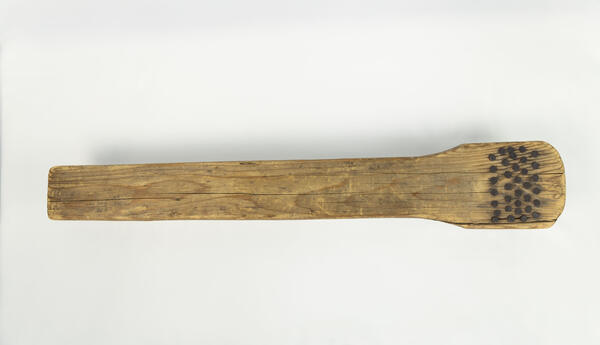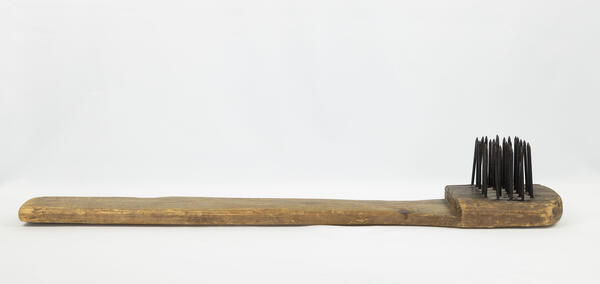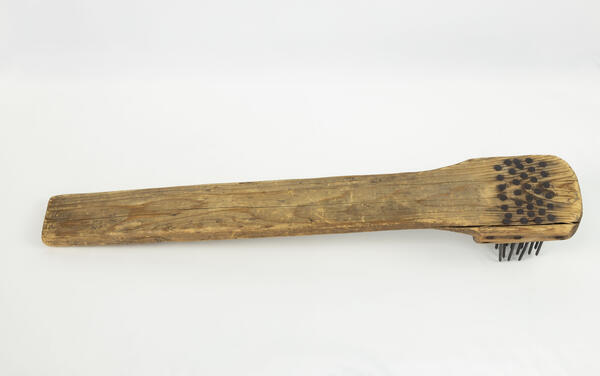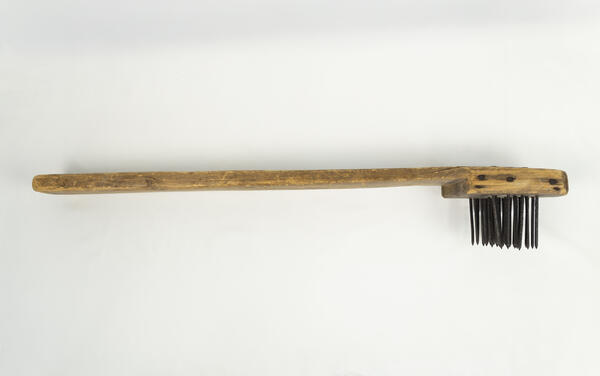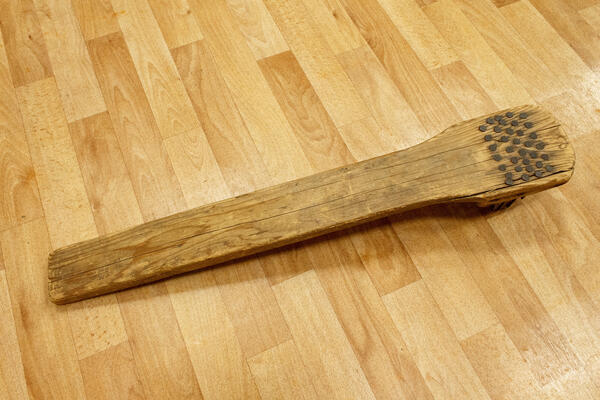
A hetchel, or a heckling comb, is a tool for dressing flax. It was used to split and clean the flax fibers and remove the fibrous core — the woody part of the stem. The Glazov Museum of Local Lore presents a hetchel, which was in use in the Vyatka Governorate in the 19th century.
Flax was harvested in the field by hand, then gathered in small bundles and left to dry. Sometimes flax was “spread out on the ground under the autumn rain” to let the coarse woody parts of the stem ret. The craftswomen beat the bundles to remove the seeds, from which they made oil, and crushed the stems of dry flax on a special wooden flax brake. Then they used a scutching knife — a wooden tool with which flax fibers were beaten. This process produced a lot of dust, and dirt was everywhere, so they chose a stable or an uninhabited hut to do it in, and to cheer each other up, the women gathered together and sang songs.
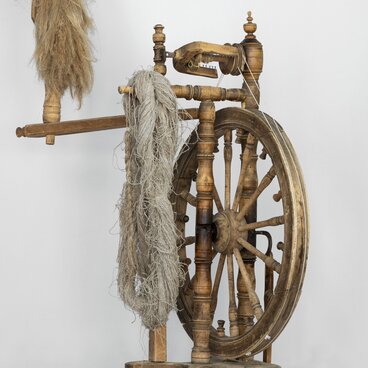
Only after the scutching, the women began to comb out the flax with the help of a hetchel. This process was also called “weeping” because of the monotonous work and routine movements. The longer and more carefully this work was done, the softer and better the fabric would be. To make coarse linen, they combed the fibers out quickly, and to make soft elegant shirts — for a long time. The finished sliver was attached to the distaff of a spinning wheel. Women would spin threads and weave fabrics all winter until Maslenitsa (an Eastern Slavic religious and folk holiday, celebrating the end of winter).
Flax has been known on the territory of Russia for 4,000 years. This is an annual plant with beautiful sky-blue flowers. Flax produces small seeds containing a lot of fatty and healthy oils. Flax stems contain a long and even fiber, which gives a dense and strong yarn.
Flax began to be cultivated for fiber and oil in Russia in the 10th century — it is mentioned in the annals. In the 18th century, flax crops covered almost the entire territory of the country, and soon the yarn and seeds became one of Russia’ main exports. The regions of the northern and central belt of Russia, including the territory of present-day Udmurtia, were ideal for growing flax. Flax grown in the Vyatka Governorate was famous throughout the country and beyond. Every year, 10 million meters of linen canvas were exported. The locals used to say and still say it today — “Udmurt flax is for all times”.
Flax was harvested in the field by hand, then gathered in small bundles and left to dry. Sometimes flax was “spread out on the ground under the autumn rain” to let the coarse woody parts of the stem ret. The craftswomen beat the bundles to remove the seeds, from which they made oil, and crushed the stems of dry flax on a special wooden flax brake. Then they used a scutching knife — a wooden tool with which flax fibers were beaten. This process produced a lot of dust, and dirt was everywhere, so they chose a stable or an uninhabited hut to do it in, and to cheer each other up, the women gathered together and sang songs.
Only after the scutching, the women began to comb out the flax with the help of a hetchel. This process was also called “weeping” because of the monotonous work and routine movements. The longer and more carefully this work was done, the softer and better the fabric would be. To make coarse linen, they combed the fibers out quickly, and to make soft elegant shirts — for a long time. The finished sliver was attached to the distaff of a spinning wheel. Women would spin threads and weave fabrics all winter until Maslenitsa (an Eastern Slavic religious and folk holiday, celebrating the end of winter).
Flax has been known on the territory of Russia for 4,000 years. This is an annual plant with beautiful sky-blue flowers. Flax produces small seeds containing a lot of fatty and healthy oils. Flax stems contain a long and even fiber, which gives a dense and strong yarn.
Flax began to be cultivated for fiber and oil in Russia in the 10th century — it is mentioned in the annals. In the 18th century, flax crops covered almost the entire territory of the country, and soon the yarn and seeds became one of Russia’ main exports. The regions of the northern and central belt of Russia, including the territory of present-day Udmurtia, were ideal for growing flax. Flax grown in the Vyatka Governorate was famous throughout the country and beyond. Every year, 10 million meters of linen canvas were exported. The locals used to say and still say it today — “Udmurt flax is for all times”.