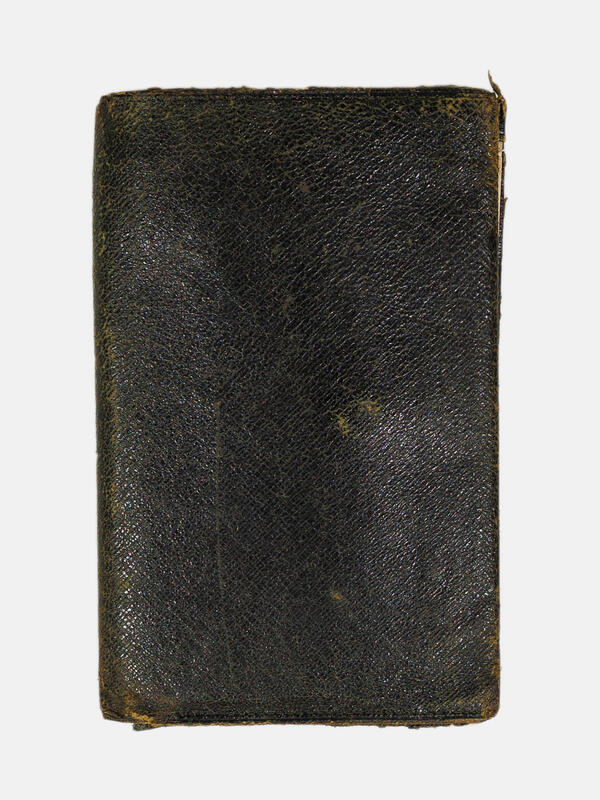
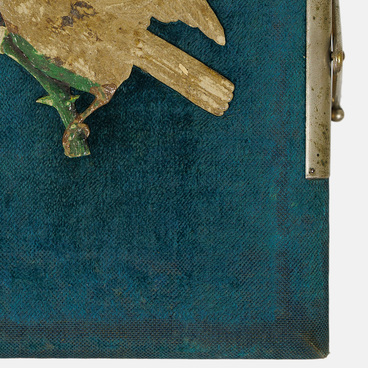
This daily planner from the museum’s collection was used by the Chekhov family in 1913. Its cover is made of black leatherette, and inside there is a compartment with a snap button and a pen holder. The notebook is dated according to the Julian calendar and uses the pre-revolutionary spelling rules.
After the Russian Revolution of 1917, the Bolsheviks decided to change to the Gregorian calendar by skipping 13 days. Since then, the dates of many historical events have been given according to both styles of dating — Old and New Style.
A spelling reform was also implemented in 1918. Four letters were excluded from the Russian alphabet, while the endings and some word forms were replaced. Two new letters — “ё” and “й” were introduced to represent the existing sounds in Russian. Nowadays, spelling is an easy way to determine whether a certain edition was printed in the Russian Empire or in the Soviet Union.
In Europe, the first notebooks appeared at the court of the French king Louis XIV. At social gatherings, guests discreetly exchanged small notes — for this purpose, craftsmen made custom notebooks with easy-to-tear sheets, which were sewn together.
In 1872, the first spiral notebook with perforated pages appeared. The American writer Mark Twain is credited with this invention. Mass production of notebooks began in the second half of the 19th century. The notebooks were bound on the left side or on top using springs, screws, rings, clamps, or glue. The cover was made of thick cardboard, leather, or cloth.
The first notebooks were often used by people of creative professions, including actors, writers, painters, and journalists. In such notebooks, they wrote down texts, sheet music, and rhymes, and made sketches and studies. Pablo Picasso, Jean-Paul Sartre, Ernest Hemingway, and Vincent van Gogh were fans of pocket notebooks.
Anton Chekhov always carried notebooks with him. He
used them for making diary entries, writing down notes for future short
stories, and recording curious anecdotes, names, and family names. Here are a
few examples, “A dachshund walked in the street and was ashamed of its crooked
legs”; “Perhaps the universe is suspended on the tooth of some monster”; “What
we experience when we are in love may be the normal condition after all. When
we fall in love, we see what we should really be like.”