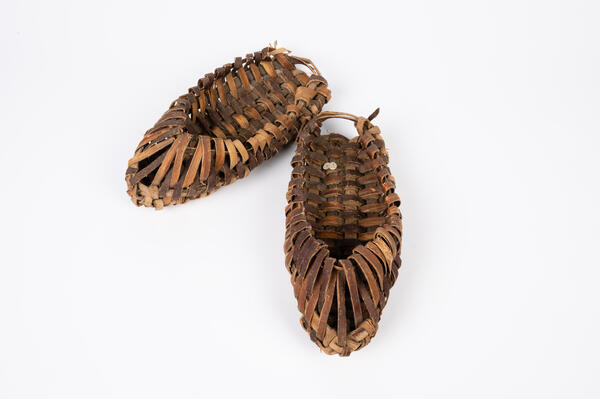
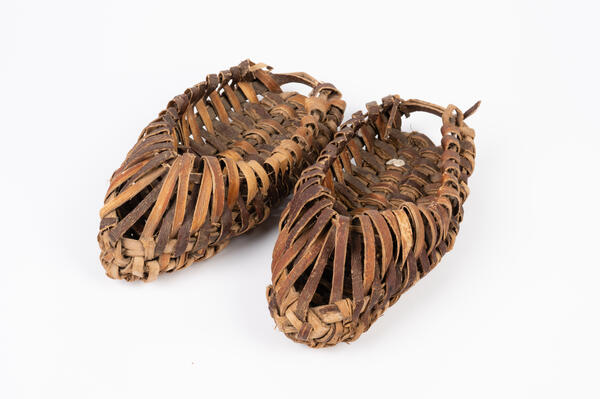
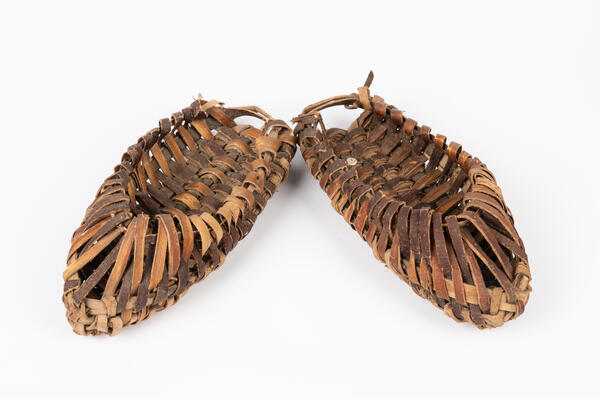
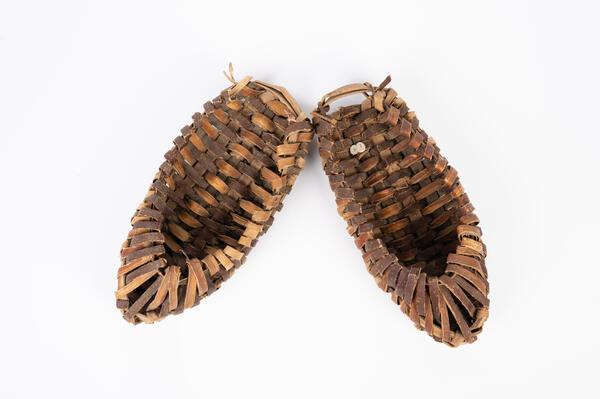
The Slavs have worn bast shoes since ancient times — always and everywhere: in winter and summer, on holidays and weekdays, when visiting friends and doing household chores. These shoes accompanied the peasant practically from cradle to grave. The memory of bast shoes lives on in proverbs, sayings, riddles, and jokes. In olden times, peasants who wore bast shoes were called lapotniki (from “lapti” meaning bast shoes) — a term first recorded in “The Tale of Bygone Years”.
To insulate and reinforce bast shoes, straw was placed inside, and the soles were edged with hemp rope — keeping feet warm and dry. Depending on the material, bast shoes had different names. Bast shoes were also classified by weaving technique into two main types: straight and diagonal.
The diagonal-weave bast shoes — known as “pokhlopni” — were far more elegant, featuring rounded, deep toes, high backs, and raised sides. They were stronger, more attractive, and reserved for special occasions, for example, fairs, church services, and holidays. The bast shoes from the collection of the Unecha Museum of Local Lore were made using the diagonal-weave technique.
In the Unecha region, straight-weave bast shoes were called “shcherbaki”. They were simple, lightweight, and shallow, lacking the distinctive toe and back found on more refined styles, and were woven from coarse bast. Instead of the usual “ears”, two bast loops were formed at the front, and along the sides ran delicate braids made from the thinnest bast strips. Straps used for fastening were attached to these strips. Shcherbaki were considered summer footwear, suited for fieldwork, gardening, and everyday household tasks.
The primary material for bast shoes was bast — most commonly from linden, but also from oak and elm. It was harvested with care to avoid damaging the tree. Although bast was regarded as a humble, inexpensive material, it gave rise to a well-known saying: “I am not made of bast!” — meaning, “I am no simpleton; I am clever and no worse than anyone else”.
To weave bast shoes, a craftsman needed only a few tools: a wooden last shaped like a foot, a special hook, and the bast itself. On average, a peasant wore through one pair of bast shoes per week. Consequently, many went barefoot in summer to save money. Because bast shoes were quite rigid, onuchi (traditional foot wraps) were always worn underneath, and crosswise strings were wrapped around the legs to keep the shoes securely in place.