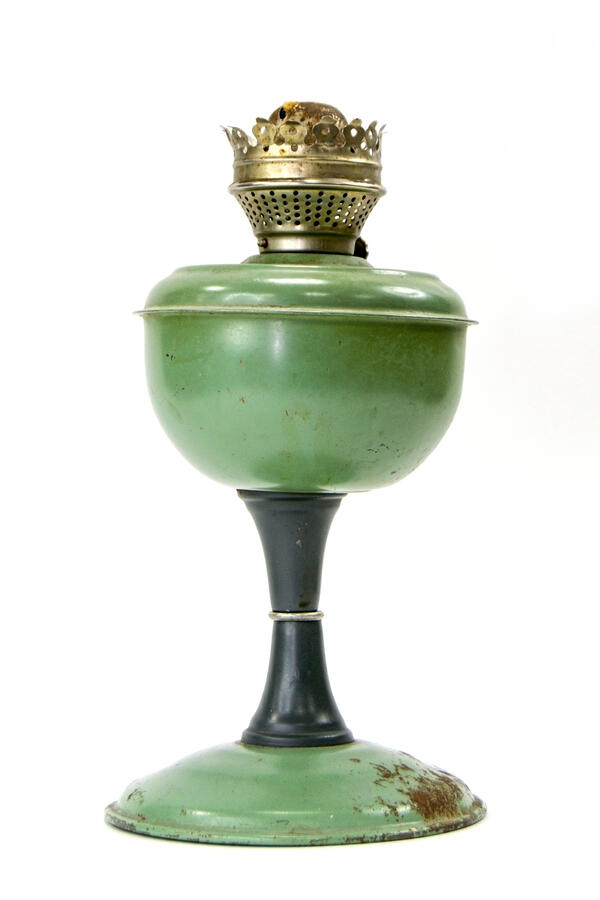
A kerosene lamp functioned by burning kerosene and was used in the 19th and early 20th centuries. Since the widespread introduction of electric lighting, kerosene lamps have mainly been used where there is no electricity, for example, as emergency appliances in case of a power outage and for camping trips.
The kerosene lamp was invented by the Polish scientist Ignacy Lukasiewicz in 1853. The design of a kerosene lamp is simple: kerosene was poured into a metal container, into which a wick was immersed. The other end was used to light the lamp. For some additional traction and protection from the wind, the wick was covered with a glass flask. Craftsmen successfully adapted porcelain and glass vases for kerosene lamps. The body of the vase concealed an oil font, a burner rose above a crown, and an additional metal structure supported a glass shade that softened the bright light that was unpleasant for the eyes. Glass ball shades with two holes played the same role.
In the 1890s, after the publication of “Fundamentals of the Theory of Lamp Combustion” by the engineer Aleksey Stepanov, kerosene lighting became famous with lightning speed. When the fame of the kerosene lamp spread throughout neighboring countries, the Austrians became keenly interested in this type of lighting. Without hesitation, they began to produce it domestically. The production process was taken over by the Vienna company R. DITMAR WIEN. This factory developed about 1,000 models of such lamps. Apart from Vienna, the warehouses of the company were also located in Trieste, Milan, Prague, Lyon, Krakow and even Bombay.
The collection includes six Soviet kerosene lamps, made in the 1920s–1930s at factories in the Vladimir region. One of them was made by A.I. Chernyshov, a craftsman at the Krasny Kust Plant (the former Bogoslovsky Plant). All the lamps are equipped with Russian-made burners with the inscriptions of the factories: “Metallamp Moscow”, “Metallistsamara”, “Metallamp Gospromtsvetmet”, “Metallamp 50.8”, and “ShMZ. MPS”.
This exhibit was donated to
the museum by Irina Gorskaya in 2001. The metal light green lamp consists of a
base, a stem, an oil font, and a burner. The round base is slightly elevated
toward the center, and a stem is attached to it, consisting of two gray truncated
cones with a metal crosspiece between them.