

A trough is a long open receptacle with rounded walls. It can be made of wood or zinc-plated metal. In the past, all troughs were made of wood: half of a split log was hollowed out from the center. Troughs were made from such types of wood as birch, linden, and aspen. There were always many troughs in each household because every man could make one for his family without the help of a craftsman. Troughs were always elongated, shallow, and rounded at the bottom. Sometimes, handles were carved on their ends.
In Russia, troughs were already used in the 10th century as evidenced by archaeological finds in Veliky Novgorod, Staraya Ladoga, and other places where wooden artifacts have been well preserved in the ground. A trough was used for various purposes just like any other receptacle: for harvesting apples and cabbage, pickling, doing laundry, bathing, cooling down beer and wort, kneading, and holding water and fodder for livestock and poultry. Turned upside down, a trough could serve as a large lid. It was an extremely versatile household object. In winter, it was sometimes even used by children for sliding downhill over snow. In the 19th century, metal troughs appeared but peasant households also continued to use wooden troughs.
The shape of troughs has remained almost unchanged throughout the centuries: a trough has always been a long and narrow container, unlike round basins and bowls with very similar purposes. The size of troughs varied in a wide range: the largest ones reached two meters in length and about 40–50 centimeters in width, while the smallest ones had a length of 30–40 cm and a width of 15–20 cm. The latter were sometimes used for cooking, cutting, and chopping small ingredients. In Russian peasant households, troughs were so ubiquitous that they came to symbolize everything commonplace, primitive, uninteresting, unsophisticated, and unworthy of attention.
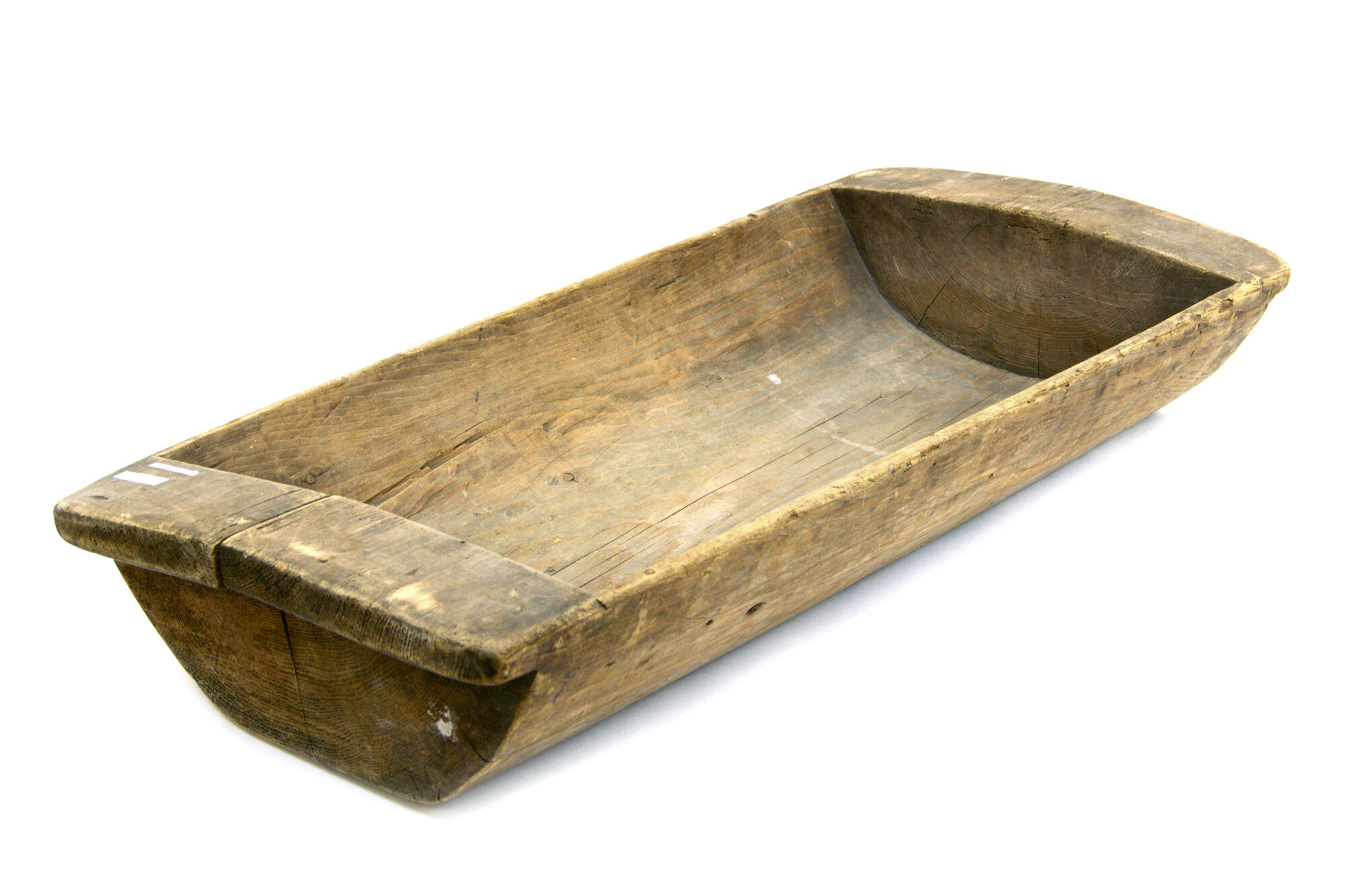
The displayed trough is made
of a thick log. It is shaped like a hollow cylinder half. There are handles at
the ends. This trough was intended for bathing and doing laundry.