Font
Color
Graphics
Изображение точки

To see AR mode in action:

1. Install ARTEFACT app for iOS or Android;

2. Find the exhibition «Rybinsk in the 19th and Early 20th Centuries»

3. Push the «Augmented reality» button and point your phone's camera at the exhibit;

Скрыть точки интересаПоказать точки интереса
Показать в высоком качестве

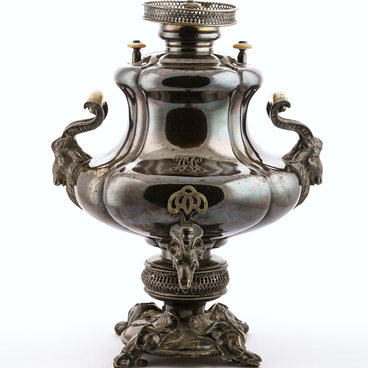
Table kerosene lamp

Creation period
the early 20th century
Place of сreation
Klyuchino, Vyshnevolotsky Uyezd, Tver Governorate, the Russian Empire
Dimensions
height — 68 cm, base diameter — 16.8 cm
Technique
metal, glass; painting with silicate paints, gilding, etching
1
Open in app
#2
A kerosene lamp uses kerosene as a fuel.


Until the middle of the 19th century, oil lamps that burned vegetable and animal fats were used for lighting purposes.


Kerosene lamps were brighter and eliminated the formation of deposits inside the lamp. Kerosene has a high fluidity and evaporation rate, which allowed for a simpler design of oil lamps.


The possibility of using kerosene for lighting was discovered in 1846 by the geologist Abraham Gesner from Nova Scotia. His invention helped save the whale population by providing an alternative to whale oil as a lighting fuel. Gesner founded the Kerosene Lighting Company in 1850, in Halifax, naming his invention “kerosene”.


The first kerosene lamps were produced in 1853. The Austrian pharmacists Ignacy Łukasiewicz and Jan Zeh began using kerosene in modified oil lamps.


Table kerosene lamps, made of glass and porcelain, became a part of the daily lives of wealthy individuals. Ordinary people used devices made from cast iron, iron, and other inexpensive materials.


Various works of literature from the 19th century mention the use of kerosene lamps. For instance, in Nikolai Eduardovich Heinze’s novel “The Hero of the End of the Century”, we find the following description,

#4

In a corner of the living room of the landlord’s house, at a round table with a tall antique lamp that probably once ran on oil and now uses kerosene, with a new huge crimson shade, sat Fanny Mikhailovna Savina; an eighteen-year-old girl sat opposite her.

#5

In his series of essays titled “The Peasant and Peasant Labor, ” Gleb Ivanovich Uspensky discusses the use of kerosene lamps in rural life. He writes,

#6

Ivan Ermolaevich is indeed a true peasant, do not worry, he would not trade a kerosene lantern for a splint, nor would he put his wife to work at a spinning wheel when there was money to purchase calico.

#7

In the 19th and early 20th centuries, kerosene lamps became increasingly popular. However, after the widespread adoption of electric lighting, they were primarily used in areas without electricity for emergencies, such as in the event of a power outage.

#3
View in the State Catalogue
read morehide
00:00
00:00
1x

Table kerosene lamp

Creation period
the early 20th century
Place of сreation
Klyuchino, Vyshnevolotsky Uyezd, Tver Governorate, the Russian Empire
Dimensions
height — 68 cm, base diameter — 16.8 cm
Technique
metal, glass; painting with silicate paints, gilding, etching
1
Point your smartphone camera to open in the app
Share
VkontakteOdnoklassnikiTelegram
Share on my website
Copy linkCopied
Copy
Open in app
To see AR mode in action:
  1. Install ARTEFACT app for 
  2. iOS or Android;
  3. Find and download the «Paintings in Details» exhibition
  4. Push the «Augmented reality» button and point your phone's camera at the painting;
  5. Watch what happens on your phone screen whilst you flip through the pictures.
 
We use Cookies
Cookies on the Artefact Website. We use cookies to ensure that we give you the best experience on our website. If you continue without changing your settings, we'll assume that you are happy to receive all cookies on the Artefact website. However, if you would like to, you can change your cookie settings at any time.
Learn more about useHide
Content is available only in Russian

X

Нашли опечатку?...

%title%%type%