After the Russian engineer Aleksey Stepanov published his study ‘The Fundamentals of Lamp Theory’ in 1890, kerosene lighting gained considerable popularity. Entrepreneurs began to manufacture various types of kerosene lamp burners in Russia, Europe, and the United States. Thanks to the simplicity of their design, low cost, and practicality, kerosene lamps became the main lighting tool and were used by almost all social strata. This was not hampered even by the fact that wealthy townspeople, merchants, and aristocrats could already power their homes with the latest scientific achievement, electricity.


Kerosene lamp
Creation period
Late 19th–early 20th century
Place of сreation
Warsaw
Dimensions
27x13,5 cm
Technique
Manufacturing
Collection
Exhibition
1
Open in app#3
Kerosene Lamp
#4
#6
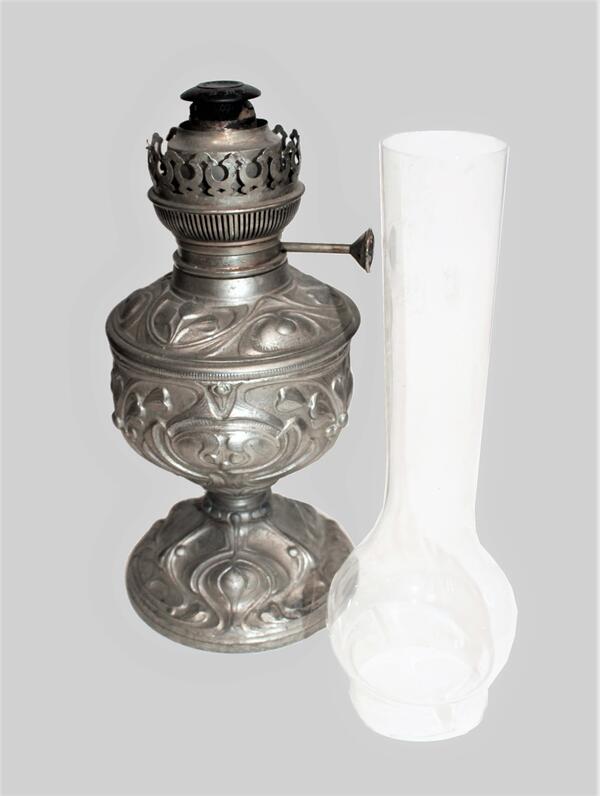
Kerosene lamps have a simple design: they give off light by burning kerosene. The fuel was filled into the tank so that the lamp’s wick, which was usually made of cotton, soaked in it and could be lit on fire. The length of the wick could be adjusted to control the lamp’s brightness. The wick required constant re-extension every time it burned out, which led to the introduction of a special lamp design fitted with a glass chimney. This created a division of labor in lamp production: metal burners were manufactured by specialized enterprises, while glass parts were made at glass factories. Typically, glass chimneys were bought not by end customers, but rather lamp factories themselves, which then pre-assembled the products before selling them in their own stores. The production process involved a large number of specialists: first, artists drew sketches of different models, and then factory workers cast the necessary parts and put them together.
#5
The ‘Merchant’s Drawing Room’ of our museum contains a lamp that was made by the Warsaw-based Brunner Brothers, G. Schneider & R. Ditmar joint-stock company, which operated lamp, burner, and metalworking factories. At the time, wealthy households used table and pendant lamps not only as light sources but also as interior decor. Their metal bases were commonly made of bronze and in some cases were even plated with gold or silver. The lamp from our collection is embossed with ornamentation in the form of complicated curvy patterns with floral motifs. Designs like these were common during the Art Nouveau period at the turn of the 20th century.
#7
Tomsk History Museum
read morehide
00:00
00:00
1x
Kerosene lamp
Creation period
Late 19th–early 20th century
Place of сreation
Warsaw
Dimensions
27x13,5 cm
Technique
Manufacturing
Collection
Exhibition
1
 Point your smartphone camera to open in the app
Open in app
Share