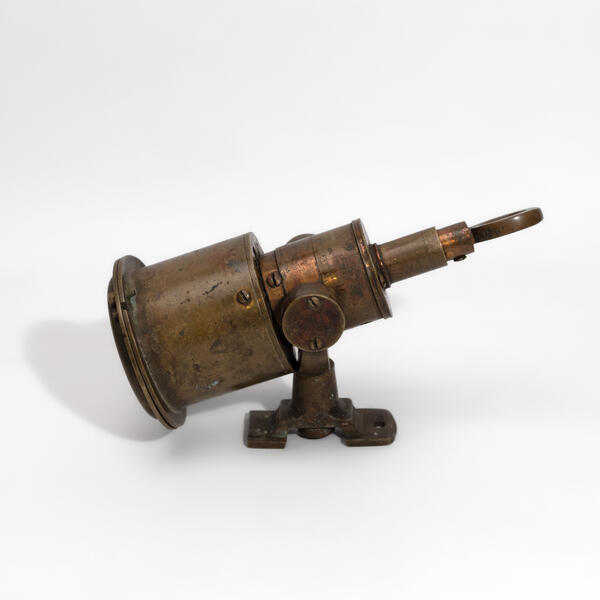
The mechanical log was used to measure the ship’s speed with reference to water. The log from the museum collection was manufactured in England in the first half of the 20th century. It features the inscription “Walker’s tent CHERUB” and the marking “1503 E”. The log was produced by Thomas Walker & Son, a company that was founded by Thomas Walker in Birmingham in the 1830s. The family business was continued by his son Thomas Ferdinand Walker.
Throughout history, manual, mechanical, and electromechanical logs have been used. The manual log, or chip log, consisted of a wooden board with a small lead weight. It was attached to a log-line, a thin rope made of special material. The log-line was divided into identical segments, with a knot tied in it every 120th part of a nautical mile, at a distance of slightly more than 15 meters.
To determine the ship’s speed, a sailor dropped the log overboard. The sailor let the log-line run out for half a minute while counting the knots that passed over. Since the distance between two knots was the 120th part of a mile and half a minute was the 120th part of an hour, the number of knots was equal to the ship’s speed in nautical miles per hour.
Nowadays, chip logs are used very rarely since they are difficult to handle in rough weather. Also, more advanced tools for measuring the ship’s speed have been developed, such as the mechanical log. This instrument consisted of a rotator that was dragged behind the ship on a log-line, and a counter that measured the number of revolutions made by the rotator per mile.
The information was transmitted to a recorder, which was usually located on the ship’s taffrail. There were two hands on the dial. One hand showed the number of miles, and the other hand showed tenths of a mile or cables.
Hydrodynamic and electromechanical logs operate based on either measuring the water pressure generated during the ship’s movement or measuring the speed of the log’s rotator, moved by the water flowing past it.
Over time, the side of the ship was named after the instrument in Russian. To
say that the ship stands across something, like a wave, sailors would say, “It
is logging to the wave,” or “We have cast off the moorings with the log side.”