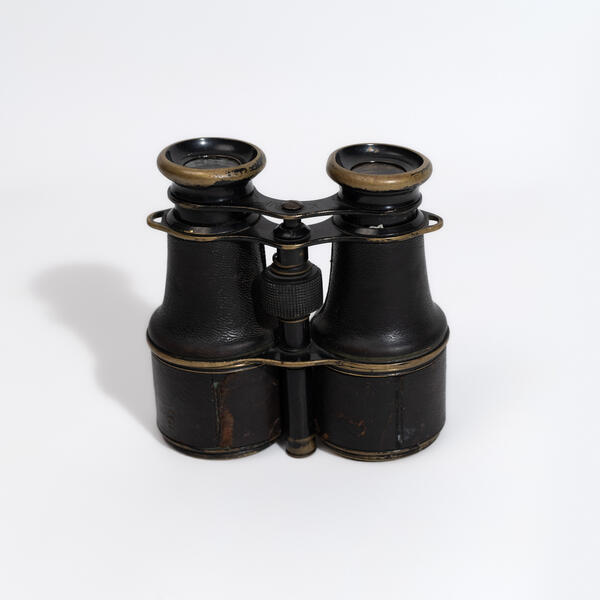
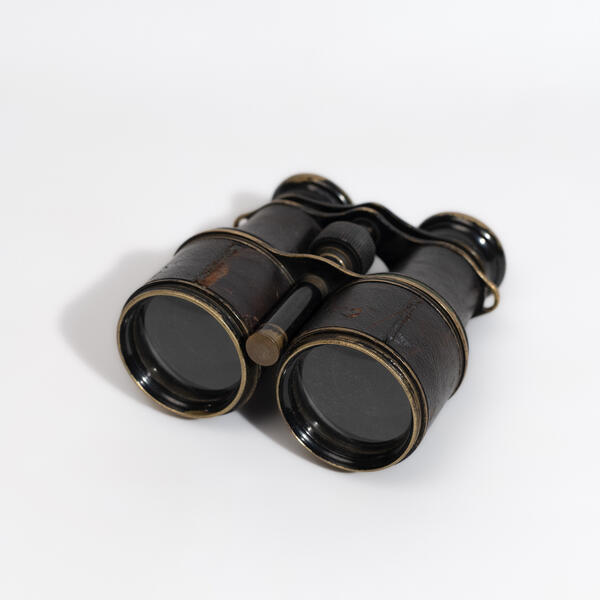
The brass binoculars from the museum collection are partly covered in black leather. Inscriptions with the letters “K” and “MF” have been preserved on the case. The binoculars were made in the United Kingdom in the second half of the 19th century. Similar devices were used by Onega sailors when navigating sailing ships and steamships in the White and Barents Seas. Copper and its alloys were chosen for their durability, as they did not rust, and it was important for sailors.
The optical design of the binoculars allowed users to observe objects at a distance, with the same perception of shape and size. This type of image is known as stereoscopic. Although the exact manufacturer of these binoculars is unknown, one of the major manufacturers in the UK during this time was Head Optician, founded by James Steward in 1852. In the 20th century, companies like Ross and Co., Barr and Stroud, and Wray (Optical Works) Ltd. also started producing binoculars.
In the 19th century, binoculars were some of the most high-margin products for optical device manufacturers. In the Russian Empire, binoculars were produced from components purchased abroad, including German and French lenses.
French, German, and Russian opticians independently designed a complicated system of prisms. These prisms helped to refract and reflect light, providing a sharp and clear image. By adjusting mirrors and prisms, various image parameters could be achieved. Thanks to this system, the image was mirrored back in such a way that it looked the same as it did without the device. This traditional design of binoculars has remained unchanged to this day.
In the 19th century, several prism systems were designed for binoculars. One of them was patented by the Italian engineer Ignazio Porro in 1854. The other one was developed by the German physicist Ernst Abbe who collaborated with Carl Zeiss, a German engineer and the founder of an optical systems manufacturer.