Font
Color
Graphics
Изображение точки

To see AR mode in action:

1. Install ARTEFACT app for iOS or Android;

2. Find the exhibition «The Kazan Fair»

3. Push the «Augmented reality» button and point your phone's camera at the exhibit;

Скрыть точки интересаПоказать точки интереса
Показать в высоком качестве

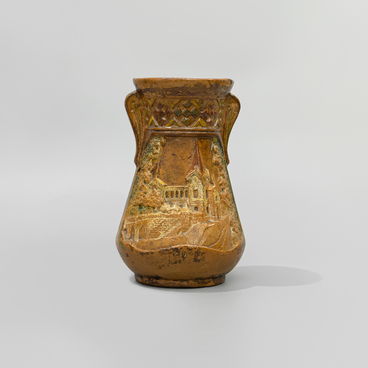
Korchaga

Creation period
the early 20th century
Place of сreation
the Russian Empire
Dimensions
28x25x28 cm
Technique
clay; modeling, firing
Exhibition
0
Open in app
#1
The korchaga was a large clay vessel. It had a wide variety of uses. It was used for heating water, making beer, kvass, and braga, as well as storing food and drinks such as grain and milk. It was also used for boiling laundry with lye. Later, cauldrons were made in the shape of korchagas.


According to historical records, in the 12th century, the korchaga served not only as a storage container but also as a unit of measure. One korchaga was equivalent to two buckets, which at that time did not have a standard size across Russia. The bucket varied in size from 12 to 15 liters in different regions. Therefore, it can be assumed that the korchaga held approximately 25 liters of liquid.


Craftsmen could give such vessels the shape of a pot or a jug with an elongated, almost cylindrical body. The korchaga often had a handle attached to the neck, as well as a shallow spout on the rim. Beer, kvass, and water were poured out of the korchaga through a hole in the body, which was located near the bottom and was closed with a stopper most of the time.


As a rule, the korchaga did not have a lid. When beer was brewed, it was covered with canvas smeared with dough. In the oven, the dough was baked into a dense crust that sealed the vessel. When boiling water or washing clothes, the korchaga was covered with a board after the fire in the oven had burned out for greater safety.


To prolong their life, korchagas could be wrapped with special ribbons made of birch bark. This protected the vessel’s walls. The korchaga from the Museum of Local Lore was produced in the early 20th century.
In his novel “Oblomov”, Ivan Aleksandrovich Goncharov mentioned this vessel. He wrote,

#2

On the floor there were barrels of butter, big covered jars [korchagas] of sour cream, baskets of eggs and all sorts of good things! Another Homer would be needed to describe in full detail all that had been accumulated in the corners and shelves of this small ark of domesticity. The kitchen was the true arena of Agafya Matveyevna’s and her worthy helper Anissya’s activity.

#3
read morehide
00:00
00:00
1x

Korchaga

Creation period
the early 20th century
Place of сreation
the Russian Empire
Dimensions
28x25x28 cm
Technique
clay; modeling, firing
Exhibition
0
Point your smartphone camera to open in the app
Share
VkontakteOdnoklassnikiTelegram
Share on my website
Copy linkCopied
Copy
Open in app
To see AR mode in action:
  1. Install ARTEFACT app for 
  2. iOS or Android;
  3. Find and download the «Paintings in Details» exhibition
  4. Push the «Augmented reality» button and point your phone's camera at the painting;
  5. Watch what happens on your phone screen whilst you flip through the pictures.
 
We use Cookies
Cookies on the Artefact Website. We use cookies to ensure that we give you the best experience on our website. If you continue without changing your settings, we'll assume that you are happy to receive all cookies on the Artefact website. However, if you would like to, you can change your cookie settings at any time.
Learn more about useHide
Content is available only in Russian

X

Нашли опечатку?...

%title%%type%