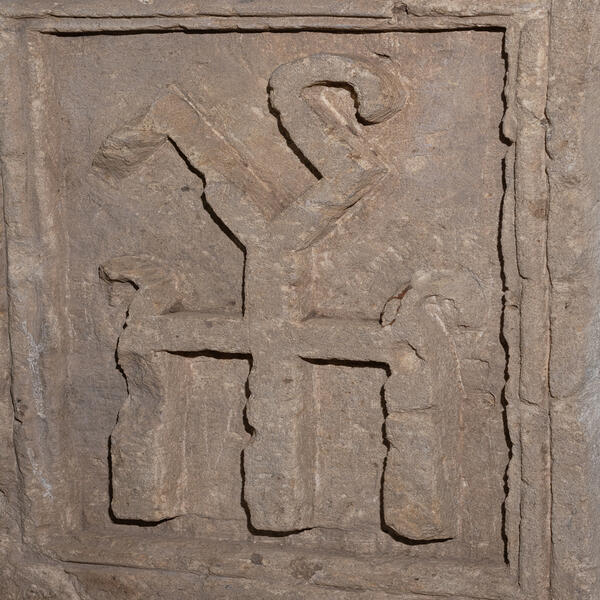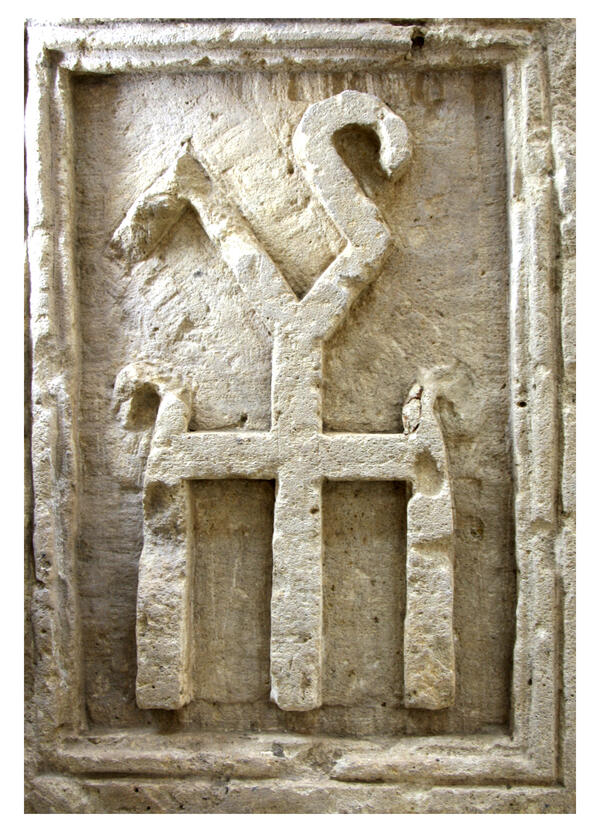
In the summer of 1964, when conducting excavations in Tanais, the Lower-Don archaeological expedition discovered a slab with a Sarmatian tamga-like symbol carved on it.
The slab was made from local Nedvigovka limestone. The back side of the slab did not undergo any processing, while the narrow sides were roughly finished, and the front side was carefully processed. Along the edge of the slab, there is a rectangular double relief frame, and in the recess in the center, there is a Sarmatian symbol carved in high relief. It takes up almost the entire area inside the frame. This was not the first time that such a symbol was found. Exactly the same symbol was depicted on an openwork bronze buckle tip discovered by Vladislav Shkorpil in 1909 in Kerch, in a burial near the Karantinnoye Highway. It was also found on a slotted buckle from the Hamburg Museum, discovered by Eugen von Mercklin, and on a fragmented limestone slab kept in the Kerch History and Archaeology Museum, discovered by Ella Solomonik.
The slab discovered in Tanais in 1964 is an important find. It marked the first artifact where such a sign had been carved on a slab processed specifically with this purpose. This suggests that the symbol was a personal tamga of one of the Bosporan kings. The personal symbols of kings were often carved on marble and limestone slabs, sometimes accompanied by an inscription in Greek. Even before that discovery, it was possible to suggest that the symbol belonged to one of the Bosporan kings. It resembles some other symbols which are attributed to Eupator, Sauromates II, and Rhescuporis III without any doubt. The fact that a slab was processed for such a symbol, similar to the plates with symbols of Eupator, supports this theory. The circumstances of the discovery of the slab in Tanais also support this conclusion.
The Tanais slab features a symbol that consists not
of three but of two parts. The lower part exactly repeats the outline of the
lower part of some other similar tamgas of kings. The upper part corresponds to
the upper part of Eupator’s symbol. The middle part is missing, but this does
not prevent researchers from considering it to be the tamga of Bosporan King
Rhoemetalces.