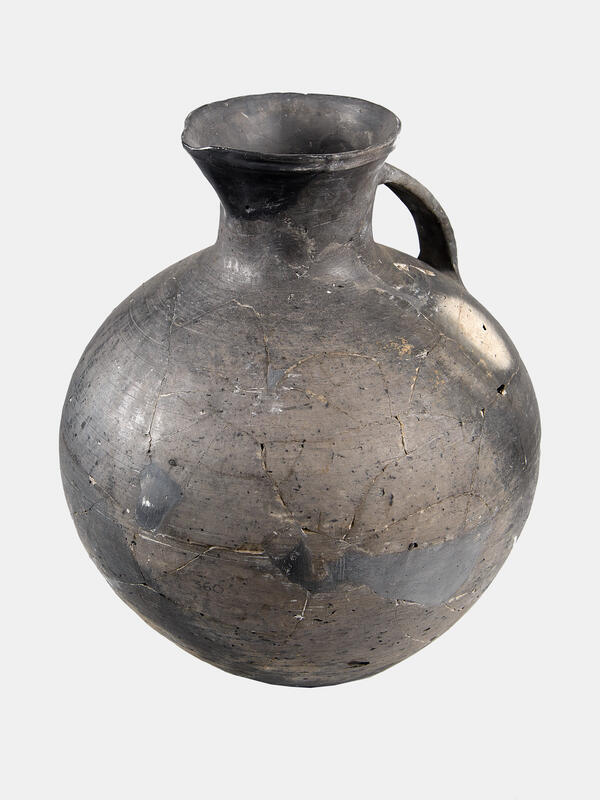
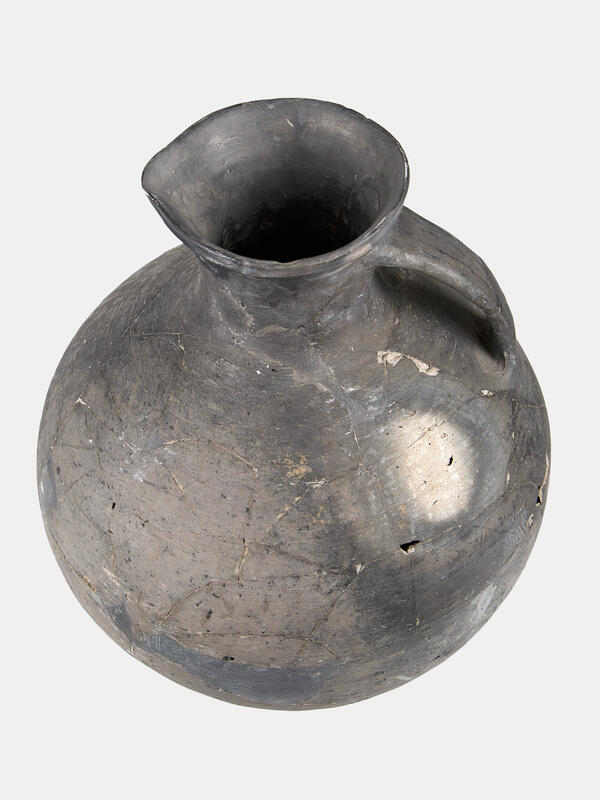
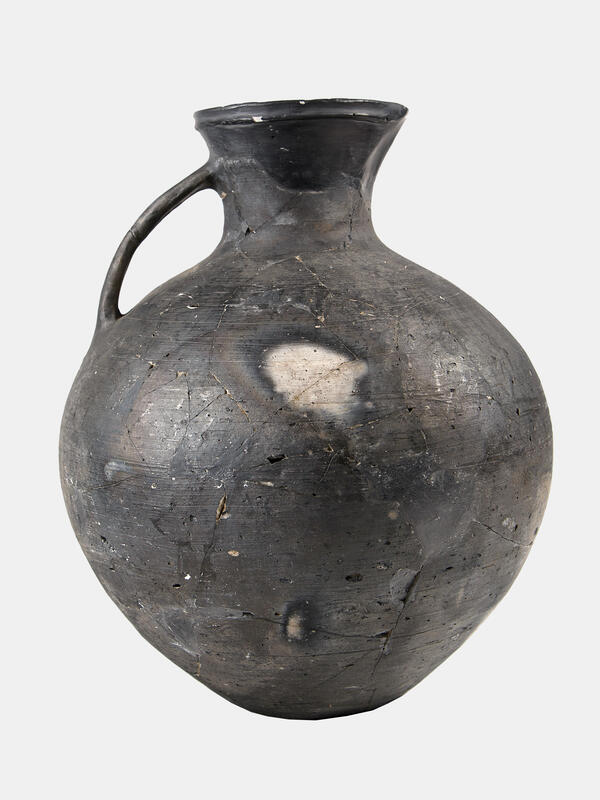
A jug is a type of vessel designed for liquids. In the 16th–17th centuries, large vessels with a spherical body were especially popular in Rus. Later, jugs began to decrease in size, their shapes became more elaborate and varied, and materials such as porcelain, glass, and metal came into use.
Liquids were stored in large jugs, and smaller vessels were taken to fetch water — people carried them on their shoulders. Several intact jugs were found at the bottom of 18th-century wells during excavations on Sovetskaya Street, the central street of Tula. Smaller vessels were used as tableware to serve drinks.
The surface of most jugs was polished before firing to increase their ability to store liquids. Polishing is an ancient decorative technique: the surface of a ceramic product or its individual sections is rubbed to a mirror shine with a smooth object — a stone, a polishing stone, a steel spoon, or a glass vial.
Smooth polishing objects are used to apply simple patterns to the clay surface, most often in the form of wavy or straight lines. Before polishing, the product is dried to a state in which the clay has already lost its plasticity but has not yet completely hardened.
This condition is determined experimentally by drawing a smooth object along the surface in an inconspicuous place — for example, on the bottom of a vessel. Shiny streaks left on the clay during this procedure mean that polishing can begin.
After polishing, the top layer of clay becomes denser and more durable. In the old days, polishing was to some extent used instead of glazing, being a simpler and more affordable way to strengthen ceramics. The shine acquired during polishing intensifies after firing of the ceramic product.
The firing of jugs was most often carried out in a deoxidizing mode — without air access at the last stage. As a result, soot formed, and the surface of the vessel became dark gray or black. Another method of surface treatment was engobe — covering it with a thin layer of light clay and then coloring it with mineral dyes.