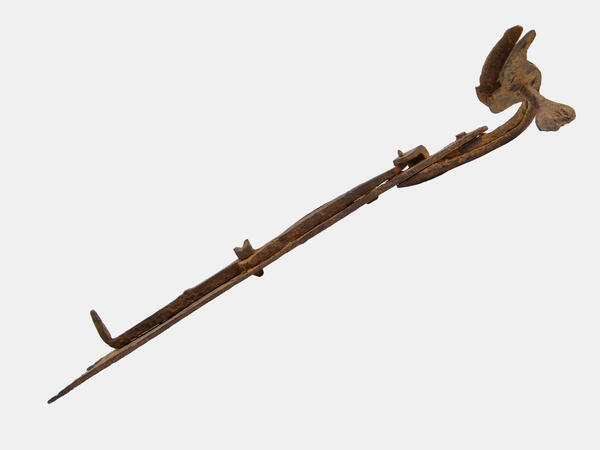
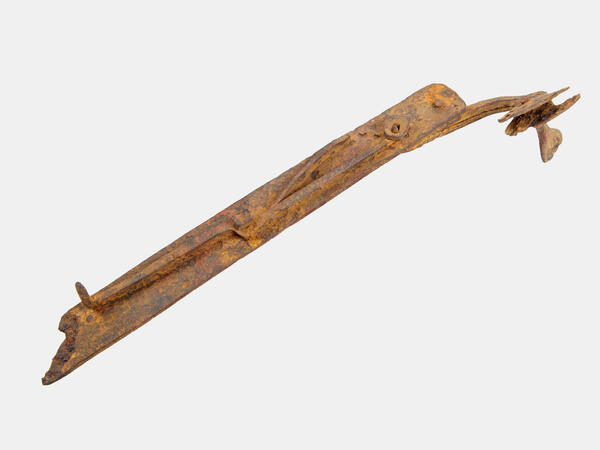
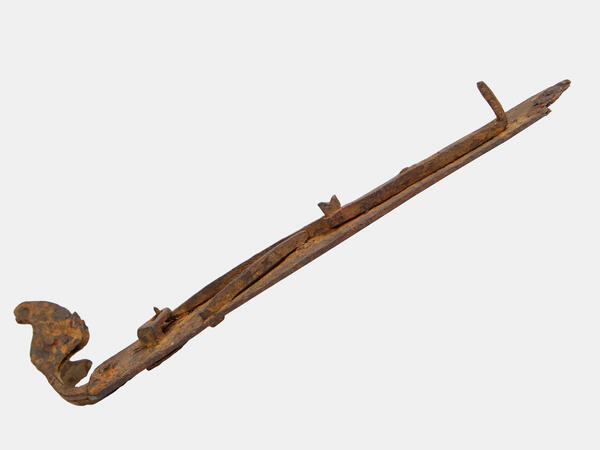
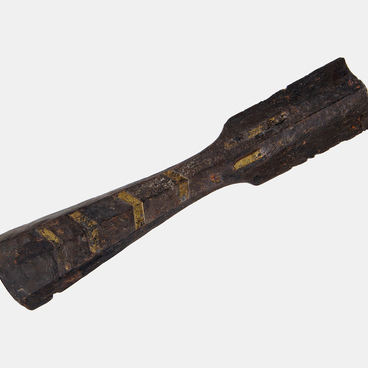
Matchlocks appeared in Europe at the end of the 15th century and became an important stage in the development of firearms. Previously, the powder charge was ignited manually by bringing a hot metal rod to the fuse. Both hands were busy, the process blocked the sight and required the shooter to carry a flint and a rod around all the time. The matchlock made the shooting process faster, more accurate and easier.
Matchlocks were valued for their simplicity and reliability; more modern, but expensive and complex wheel mechanisms were often converted into matchlocks. After 150 years in Europe and Russia, matchlocks were replaced by the next generation of locks —the convenient and reliable impact flintlock. In Asia, matchlocks were used in firearms until the beginning of the 20th century.
One of the earliest mentions of a matchlock is dated to 1411 — it was an illustration in an ancient manuscript. The drawing displayed a mechanical device in the form of a curved lever, which was mounted on an axis on the side of the barrel. The upper end of the lever clamped the smoldering wick, and if one pressed the lower end of the lever, the wick would touch the gunpowder at the hole, and there would be a shot.
The first matchlock had an S-shaped lever and was often shaped like the head of a snake or dragon. In Russian it was called “serpentin”, from the Latin word “serpens’ meaning “serpent”. In Rus, the first matchlocks were called “zhagra” as a variation of the Russian word meaning “burn”, “set on fire”.
The matchlock design was constantly improved: a cover was added to protect the gunpowder, all the parts were assembled into a single mechanism, a shield was made to protect the shooter’s eyes, the lock parts were equipped with a spring to make the use of the trigger easier.
Basically, the fastenings in the wick mechanisms had no hardware, so no special tools were required to secure them. As locks became more complex and wheel and trigger mechanisms appeared, the first weapon tools came into use — they were called fire striker screwdrivers. On one side they were sharpened to work with screws, and on the other they had a hole that could be used to attach the instrument to the belt. Screwdrivers at the same time served as a lighter. They were widespread not only among craftsmen, but also among ordinary weapon owners.