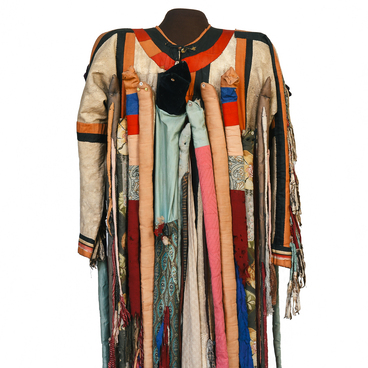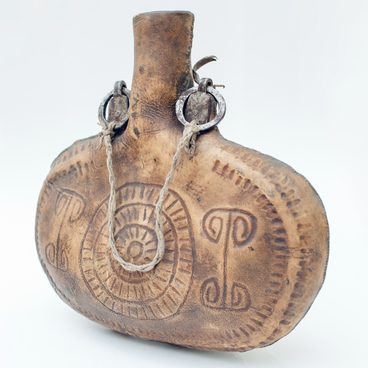
Traditional Tuvan costume in its modern form has been shaped over several centuries. It changed most noticeably during the yoke of the Manchurian dynasty. In 1757 Tuva was incorporated into the Qing Empire, and the wearing of traditional costume became obligatory under the ‘Decree of the Chinese Chamber of External Affairs’.
Like many nationalities, Tuvans divided clothes into everyday and festive ones, and also into those worn by commoners and dignitaries.
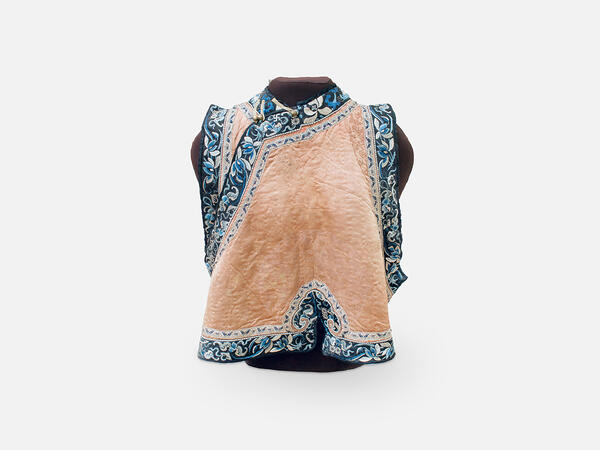
The kurma sleeveless jacket -also called a hurme or kandaazin-is of Chinese origin. Only rich and noble Tuvans had the right to wear it, while ordinary people did not. The sleeveless jacket was sewn short (about 48 centimeters), it covered only the chest and the upper part of the abdomen. The light pink quilted lining was lined with cotton. The collar of kurma, cutouts for sleeves, and hem were trimmed with black silk cloth, which was decorated with embroidered flowers and braid band. Also, the vest for wealthy men was decorated with gold trim, sable fur, brocade, and velvet. These decorations depended on the position held by the official who owned the garment.
Tuvans supplemented kurma with different ornaments. Their symbolism echoed that of the peoples of Central Asia. The artistic motifs were first borrowed from the Turks, and later from the Mongols, Chinese, and Tibetans, who practiced Buddhism.
Ornaments were embroidered or applied as appliqués. The most common patterns were argali (deer) horns, butterfly, flower, cloud, yurt wall, sea waves, and leaves. Hammer patterns, wave-rock or paired, angular and circular ornaments were also common.
Buddhist signs were also put on the sleeveless cloth. The endless string of happiness symbolized eternal love and compassion for all living things, the vessel signified long life, the goldfish was associated with the concept of harmony, and the lotus with purity. The colors of Tuvan clothes also had a special meaning. Red meant joy and prosperity, and blue meant good luck and victory. The sleeveless jacket was usually made of dark red silk fabric with stains. But it could also be in other colors, such as green or orange.
Like many nationalities, Tuvans divided clothes into everyday and festive ones, and also into those worn by commoners and dignitaries.
The kurma sleeveless jacket -also called a hurme or kandaazin-is of Chinese origin. Only rich and noble Tuvans had the right to wear it, while ordinary people did not. The sleeveless jacket was sewn short (about 48 centimeters), it covered only the chest and the upper part of the abdomen. The light pink quilted lining was lined with cotton. The collar of kurma, cutouts for sleeves, and hem were trimmed with black silk cloth, which was decorated with embroidered flowers and braid band. Also, the vest for wealthy men was decorated with gold trim, sable fur, brocade, and velvet. These decorations depended on the position held by the official who owned the garment.
Tuvans supplemented kurma with different ornaments. Their symbolism echoed that of the peoples of Central Asia. The artistic motifs were first borrowed from the Turks, and later from the Mongols, Chinese, and Tibetans, who practiced Buddhism.
Ornaments were embroidered or applied as appliqués. The most common patterns were argali (deer) horns, butterfly, flower, cloud, yurt wall, sea waves, and leaves. Hammer patterns, wave-rock or paired, angular and circular ornaments were also common.
Buddhist signs were also put on the sleeveless cloth. The endless string of happiness symbolized eternal love and compassion for all living things, the vessel signified long life, the goldfish was associated with the concept of harmony, and the lotus with purity. The colors of Tuvan clothes also had a special meaning. Red meant joy and prosperity, and blue meant good luck and victory. The sleeveless jacket was usually made of dark red silk fabric with stains. But it could also be in other colors, such as green or orange.