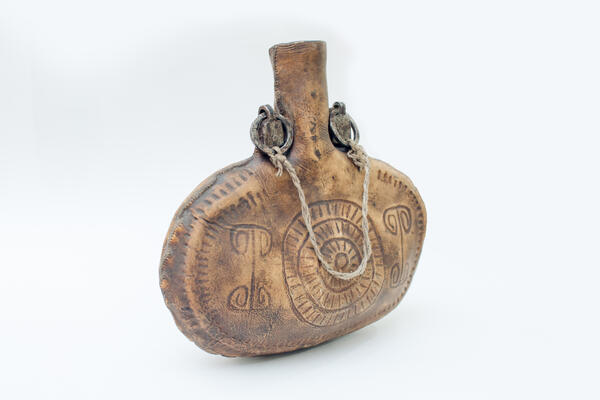
Kogeerzhik is a traditional leather flask for milk, milk vodka ‘araka’ and koumiss. The liquid in such a flask was preserved for a long time, and the skin did not lose its shape, because during dressing it was smoked to make it tan.
Simple kogeerzhiks were created in the form of an ordinary sack. But craftsmen often gave the flask an exquisite shape and applied authentic ornaments that had symbolic meaning.
The technology of skillful leather processing was familiar to nomadic herders
since ancient times. The skin of bulls and yaks was used to make kogeerzhiks. It was soaked for several days in a special fermented liquid left over from the distillation of a drink called hoiptak.
Then the wool and the underskin — the remains of the fat layer with flecks of wool — were peeled off the skin, the two halves of the flask were made and the workpiece was allowed to dry. At the same stage, a pattern was stamped on the future kogeerzhik. They did it with a special wooden matrix and a rod.
After drying, the halves were sewn together with a special stitch that had its own name — ‘Istiktap daaraary’, the workpiece was turned inside out, tightly packed with earth, straw or dung, and suspended over the hearth for smoking. The result was a heat-resistant leather vessel, indispensable in the life of nomads.
For kogeerzhiks, Tuvan deer breeders also used whole skins, removed from the legs of a roe deer or hind legs of a moose. As a result, the product turned out to be of velvety brown color. Such vessels were used at home to store milk. When not in use, they stuffed the cavities with needles of larch or cedar to keep their shape and hung them from the poles of the yurt.
Depending on the size, the vessels were divided into three groups. The biggest was a koger — a vessel about 1.5 meters high and up to 200 liters in capacity. The height of the kogeerzhik varied from 20 to 50 centimeters, it could hold up to two or three liters of liquid. Hoylaarak is the smallest vessel. It was 5 to 20 centimeters in height and its capacity was about 0.3 to 0.5 liters. They carried it between the chest and the adjacent clothing.
Masters made a variety of ornaments on kogeerzhiks. A large traditional pattern was usually in the center of a flask, edged with a border in the form of a dotted line, a linear band, a notched stripe, or a meander — a rectangular broken line imitating waves.
Animal heads and Buddhist symbols were depicted in the center: cross-shaped rosettes of four diamond-shaped spirals, figures with horn-shaped branches at the ends, or patterns of paired spirals. Researchers believe that the most ancient types of Tuvan ornaments were preserved and survived on the kogeerzhiks.
Simple kogeerzhiks were created in the form of an ordinary sack. But craftsmen often gave the flask an exquisite shape and applied authentic ornaments that had symbolic meaning.
The technology of skillful leather processing was familiar to nomadic herders
since ancient times. The skin of bulls and yaks was used to make kogeerzhiks. It was soaked for several days in a special fermented liquid left over from the distillation of a drink called hoiptak.
Then the wool and the underskin — the remains of the fat layer with flecks of wool — were peeled off the skin, the two halves of the flask were made and the workpiece was allowed to dry. At the same stage, a pattern was stamped on the future kogeerzhik. They did it with a special wooden matrix and a rod.
After drying, the halves were sewn together with a special stitch that had its own name — ‘Istiktap daaraary’, the workpiece was turned inside out, tightly packed with earth, straw or dung, and suspended over the hearth for smoking. The result was a heat-resistant leather vessel, indispensable in the life of nomads.
For kogeerzhiks, Tuvan deer breeders also used whole skins, removed from the legs of a roe deer or hind legs of a moose. As a result, the product turned out to be of velvety brown color. Such vessels were used at home to store milk. When not in use, they stuffed the cavities with needles of larch or cedar to keep their shape and hung them from the poles of the yurt.
Depending on the size, the vessels were divided into three groups. The biggest was a koger — a vessel about 1.5 meters high and up to 200 liters in capacity. The height of the kogeerzhik varied from 20 to 50 centimeters, it could hold up to two or three liters of liquid. Hoylaarak is the smallest vessel. It was 5 to 20 centimeters in height and its capacity was about 0.3 to 0.5 liters. They carried it between the chest and the adjacent clothing.
Masters made a variety of ornaments on kogeerzhiks. A large traditional pattern was usually in the center of a flask, edged with a border in the form of a dotted line, a linear band, a notched stripe, or a meander — a rectangular broken line imitating waves.
Animal heads and Buddhist symbols were depicted in the center: cross-shaped rosettes of four diamond-shaped spirals, figures with horn-shaped branches at the ends, or patterns of paired spirals. Researchers believe that the most ancient types of Tuvan ornaments were preserved and survived on the kogeerzhiks.